Technology · 7 min read
How Encryption Works: Identity, Secrecy, and the Backdoor Debate
The padlock icon in your browser isn't sealing a vault—it's completing a handshake. And that single misunderstanding has driven three decades of the most consequential policy debate in the history of the internet.
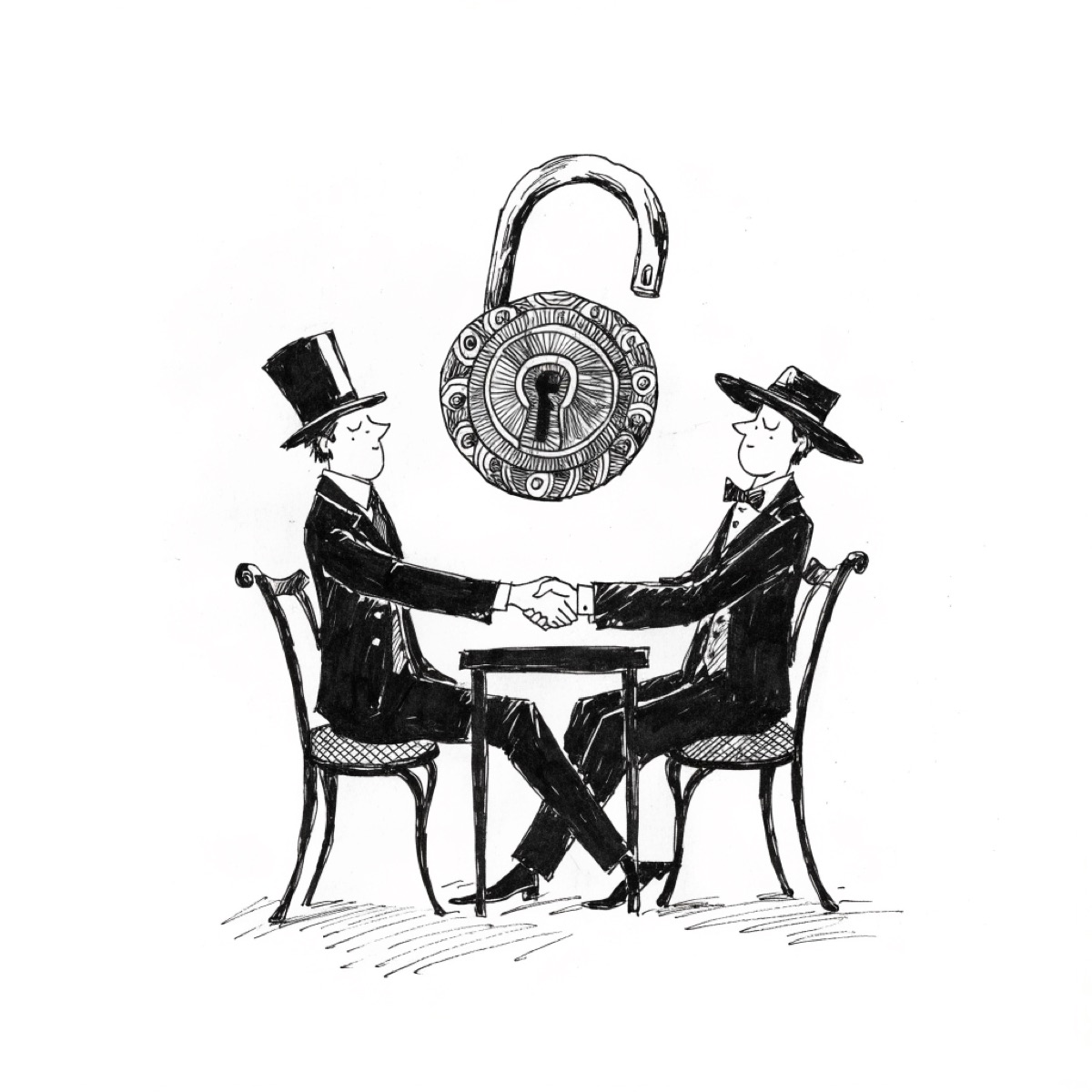
Every time you see the padlock icon in your browser, you are witnessing a handshake between strangers—not a vault being sealed. The padlock doesn't mean hidden. It means verified. That distinction sounds like a technicality. It is, in fact, the difference between a coherent policy debate and a catastrophic one.
In 2023, the FBI renewed its calls for encryption backdoors, arguing that law enforcement was "going dark" as criminals sheltered behind impenetrable walls of code. Almost no one in the room was talking about the same technology. The engineers understood one thing; the legislators, quite sincerely, understood another. That gap has persisted, with enormous consequences, for three decades.
Here is the reframe this debate urgently needs: the foundational protocols of the internet—SSL/TLS, public-key infrastructure, digital signatures—were engineered first as identity systems. Secrecy was the byproduct, not the goal.
A Brief, Honest History: Where Cryptography Actually Came From
Ancient cryptography was about secrecy. Caesar shifted his alphabet by three letters to obscure military orders. The Enigma machine scrambled Luftwaffe communications so thoroughly that cracking it required Alan Turing and a small city of mathematicians at Bletchley Park. For most of human history, the cryptographer's job was to hide a message from anyone who intercepted it.
But the internet's cryptographic backbone was born from an entirely different problem—one that has nothing to do with hiding and everything to do with trust. The question wasn't "how do we conceal this message?" It was: "How do two people who have never met, on opposite sides of the planet, agree to trust each other across a network that neither of them controls?"
That question was answered, at least mathematically, in a 1976 paper by Whitfield Diffie and Martin Hellman titled "New Directions in Cryptography." It was not primarily a manifesto for hiding data. It was a solution to the key distribution problem—specifically, how to establish authenticated communication without first exchanging a secret in person. The breakthrough was conceptual before it was technical.
The genealogy matters enormously. RSA, developed by Rivest, Shamir, and Adleman in 1977, was another link in the same chain. Certificate authorities, the organizations that vouch for website identities, were yet another. Digital signatures followed. Each innovation was solving, first and foremost, for authentication—for the ability to prove who you are to someone who has never seen your face. Confidentiality arrived as an elegant side effect, not the founding ambition.
What "Trust Between Strangers" Actually Means, Mathematically
The core mechanism of modern cryptography is the public-private key pair, and it is worth understanding plainly because it rewires how you see everything else. Your public key is your address. Your private key is proof you live there. The mathematics binds them together in a relationship that is easy to verify but, with sufficient key length, essentially impossible to reverse-engineer.
When you connect to your bank's website, your browser and the server perform a handshake in which the server proves it holds the private key corresponding to a public key that a trusted certificate authority has vouched for. No message has been hidden yet. What has happened is a proof of identity. The server has mathematically demonstrated it is who it claims to be.
Digital signatures make the identity function even more explicit. When you sign a document with your private key, you are not hiding it—you are certifying it. Anyone in the world can verify the signature using your public key. The content remains completely readable. The point is undeniability, not secrecy. The signature says: this came from me, and I cannot later claim otherwise.
Confidentiality—the part everyone argues about—is actually a secondary application of these identity tools, used in reverse. When you want to send a private message, you encrypt it to the recipient's public key. Only their private key can decrypt it. But notice what you are really doing: you are using an identity primitive—the fact that only one person holds a particular private key—to achieve secrecy. Confidentiality is a tool repurposed, not the original design.
Why This Distinction Demolishes the Backdoor Argument
The surveillance debate, as conducted in Congress and in newspaper op-eds, proceeds from a persistent mental image: a locked box, inside which criminals store incriminating conversations, to which the government merely wants a spare key. Give us the key, the argument goes, and we can catch the bad guys without disturbing ordinary citizens.
But the "lock" is not a lock. It is a mathematical proof of identity. A backdoor does not weaken the lock the way a copied key weakens a deadbolt. It invalidates the proof. It introduces, by design, a condition under which the mathematical guarantee no longer holds—and mathematics is not selective about who benefits when a guarantee breaks.
The technical reality is unambiguous, and engineers have explained it with increasing exhaustion since the "Clipper chip" debates of the early 1990s: there is no architectural distinction between a backdoor for governments and a vulnerability for criminals. The TLS encryption protecting your bank login and the TLS encryption protecting a terrorist's messages is the same cryptographic system, running on the same protocols, verified by the same mathematical principles. You cannot weaken one without weakening both. A wall with a door is not a wall.
What legislators are actually demanding, when you translate their requests into mathematical terms, is a proof that works—except when the government asks it not to. They are requesting an exception to a theorem. This is not a political disagreement or a matter of balancing interests. It is a logical contradiction, and cryptographers have explained it, repeatedly and with considerable patience, for thirty years.
The Surveillance That Is Already Mathematically Possible
Here is what consistently gets buried in the backdoor debate: vast amounts of surveillance are already possible without touching encryption at all. Metadata—who communicates with whom, at what time, for how long, from which location—is largely unencrypted and, in intelligence terms, deeply revealing.
The NSA's own internal documents, revealed through Edward Snowden's 2013 disclosures, noted explicitly that metadata analysis often yields more actionable intelligence than message content. Call logs reconstruct social networks. Location data traces physical movements. Patterns of communication reveal relationships that no single message would disclose. None of this requires a backdoor, because none of it was ever encrypted in the first place.
Encryption, understood correctly, enforces a ceiling on surveillance, not a floor. It defines the mathematical limit of what is knowable through interception. But that ceiling is already higher than most citizens realize, because enormous swaths of digital life—browsing habits, app usage, purchasing behavior, physical location, social graphs—remain entirely outside encrypted channels and are routinely collected, sold, and, under appropriate legal process, disclosed to authorities.
What We Lose If We Keep Debating the Wrong Thing
When public discourse fixates on breaking encryption, it functions as a distraction—not necessarily a deliberate one, but a consequential one—from the surveillance vectors that genuinely exist and are susceptible to democratic regulation. Device-level access achieved through lawful search. Cloud storage, where data often sits unencrypted on provider servers. Behavioral data brokers who sell intimate profiles without any governmental warrant. Legal compelled disclosure, which already requires technology companies to hand over substantial information under court order.
These are the actual levers. They are imperfect levers, and regulating them involves genuine tradeoffs between privacy and security that democratic societies are entirely capable of debating. But they are real levers, grounded in how digital systems actually function.
The cost of the misdiagnosis is not abstract. Policymakers who do not understand that confidentiality is a byproduct of an identity system will keep proposing solutions that would catastrophically damage global commerce, journalism, healthcare records, and the communications of political dissidents living under authoritarian governments—while simultaneously failing to close the actual intelligence gaps they claim to want to close. The proposal is both dangerous and ineffective. That combination is rare enough to deserve emphasis.
The Question Worth Asking
The right question is not "can we add a backdoor to encryption?" We know the answer: yes, technically, and at a cost that makes the benefit incoherent.
The right question is harder and more interesting: What does a democratic society decide is the acceptable ceiling of state visibility into private communication—and how do we enforce that ceiling through law rather than through broken mathematics?
That question has no clean answer. It requires negotiating between security and liberty, individual privacy and collective safety, in a domain that changes faster than legislatures can meet. But it is the question that respects what the technology actually is.
The padlock in your browser is not a vault. It is a handshake—a mathematical promise between strangers that each is who they claim to be. Before any society decides to break that promise, it should at least understand what it is breaking, and what the world looks like on the other side of a promise that no longer holds.