Politics · 9 min read
How Neutrality Tends to Favor Those Already in Power
Switzerland stayed "neutral" during World War II—while its banks quietly held Nazi gold and its borders stayed shut to Jewish refugees. This is the story of how neutrality, far from being an absence of power, has always been one of its most effective disguises.
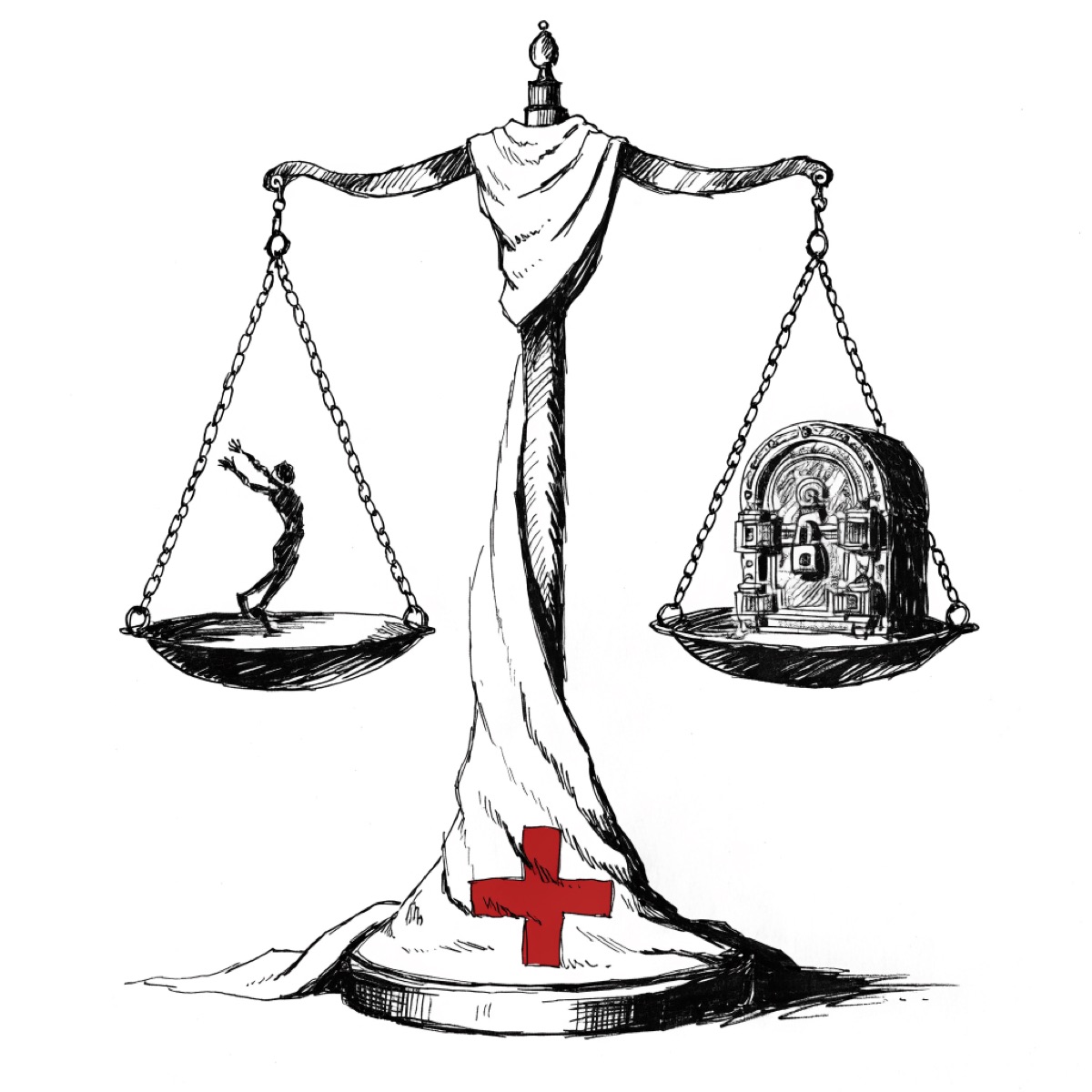
In the spring of 1944, as the Nazis accelerated deportations to the death camps, Switzerland—Europe's great emblem of neutrality—kept its borders firmly closed to Jewish refugees attempting to flee. Meanwhile, the Swiss National Bank was accepting looted gold from the Reichsbank, some of it melted down from the dental fillings and jewelry of concentration camp victims. After the war, the Swiss government described this behavior as the difficult arithmetic of survival, the price of staying out. What they rarely acknowledged was that staying out was itself a choice with consequences—and those consequences fell almost entirely on the people least able to absorb them.
This is neutrality's oldest trick: presenting itself as an absence of action while functioning, in practice, as a very specific kind of action.
Think of it this way. When a referee refuses to call a foul, the player committing it wins. The whistle that doesn't blow is not silence—it is a verdict. What follows is a forensic examination of how neutrality, in practice, is never an absence of power but a redistribution of it, almost always toward whoever already holds the most.
The Grammar of Neutrality: What We Actually Mean When We Say It
There is an important distinction hiding in plain sight between neutrality and impartiality, and the fact that we use them interchangeably is itself a small political act. Neutrality treats competing parties as equivalent—it splits the difference, holds the line, refuses to weigh in. Impartiality is something harder and more honest: it weighs claims on their merits, which sometimes means concluding that one side is simply wrong, or weaker, or being harmed. Institutions reach reflexively for the language of neutrality precisely because impartiality might force a conclusion.
Listen to how procedural language works in practice. Phrases like "both sides," "we don't take positions," and "we present all perspectives" perform a quiet sleight of hand—they frame power asymmetries as disputes between equals. When a major newspaper applies "both sides" framing to a conflict between a government and the people it is suppressing, it has already smuggled in a moral equivalence that serves the stronger party. The framing itself is the verdict.
Neutrality as a formal political doctrine has a specific origin, and it is instructive. The concept emerged from 17th-century European state law, crystallized in treaties like the Peace of Westphalia in 1648. It was not designed to protect the weak. It was designed by powerful trading nations to protect their commercial interests during other people's wars—to keep the shipping lanes open, the ledgers balanced, the profits flowing. From its very inception, neutrality was a tool of those with enough leverage to declare it.
When Standing Still Means Moving Backward: The Physics of Power Asymmetry
There is a thought experiment that cuts through a lot of confusion here. Imagine a tug-of-war in which one side is already three feet from the edge, losing badly. Now someone shouts "freeze"—no one moves, the rope goes slack, and the contest is declared suspended in the name of fairness. Who benefits from the freeze? Not the team that was winning on merit. The team that was already ahead. Declaring neutrality in an unequal situation doesn't pause the contest—it locks in the score.
This is precisely what happened during apartheid South Africa. For decades, calls for "non-interference," "dialogue," and "engagement over isolation" from Western governments and business interests effectively preserved the status quo. When activists pushed for arms embargoes and economic sanctions, the response from many quarters was that such measures would constitute "taking sides." But here is the unavoidable logic: the absence of sanctions was equally political. Continuing to sell arms and do business with Pretoria was a choice, dressed up in the language of not choosing. It was the freeze-frame applied to a system of violent racial hierarchy, and it kept that system alive for years longer than it might otherwise have survived.
The data supports this pattern beyond individual cases. Research from the Uppsala Conflict Data Program—which tracks armed conflicts worldwide—has found that ceasefires and "neutral" mediation agreements in asymmetric conflicts disproportionately benefit the militarily superior party. The stronger side uses pause periods to resupply, consolidate territorial gains, and regroup, while the weaker party, often lacking the infrastructure to do the same, simply loses time it cannot afford. Neutral process, unequal outcome.
The United Nations and the Architecture of Institutionalized Impartiality
The United Nations was founded on a promise of collective security and impartial governance—a rules-based international order to replace the chaos of two world wars. It is a genuinely important institution, and it has done genuine good. But its foundational architecture tells a particular story about whose definition of neutrality gets built into the walls.
The Security Council's five permanent members—the United States, Russia, China, the United Kingdom, and France—each hold veto power over any binding resolution. This structure presents itself as balanced governance. In reality, it hardwires the geopolitical preferences of 1945's victors into every subsequent "neutral" international response. When Russia vetoes resolutions on Ukraine, or the United States vetoes resolutions on Gaza, they are not disrupting a neutral system—they are using the system exactly as designed, by people who understood that neutrality, at scale, means your interests become everyone's default.
No case illustrates the human cost of procedural neutrality more starkly than Rwanda in 1994. UN peacekeeping commander Roméo Dallaire was on the ground as the genocide began, and he pleaded for permission to act—to protect civilians, to confront the Interahamwe militias slaughtering Tutsi families by the thousands. He was ordered to remain neutral. His cables to UN headquarters, later published in his devastating memoir Shake Hands with the Devil, make clear that he understood something his superiors were unwilling to say out loud: neutrality between killers and their victims is not a moral position. It is a category error with a body count. Approximately 800,000 people were killed in 100 days while the world's official neutral body deliberated.
There is also a quieter form of political neutrality worth examining: the abstention. Nations that abstain on UN human rights resolutions often describe their abstention as procedural restraint—not opposition, simply non-participation. But documented analyses of UN voting patterns reveal that abstentions track closely with trade dependency. Countries that do significant business with the state under scrutiny tend to abstain rather than vote yes on resolutions criticizing it. Economic interest performs in the costume of procedural neutrality, and the costume is convincing enough that almost no one calls it what it is.
Courts, Referees, and the Myth of the View from Nowhere
Justice, the saying goes, is blind. The scales are balanced. The law applies equally to all. These are genuinely important ideals, and they are worth defending—but defending them honestly requires acknowledging how far the reality falls short, and why.
Judicial neutrality assumes a level playing field before the gavel falls. It does not account for differential access to legal representation, for bail systems that make pretrial detention a function of wealth rather than flight risk, or for the well-documented sentencing disparities that fall along racial and class lines in nearly every country that has studied them. The blindfold on Justice's statue is fitted more loosely on some people than others, not because the judges are necessarily corrupt, but because the system they are neutrally applying was built on ground that was never level.
The Lochner era in American constitutional history offers a textbook case. Between roughly 1897 and 1937, the U.S. Supreme Court struck down a series of labor protection laws—minimum wage requirements, limits on working hours, child labor restrictions—on the grounds that they violated freedom of contract. The reasoning was framed in rigorously neutral terms: the law applies equally to employer and employee, both of whom are free to contract as they choose. What this neutral application actually produced was the systematic dismantling of protections for workers who had no meaningful freedom to refuse bad contracts at all. Neutral application of a rule designed within an unequal context produces unequal outcomes. The neutrality was real; the justice was not.
Even sports officiating—a domain of pure procedural neutrality if any exists—turns out to be social. Studies of Premier League refereeing have found that officials award significantly more stoppage time when the home team is trailing, a pattern that persists even when researchers control for match events. Research on NBA officiating has found that referees call fouls differently depending on the status and reputation of the player involved. The officials are not cheating; they are human, embedded in social contexts that shape perception in ways they cannot fully see. Neutrality is always performed by someone, which means it is always performed from somewhere.
How Power Learns to Speak in Neutral's Voice
When dominant groups get to write the rules of neutrality, something subtle and important happens: they encode their own preferences as defaults. The center becomes wherever they already stand. The reasonable position becomes whatever they already hold. "Neutral" comes to mean whatever they already do, and anything that challenges that is framed as radical, biased, or agenda-driven.
This dynamic is nowhere more visible than in the journalistic norm of "both-sidesing." The convention that responsible journalism presents all perspectives is, in principle, reasonable—it guards against propaganda. But applied to empirically settled questions, it doesn't split the difference. It manufactures false equivalence. When a newspaper presents "both sides" of the climate science debate, it does not land neutrally between evidence and denial. It functionally advantages denial, because it grants denial a legitimacy that the evidence does not support. The norm of balance, applied without judgment, produces imbalance.
The Overton window—the range of ideas a society considers acceptable at any given moment—helps explain why this is so hard to see from inside it. "Neutral" journalism and "neutral" policy both tend to enforce the center of whatever range of opinion currently exists. But if that range has shifted—pulled in one direction by sustained pressure, propaganda, or cultural change—then "neutral" shifts with it, invisibly, without anyone having to make a conscious choice. A journalist who covered American politics with identical neutrality in 1985 and 2025 would, without changing a single professional instinct, be covering two very different political realities as if they were the same. The neutrality would be real. The equivalence would not be.
What Honest Impartiality Actually Requires
None of this means that objectivity is impossible or that we should abandon the attempt. It means something more demanding: that genuine impartiality requires acknowledging the terrain before you claim to stand on level ground.
What honest impartiality actually looks like is not the refusal to weigh evidence—it is the willingness to follow evidence even when it leads to uncomfortable conclusions. It is what Roméo Dallaire was practicing when he told his superiors that neutrality between murderers and their victims was incoherent. It is what economists practice when they distinguish between empirical questions (what is happening?) and normative ones (what should we do?), rather than hiding the latter inside the language of the former. It requires, above all, the intellectual honesty to ask: who benefits from the position I am calling neutral?
This is not a comfortable question. It implicates everyone who has ever claimed objectivity—journalists, judges, diplomats, referees, academics, and ordinary people trying to seem fair in a difficult conversation. But discomfort is not a reason to avoid the question. It is usually a sign that the question matters.
Here is the thought worth sitting with: in a world of unequal power, the demand that the powerless accept neutral process as a substitute for just outcomes is itself a political position. It just happens to be one that never has to say its name—because it has learned to call itself nothing at all.