Health · 6 min read
How Oral Rehydration Solution Uses Intestinal Transport
Oral rehydration solution works through sodium-glucose cotransport, with exact proportions and clear clinical limits.
Oral rehydration solution looks too simple for the work it performs. A packet contains glucose and salts to be mixed with a specified volume of safe water. It does not stop the infection that caused diarrhea, and it does not physically block fluid loss. Instead, it uses a transport mechanism in the small intestine that often remains functional during acute diarrheal disease.
That distinction explains both the treatment’s value and its limits. The solution helps the body absorb water and electrolytes even while stools continue. Its proportions matter: too much sugar or salt can worsen the osmotic problem or create a dangerous electrolyte imbalance. Severe dehydration, shock, persistent vomiting, or altered consciousness may still require urgent clinical care and intravenous fluid.
Dehydration is a problem of lost water and salts
Water moves continually between the gut, blood, tissues, and kidneys. In diarrhea, secretion into the intestine and rapid transit can exceed reabsorption. The body loses not just water but sodium, chloride, potassium, and bicarbonate-related base. The clinical danger is a shrinking circulating volume and disrupted electrolyte balance, not the loose stool by itself.
Signs such as thirst, reduced urination, lethargy, sunken eyes, and poor skin recoil can indicate dehydration, but assessment is imperfect. The World Health Organization groups cases by clinical signs into no dehydration, some dehydration, and severe dehydration. The categories guide treatment, yet no single visible sign precisely measures fluid deficit.
Drinking plain water replaces water but not the full electrolyte loss. Very salty liquid can raise blood sodium; very sugary drinks can retain water in the intestinal lumen and increase stool output. Oral rehydration solution is therefore a physiological formulation, not simply any beverage containing sugar and salt.
The WHO and UNICEF reduced-osmolarity formula contains, per liter, 75 millimoles of sodium, 75 millimoles of glucose, 65 millimoles of chloride, 20 millimoles of potassium, and 10 millimoles of citrate, for a total osmolarity of 245 milliosmoles per liter. Those quantities are designed to support absorption while limiting excessive solute concentration.
The intestinal transport mechanism
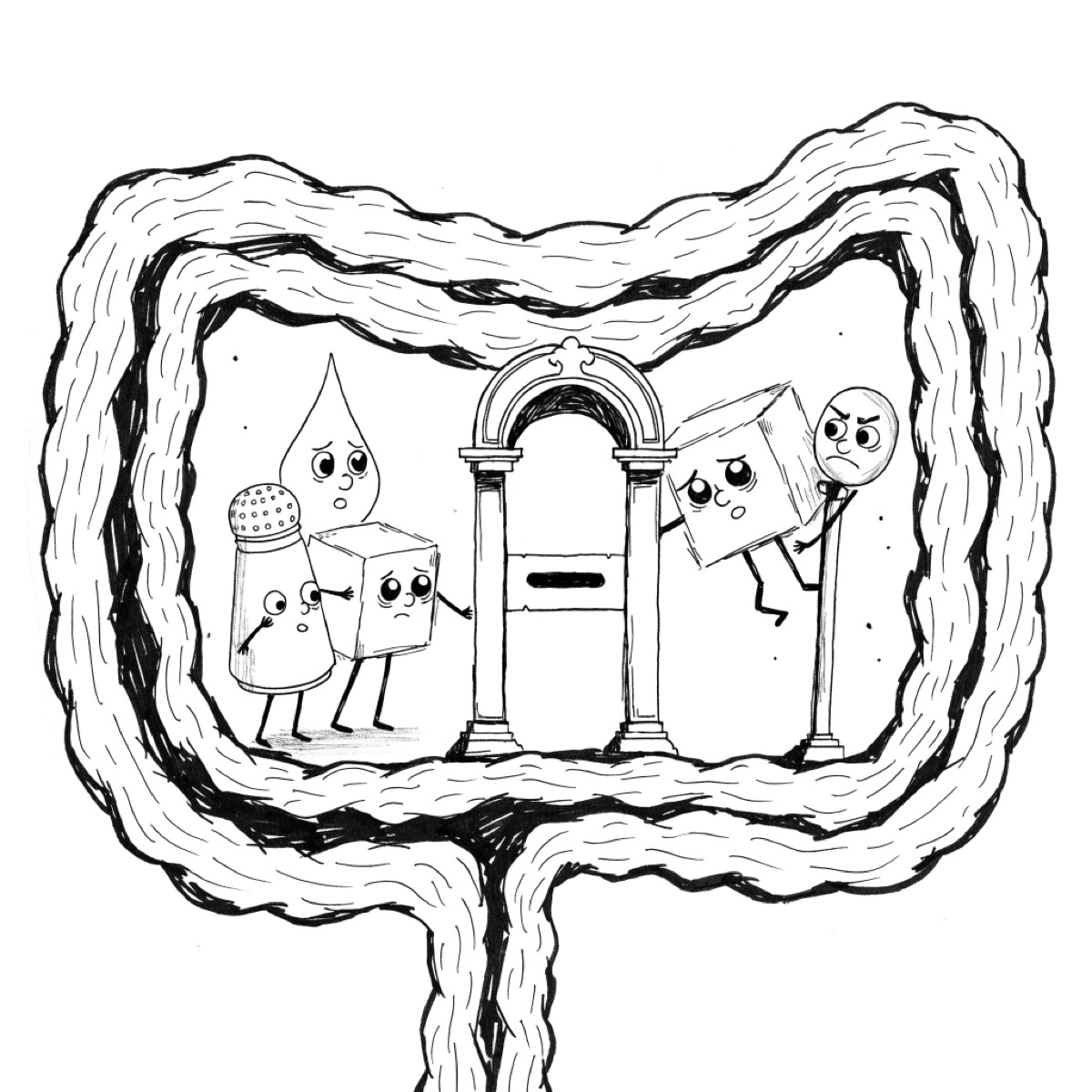
The central mechanism is sodium–glucose cotransport. Proteins called SGLT1 transporters sit in the membrane of absorptive cells lining the small intestine. They move glucose and sodium from the intestinal lumen into the cell together. The sodium gradient that powers this movement is maintained indirectly by sodium–potassium pumps on the blood-facing side of the cell, which use cellular energy.
As sodium and glucose are absorbed, water follows through and between intestinal cells in response to osmotic gradients. Chloride and other solutes also move through linked pathways. The useful clinical fact is that this coupled transport can remain available in many secretory diarrheas, including cholera, even when other processes are driving large fluid losses.
This is sometimes summarized as “sugar helps the gut absorb salt and water.” That is accurate only within a range. More glucose does not continually improve absorption. A concentrated sugary drink increases the number of dissolved particles in the lumen. Water may then be drawn toward the gut rather than into the body, especially when sugars are poorly absorbed.
Cholera provides a particularly clear demonstration. Its toxin increases chloride secretion through intestinal cells, and water follows into the lumen. The toxin does not disable all nutrient-coupled sodium absorption. A patient can therefore continue losing extraordinary volumes while still absorbing part of a correctly formulated oral solution. Replacement must keep pace with ongoing loss, which is why monitoring matters.
Nor is SGLT1 the only pathway in intestinal fluid handling. The gut has multiple nutrient transporters, ion channels, tight junctions, and regulatory signals. Oral rehydration works within that larger system. Its practical success does not imply that every diarrheal mechanism is identical.
Why the recipe has exact proportions
Early standardized oral rehydration salts used higher concentrations of sodium and glucose and had an osmolarity around 311 milliosmoles per liter. That formulation was highly effective for cholera, where sodium losses can be substantial. Researchers then tested whether a lower-osmolarity mixture could reduce vomiting, stool volume, and the need for unscheduled intravenous therapy in the broader population of patients, especially children with non-cholera diarrhea.
In 2002, WHO and UNICEF recommended a reduced-osmolarity formula after reviewing clinical trials. The change reduced both sodium and glucose concentrations while maintaining their equimolar relationship. The agencies’ 2006 production document specifies industrial composition and quality controls because measurement, water volume, and ingredient purity affect safety.
This precision creates a practical warning. A commercial packet should be diluted in the volume printed on that packet; packet sizes and formulations vary. Using too little water makes the solution too concentrated. Saving a partially used mixture beyond recommended storage periods can introduce microbial contamination.
Home recipes can be valuable where packets are unavailable, but household spoon sizes and imprecise instructions introduce error. Public-health programs use locally validated recipes and teaching methods. A universal improvisation such as “a handful of sugar and a pinch of salt” is not equivalent to a manufactured formula unless quantities and water volume are reliably controlled.
What clinical comparisons established
A Cochrane review by S. Hahn, Y. Kim, and P. Garner compared reduced-osmolarity oral rehydration solution with the older WHO standard in children with acute diarrhea. Across eight trials reporting the primary pooled outcome, the lower-osmolarity formula was associated with fewer unscheduled intravenous infusions: odds ratio 0.59, with a 95 percent confidence interval from 0.45 to 0.79. The review also found lower stool output and less vomiting, without detecting an additional risk of hyponatremia.
Those findings support the newer formula, but the evidence has boundaries. The trials involved children receiving treatment and monitoring; results do not erase differences in cause, severity, nutrition, or clinical setting. A failure to detect increased hyponatremia is not proof that electrolyte disturbances cannot occur.
Polymer-based solutions made from rice or other starches have also been studied. A later Cochrane review found possible reductions in diarrhea duration for some comparisons, but results were heterogeneous and evidence quality varied. These products do not displace the well-tested glucose-based reduced-osmolarity formula as a general standard.
ORS is often paired with continued feeding and, for children in relevant settings, zinc supplementation under clinical or public-health guidance. Antibiotics are indicated only for selected causes. The rehydration mechanism should not be confused with treatment of the pathogen.
The boundary between oral and intravenous treatment
The established claim is that correctly prepared oral rehydration solution treats or prevents dehydration in most non-severe cases of acute diarrhea. It can be given in repeated small amounts, including after vomiting, and it uses an absorptive pathway that remains functional in many illnesses.
The contested or context-dependent questions concern the best formulation for particular patient groups and pathogens, the role of food-based polymers, and how programs can ensure correct mixing and access. Clinical assessment also differs where staff, laboratory tests, and supplies are scarce.
What remains unsafe is using the mechanism as a reason to delay care. Severe dehydration can progress rapidly. WHO guidance treats signs of shock, inability to drink, marked lethargy, or worsening condition as reasons for urgent evaluation; intravenous fluid may be needed, followed by oral solution when the patient can drink.
Oral rehydration solution is powerful because it is constrained, not because it is magical. It replaces defined losses through a defined transport process. It does not end every diarrhea, correct every deficit, or make dosage irrelevant. Its success rests on the interaction of basic physiology, exact formulation, clean water, and timely judgment about when oral treatment is no longer enough.