Technology · 6 min read
How Passkeys Bind Authentication to a Website
A step-by-step account of passkey registration, authentication, phishing resistance, synchronization, and recovery.
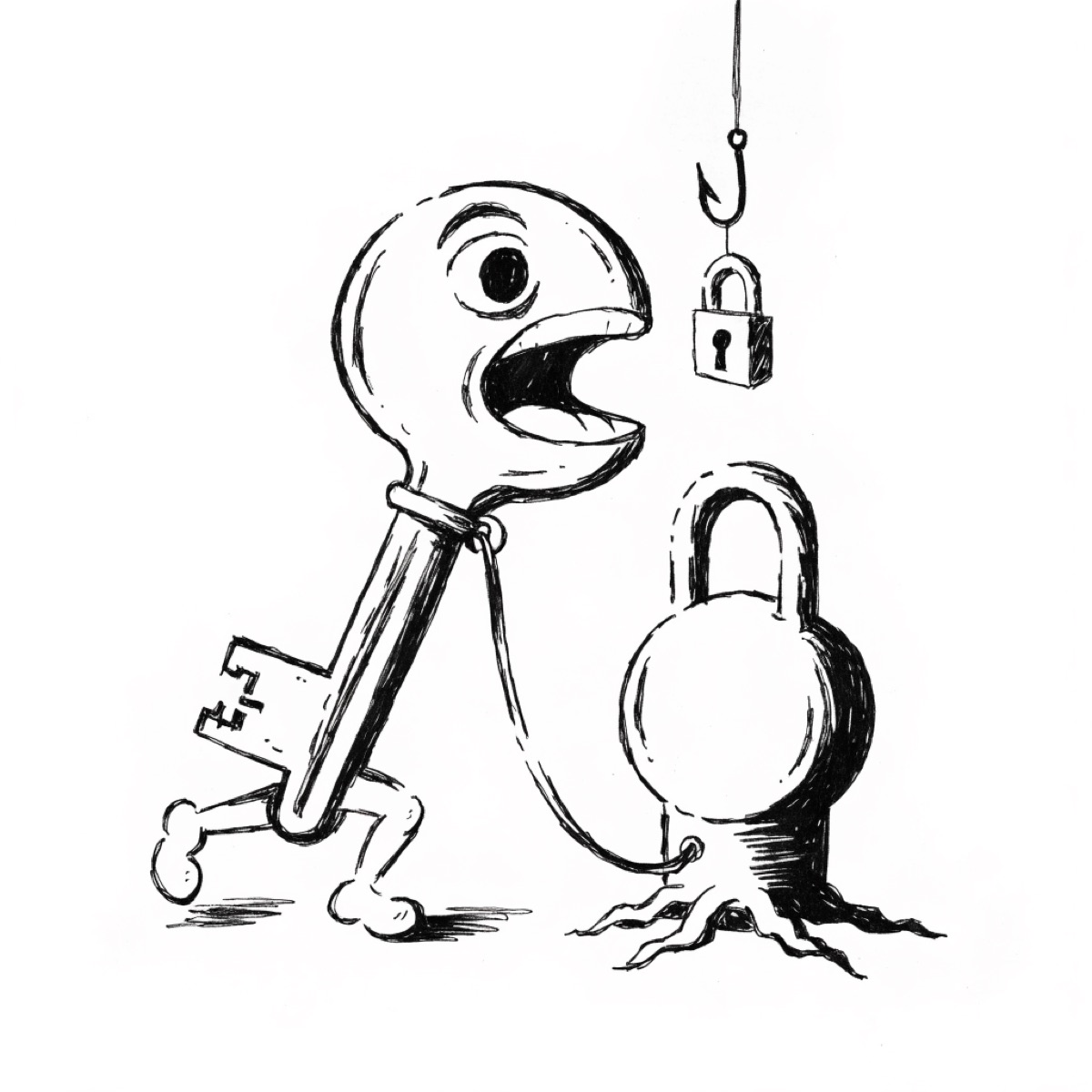
Passwords and passkeys solve different storage problems
A password works because a user and a service can test knowledge of the same secret. Responsible services store a salted password hash rather than plaintext, but the user still types a reusable secret into a website. That creates two recurring risks. A convincing impostor site can ask for the secret, and a database breach can expose material that attackers may test offline or reuse against accounts elsewhere.
A passkey changes the protocol rather than merely making the secret longer. It is a public-key credential used through Web Authentication, or WebAuthn. The service stores a public key. The authenticator—a phone, computer, hardware security key, or credential manager—controls the corresponding private key. Authentication consists of signing fresh data for the correct site. The private key is not sent to the service.
The current W3C WebAuthn Level 3 specification defines passkeys as discoverable credentials, meaning an authenticator can identify an account without the user first supplying a username. Products differ in how they present and synchronize them, so “passkey” names a user-facing credential model built on standards, not one vendor's implementation.
Registration binds a key to a relying party
When a user creates a passkey, the site acts as a WebAuthn “relying party.” Its server sends the browser registration options that include a random challenge, the relying-party identifier, information about the user account, supported cryptographic algorithms, and policy preferences. The challenge prevents a previously captured response from being reused as if it were new.
The browser checks the web origin and passes a structured request to an authenticator. With user consent, the authenticator creates a key pair scoped to the relying party. It returns a credential identifier, public key, and signed registration data. The service verifies the challenge and origin-related data before associating the public key with the account.
The credential is scoped. As the WebAuthn Level 2 recommendation explains, conforming browsers and authenticators restrict a public-key credential to origins belonging to its relying party. A credential registered for example.com is not offered as a credential for examp1e.com. This is the mechanism behind the system's phishing resistance: the decision about which credential can respond is tied to the origin processed by software, not left to a person comparing logos and spelling under pressure.
Some registration responses include attestation, evidence about the authenticator or how a credential was created. Attestation can matter in managed enterprises that allow only approved hardware. Consumer services often avoid requiring it because it can add deployment friction and privacy concerns. The protocol supports policy choices; it does not require every service to identify a device model.
Authentication signs a fresh challenge
At sign-in, the service sends a new random challenge and its relying-party identifier. The browser asks an eligible authenticator for a credential. The user performs a local authorization gesture: perhaps touching a security key, entering a device PIN, or passing a fingerprint or face check. The authenticator then signs data that incorporate the challenge and information derived from the client interaction.
The server looks up the public key and verifies the signature, the challenge, the relying-party context, and relevant flags. A valid signature demonstrates control of the private key for that credential at that moment. Because the challenge changes, a copied signature should not authenticate a later session. Because the server has only the public key, theft of the account database does not directly reveal the private signing key.
Biometrics play a narrower role than advertising sometimes suggests. A fingerprint or face match normally unlocks use of a credential locally; the biometric template is not the credential sent to the website. A device PIN can authorize the same cryptographic operation. The service receives evidence that the authenticator performed user verification when the relevant flag is present, not a copy of the user's face.
The distinction also explains why a passkey is not simply “logging in with your phone.” A roaming hardware key can hold credentials. A laptop can use a phone through a cross-device flow. A credential manager can synchronize credential material among a user's devices. The authenticator and the client may be integrated or separate, but the relying party still verifies the standardized public-key response.
Origin binding blocks a common phishing path
Conventional phishing succeeds when a person gives an attacker a reusable authenticator. A fake sign-in page can relay a password and even a one-time code to the genuine service in real time. A correctly implemented WebAuthn credential will not sign for the attacker's look-alike domain. The W3C specification consequently describes public-key credentials, under its security assumptions, as resistant to man-in-the-middle tampering after secure registration.
That claim has boundaries. Passkeys do not make the surrounding account immune to social engineering. An attacker may persuade a user to approve an unrelated recovery process, add the attacker's authenticator after taking over a logged-in session, or reveal sensitive information outside authentication. Malicious browser extensions, compromised devices, server-side authorization flaws, and stolen sessions are different attack surfaces. Origin binding prevents one important credential-relay technique; it is not a general cure for fraud.
Registration is also a sensitive moment. If an attacker controls an account before a passkey is enrolled, the protocol cannot know that the wrong person is creating the key. Services still need secure enrollment, notifications, device management, and a way to remove lost or unauthorized credentials.
Synchronization trades hardware isolation for recoverability
Early FIDO credentials were often device-bound: the private key stayed on one hardware authenticator. That can provide a strong isolation boundary, but loss of the device can lock out a user unless another credential was registered. Syncable passkeys allow encrypted credential material to be available through a credential provider on multiple devices. This reduces the recovery burden and makes public-key authentication usable for ordinary consumer accounts.
Synchronization changes the threat model. Security now depends partly on the credential provider's account protection, encryption design, device enrollment, and recovery process. In its guidance on syncable authenticators, the US National Institute of Standards and Technology treats correctly implemented syncable authenticators as phishing-resistant while distinguishing them from hardware-protected, device-bound authenticators at higher assurance needs. NIST also notes complications such as credential sharing and the limited availability of useful attestation in consumer systems.
Cross-ecosystem portability remains uneven. A passkey may synchronize smoothly among devices using one credential manager but require a nearby-device flow elsewhere. Services must also decide how users discover which provider holds a credential. These are usability and recovery questions layered on top of an interoperable authentication ceremony.
The remaining work is account lifecycle management
For a service, adopting passkeys means more than placing a button on a sign-in page. The server must validate WebAuthn data correctly, use unpredictable challenges, configure relying-party identifiers carefully, prevent credential-registration abuse, and maintain fallback paths that do not undercut the stronger method. Users need intelligible lists of registered credentials and clear warnings when a new one is added.
Migration creates a mixed period in which many accounts retain passwords. If password recovery can bypass a passkey with weak evidence, the account remains vulnerable through that route. Conversely, eliminating fallback too quickly can strand users whose devices are lost or whose synchronized credential account is inaccessible. The appropriate balance depends on the consequences of account loss and takeover.
What is established is the protocol's central advantage: WebAuthn replaces submission of a reusable, site-entered secret with proof of control of an origin-bound private key. What varies is how products store, sync, recover, and present those credentials. Those implementation choices determine whether a theoretically phishing-resistant ceremony becomes a dependable account system.