Technology · 9 min read
What GPS Reliance Does to the Brain's Navigation Skills
London cab drivers grow new brain tissue learning to navigate their city—and lose it when they retire. GPS users are running the same experiment in reverse, and most of them don't know it's happening.
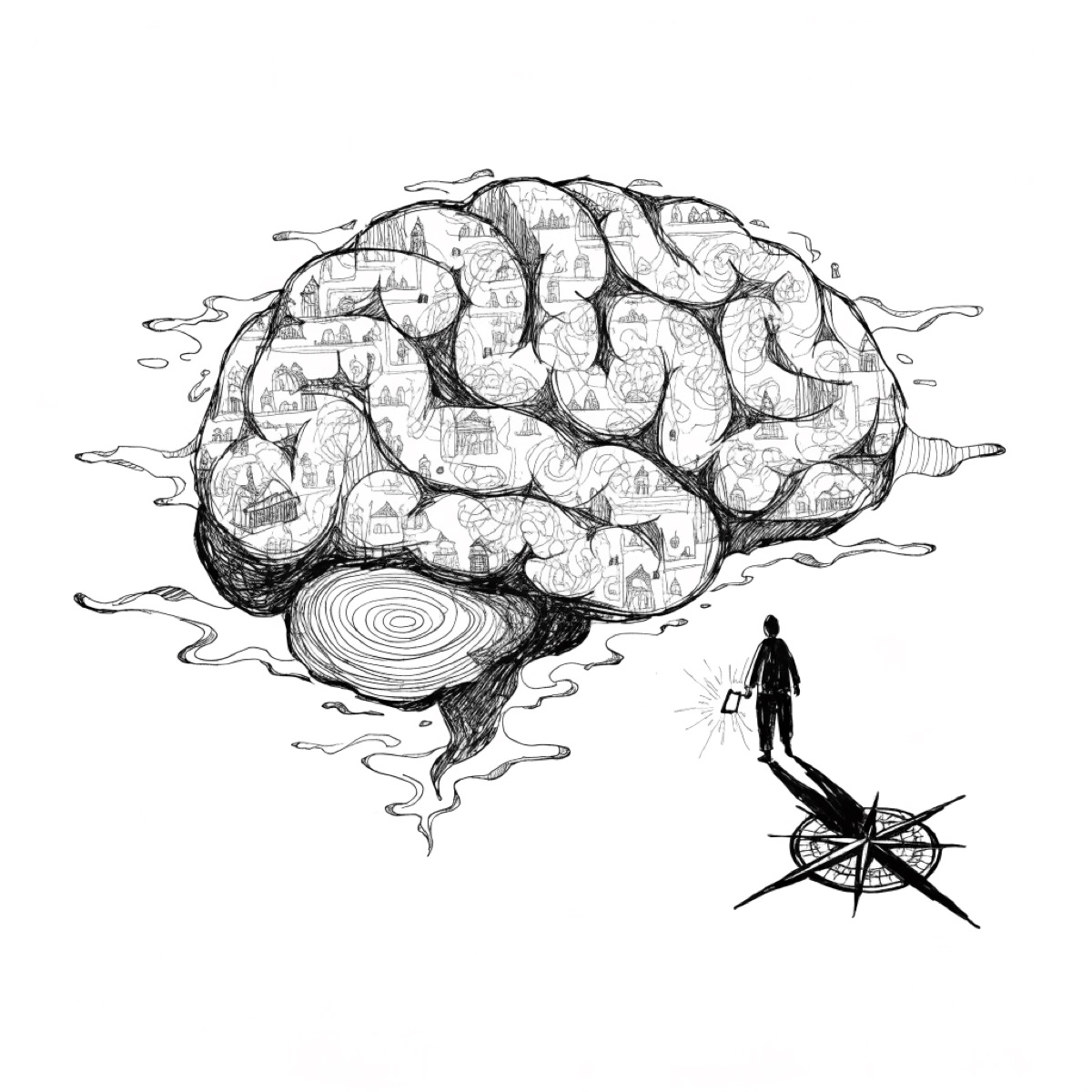
In the late 1990s, a neuroscientist named Eleanor Maguire did something that should have permanently changed how we think about technology. She scanned the brains of London taxi drivers—men and women who had spent years memorizing the labyrinthine street network of one of the world's most complex cities—and found something extraordinary. Their hippocampi, the seahorse-shaped structures deep in the brain associated with memory and spatial reasoning, were measurably larger than those of non-drivers. The longer they'd been on the job, the more pronounced the difference.
Then she followed some of them into retirement. The hippocampus shrank back.
More recently, researchers extended this line of inquiry in a direction that should make every smartphone owner uncomfortable. GPS-reliant navigators in the same city showed significantly smaller hippocampal volume than people who navigated independently—even after controlling for age, education, and general lifestyle factors. The brains of people who followed turn-by-turn directions looked, structurally, like brains that had been asked to do less. Because they had been.
This raises a question we have mostly avoided asking: when we hand a cognitive task to a machine, are we offloading it—or are we quietly dissolving the biological machinery that performed it in the first place?
What the Hippocampus Actually Does (And Why GPS Targets It Specifically)
The hippocampus is not, as it might seem from pop-science shorthand, simply the brain's GPS chip. It is something far more dynamic: a map-builder. When you navigate without assistance, your hippocampus is continuously constructing what neuroscientists call a "cognitive map"—an allocentric spatial model that represents your environment as an objective layout, independent of where you're currently standing. It does this by integrating landmarks, tracking distance and direction through a process called dead reckoning, and updating its model in real time as new information arrives.
This is cognitively expensive work. It requires active decisions: Which way did I turn? Where is the sun? Does that church spire line up with where I started? The hippocampus thrives on exactly this kind of effortful, uncertain, self-directed spatial problem-solving.
But there is a competing system. The striatum, a deeper and evolutionarily older structure, handles what researchers call "stimulus-response" navigation—essentially, follow the arrow. It doesn't build maps. It chains cues to responses: when you see this, do that. It is fast, automatic, and requires almost no conscious spatial reasoning. GPS, functionally, is a striatum feeding machine. Every recalculated route, every "turn left in 200 meters," nourishes one system while systematically starving the other.
A 2020 study from McGill University, led by researchers including Véronique Bohbot, made this structural consequence visible. GPS-reliant commuters showed significantly less grey matter in both the hippocampus and the adjacent entorhinal cortex—a region critical for integrating spatial and temporal information—compared to people who navigated independently. The difference wasn't trivial, and it wasn't explained by confounding variables. The tool was leaving a measurable biological signature.
The Illusion of Augmentation: Why We Mistake Substitution for Enhancement
We have a persistent and flattering story we tell about our tools. A hammer extends a fist. Glasses extend vision. A calculator extends arithmetic. The tool, in this narrative, amplifies human capability without touching the underlying capacity itself. We call this cognitive augmentation, and it has an appealing, almost cyborg-ish ring to it.
But the hammer analogy only holds when the tool enhances an existing process without replacing it. Glasses work because your visual cortex still does the heavy lifting of interpreting the sharpened image. GPS does something categorically different: it doesn't sharpen your spatial reasoning—it performs the spatial reasoning entirely, presenting you only with its output. You are not augmented. You are substituted.
Cognitive scientists distinguish between two very different phenomena here. Offloading is writing a grocery list so your working memory can focus on something else—the ability to remember things remains intact; you're just allocating resources temporarily. Atrophy is what happens when a skill requires regular neural exercise to maintain its structural integrity, and that exercise stops entirely. Spatial navigation is, beyond reasonable scientific doubt, an atrophy-model skill.
The hippocampus is not like a fact stored in a filing cabinet that remains retrievable as long as the cabinet exists. It is more like a muscle—one that responds to challenge by growing and to disuse by diminishing. Turn-by-turn navigation doesn't put that muscle on a rest day. It puts it in a cast.
The Broader Stakes: Spatial Memory Is Not Just About Getting Places
Here is where the stakes expand considerably. Most people, if they accept that GPS use shrinks the hippocampus, shrug and decide that's an acceptable price. They weren't planning to become London cab drivers. They just want to find the restaurant.
But the hippocampus is not narrowly specialized in geography. It is a foundational structure for episodic memory—the rich, contextualized memories of specific experiences that constitute your autobiographical self. It is central to contextual learning, to the ability to understand new information in relation to everything you already know. Perhaps most remarkably, it is heavily recruited when humans imagine future scenarios, simulate possible outcomes, and plan ahead. Spatial and temporal reasoning share deep neural infrastructure, and compromising one doesn't leave the other untouched.
This is not theoretical speculation. Early hippocampal atrophy is among the most reliable biomarkers for Alzheimer's disease, appearing years or even decades before clinical symptoms emerge. Researchers at McGill University, including Bohbot and her colleagues, have proposed directly that chronic GPS dependency may accelerate precisely the pattern of hippocampal atrophy that predisposes people to age-related cognitive decline. That is an extraordinary claim—and it is grounded in a plausible mechanism, not conjecture.
There is a parallel in animal research that should make us uncomfortable. Rats and mice raised in "enriched environments"—complex, navigable spaces full of novel objects and spatial challenges—develop larger hippocampi and demonstrate substantially greater cognitive resilience across a range of tasks compared to animals raised in bare, featureless cages. The principle generalizes: the brain responds to environmental complexity by building more of itself. Humans, equipped with the most sophisticated navigation-suppression device ever invented and keeping it in their pocket at all times, are, in a meaningful sense, choosing the bare cage.
Precedents and Patterns: This Is Not the First Time a Tool Ate a Skill
Socrates, in Plato's Phaedrus, made an argument that has been condescended to for centuries. Writing, he warned, would destroy memory. People would outsource the contents of their minds to external marks on papyrus, and the inner capacity for retention and recall would wither. He was largely right. Literate cultures do not maintain the extraordinary feats of memorization that characterized oral traditions—Homeric bards could recite tens of thousands of lines from memory, a skill that almost no one cultivates today.
We made that trade consciously, collectively, and most of us would make it again. Writing unlocked capabilities—the accumulation and transmission of knowledge across generations—that far exceeded what was lost. The point is not that the trade was wrong. The point is that it was a trade, and the people making it knew it.
GPS users are making the same fundamental exchange without recognizing it as an exchange at all. The mental model on offer is augmentation—you keep your navigational skill and gain convenience. The actual transaction is closer to the one Socrates described: you surrender a biological capacity in exchange for frictionless execution of a task.
The pattern repeats across domains with consistent fidelity. The widespread adoption of calculators in schools was followed by documented declines in arithmetic fluency—not just in specific calculation skills, but in the kind of number sense that underlies mathematical intuition. Autocorrect correlates with degraded orthographic memory. Digital photography, by eliminating the scarcity and cost of film, has paradoxically reduced the depth of attention people pay to individual images—the very thing that once made photography a practice of careful seeing.
But not all cognitive offloading extracts the same price. This is the crucial nuance. Forgetting phone numbers because they're stored in your contacts has a negligible cognitive cost—rote memorization of arbitrary strings is not a skill with deep neural infrastructure or downstream cognitive benefits. Spatial reasoning, mental arithmetic, sustained reading, and memory consolidation are different in kind: they are generative skills whose exercise builds and maintains neural architecture that supports broader cognitive function. Offloading them isn't filing a fact in a cabinet. It's removing the filing system itself.
What 'Assistive' Should Actually Mean: Designing Tools That Don't Eat Themselves
Learning science has a concept called "desirable difficulty," developed largely through the work of Robert Bjork at UCLA. The core insight is counterintuitive: we learn more deeply, and retain skills more durably, when the process involves productive struggle—when we have to work, make errors, retrieve information imperfectly, and try again. Frictionless execution feels better. It is also cognitively hollow. A skill that is never practiced imperfectly is a skill that is not being practiced at all.
Good tool design, under this principle, would preserve friction selectively—handing off the parts of a task that don't build meaningful cognitive capacity while protecting the parts that do. This is not how GPS was designed. It was designed for maximum navigational convenience, which is a coherent design goal, but not one that gave any weight to what happens to the cognitive process being replaced.
There are tentative efforts to do better. Research prototypes using haptic feedback—vibrations on a wristband that pulse in the direction you need to turn—have shown promise precisely because they supply less information than GPS does. You still have to build a spatial model. You still have to track landmarks and distances. The haptic cue guides without replacing, in much the same way that a hiking trail is helpful without preventing you from experiencing the terrain. Several navigation app concepts, including projects grouped under names like Wanderer, have explored presenting rough orientation rather than precise routes, requiring users to make navigational decisions rather than execute instructions. The evidence that these approaches preserve hippocampal engagement is preliminary but conceptually sound.
A design principle worth demanding from the technology industry is simple but radical: any tool marketed as "assistive" or "augmentative" should be required to answer two questions explicitly. What cognitive process does this tool support? And what cognitive process does it replace? The answers might often justify the trade. But asking the questions forces the trade into the open, where it can be evaluated rather than assumed away.
The Navigation Metaphor for Everything That Comes Next
GPS is not a villain in this story. It is a preview.
As large language models take over drafting, summarizing, and eventually reasoning; as diagnostic AI systems replace the pattern-recognition that physicians develop over years of clinical exposure; as generative tools perform the creative iteration that was once the engine of artistic skill—the hippocampus problem scales. Every domain in which a powerful tool performs a cognitively rich process, rather than supporting a human performing it, creates the conditions for the same structural atrophy that researchers have documented in spatial navigation.
The question is not whether to use powerful tools. That argument is already lost, and it should be—the gains are real. The question is whether we are using them in ways that maintain the neural substrate: the living, plastic, structurally dynamic brain tissue that doesn't just execute skills but constitutes the capacity for thought itself.
Somewhere in London right now, a taxi driver is learning The Knowledge—memorizing 25,000 streets and 20,000 landmarks within a six-mile radius of Charing Cross, a process that takes three to four years and involves riding around on a moped making mistakes and finding the way back. Their hippocampus is physically growing. Meanwhile, the rest of us are watching an arrow on a screen, and the most interesting question isn't where it's taking us—it's what we're leaving behind at every turn we didn't have to think about.