Technology · 7 min read
What the "Cloud" Hides About Data Center Energy and Water Use
Every time you save a file to "the cloud," a warehouse the size of a football stadium somewhere powers up to hold it—and nobody's counting that on your carbon footprint. The internet's most successful metaphor may also be its most dangerous lie.
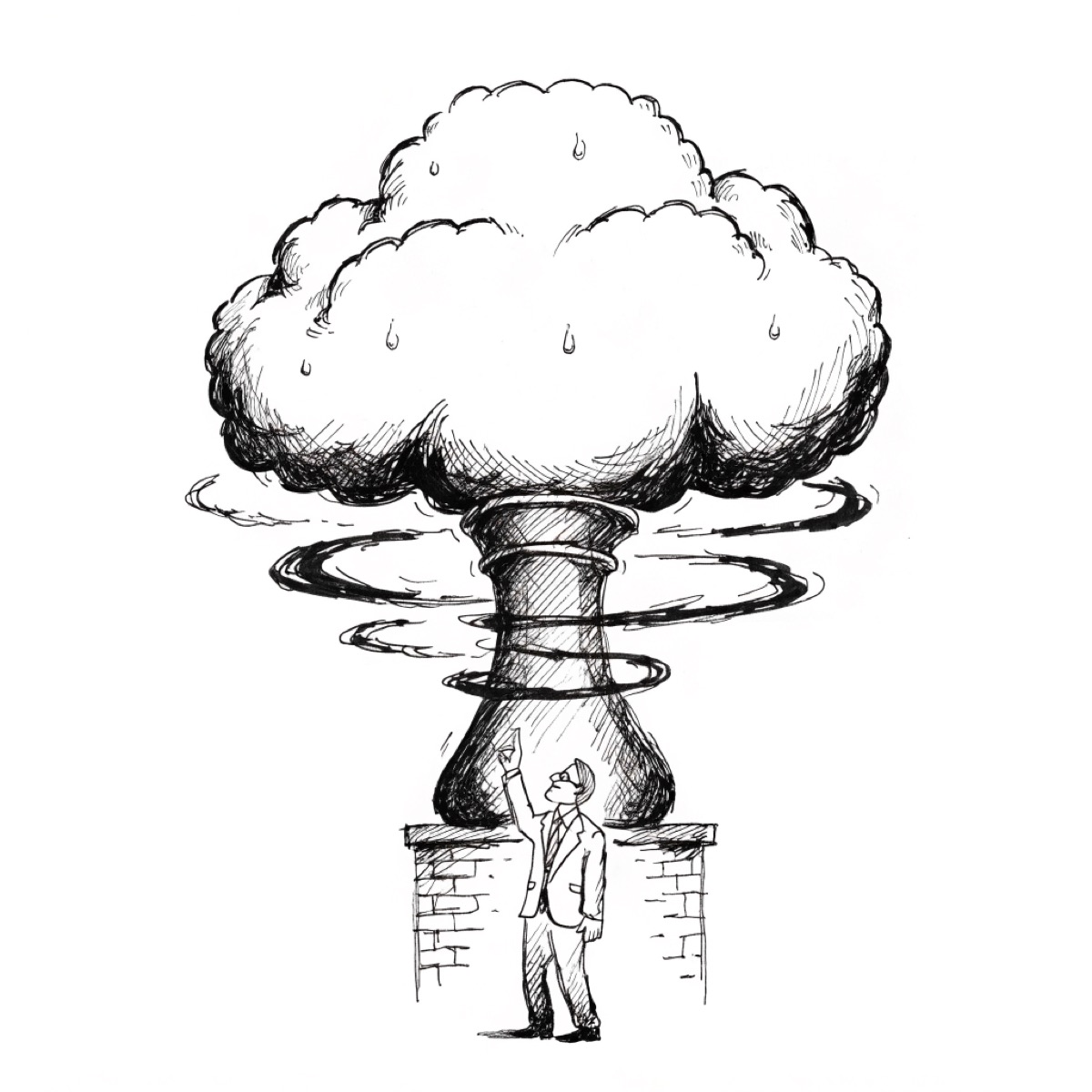
Every time you drag a file to the little cloud icon on your laptop, the gesture feels nearly weightless—a tap of a finger, a soft animation, and it's gone. But simultaneously, in a warehouse the size of a football stadium somewhere in rural Virginia or on the outskirts of Dublin, banks of servers hum at full industrial power, cooling fans roar, and chillers push tens of thousands of liters of water through pipes to keep silicon from melting. The action and its consequence have been surgically separated, and the separation is not accidental.
The numbers that describe this gap are genuinely staggering. Training a single large language model like GPT-3 emitted an estimated 552 metric tons of CO₂—equivalent to flying five passengers back and forth across the Atlantic roughly 550 times, or matching the lifetime driving emissions of 60 average American cars. That is one model, trained once, before a single user typed a single question into it.
The word "cloud" is not a neutral technical descriptor. It is an aesthetic and political choice that has systematically insulated digital infrastructure from the environmental scrutiny we apply to factories, airlines, and power plants. Understanding how that choice was made—and who benefits from it—is increasingly a matter of planetary consequence.
How the Cloud Got Its Name—and What That Name Erases
The origin of the metaphor is almost banal in its practicality. Network engineers in the 1990s needed a quick visual shorthand for the tangled complexity of internet infrastructure in their flowcharts, so they drew a cloud shape: a soft, formless blob that meant, essentially, "something complicated happens here, but you don't need to worry about it." The shape was borrowed from telecommunications diagrams that had used it for decades to represent the public telephone network—the part of the system that was somebody else's problem.
Marketing departments didn't invent the cloud metaphor so much as they recognized its extraordinary latent power and weaponized it. "The cloud" promised effortlessness, accessibility, and a kind of gentle omnipresence—your files floating overhead, always reachable, never burdensome. What it quietly erased from the frame was the physical substrate: the land, the concrete, the copper, the electricity, the water.
That erasure has measurable consequences. Data centers currently consume roughly 1–2% of global electricity. If the internet were a country, it would rank among the top five electricity consumers on Earth, ahead of most nations. Yet none of this appears on any individual user's carbon footprint calculator, because the emissions are attributed to the company running the servers, not the person uploading the photo.
The asymmetry of visibility here is almost architectural in its precision. When a coal plant opens, communities protest, regulators measure air quality, journalists photograph the smokestacks. When a hyperscale data center opens in a rural county, it is typically celebrated as a clean, quiet economic engine—bringing jobs, tax revenue, and the prestigious logos of tech giants to the welcome signs outside small towns. The smokestack is simply invisible, routed through a power grid two states away.
The Anatomy of a Data Center's Carbon Shadow
The most obvious layer of a data center's environmental cost is direct energy consumption, and even that "obvious" layer surprises most people with its scale. The servers themselves run constantly—there is no off switch for the internet—and the cooling systems required to prevent those servers from overheating can account for up to 40% of a facility's total energy use. A single hyperscale facility, the kind operated by Amazon, Google, or Microsoft, can draw between 100 and 500 megawatts of power. For reference, a small city of 50,000 people might use around 150–200 megawatts.
Beneath the operating energy lies what engineers call embodied carbon—the emissions locked into a product before it ever turns on. Manufacturing the servers, chips, fiber-optic cables, and specialized cooling hardware that fill these buildings generates enormous upstream emissions at foundries and factories scattered across Taiwan, South Korea, and China. A 2021 study found that for some computing devices, over 70% of their lifetime carbon is already committed at the manufacturing stage, before the device is ever switched on. Data centers cycle through server hardware on relatively short replacement schedules—often three to five years—meaning this manufacturing burden repeats continuously.
Water is the parallel casualty that carbon accounting almost never captures. Data centers globally consumed an estimated 1.7 billion liters of water per day in 2021 for evaporative cooling—a figure that would fill roughly 680 Olympic swimming pools every 24 hours. This stress is particularly acute when facilities are sited in drought-prone regions. Arizona, Nevada, and other parts of the American Southwest have become popular locations for data center campuses precisely because land is cheap and power is available, even as those same regions face some of the most severe water scarcity in the developed world.
The AI Acceleration—A Carbon Multiplier Arrives
The environmental conversation around data centers was already difficult before generative AI arrived to rewrite the scale entirely. The training of frontier AI models—the phase where a system like GPT-4 or Google's Gemini learns from hundreds of billions of text examples over months of continuous computation—generates the headline-grabbing emissions figures. But training is a one-time cost, relatively speaking. Inference—running the model in response to billions of user queries daily, indefinitely, once deployed—may ultimately dwarf training emissions in cumulative impact. Every ChatGPT response, every AI-generated image, every autocomplete suggestion is a small but real energy expenditure, multiplied by hundreds of millions of interactions per day.
This dynamic collides directly with an economic principle economists call the Jevons Paradox, named after the 19th-century British economist William Stanley Jevons, who observed that more efficient steam engines led to more coal consumption, not less, because efficiency made coal-powered production cheaper and thus more attractive. The same logic is playing out in silicon. As AI tools become cheaper and faster per query, demand explodes proportionally, erasing efficiency gains. Microsoft, Google, and Amazon all reported surging data center energy consumption in 2023 and 2024—precisely the same period in which they were also announcing breakthrough efficiency improvements in their hardware and cooling systems. The rebound effect is not a theoretical risk; it is already the observed reality.
The measurement problem compounds everything. AI companies routinely publish statistics about model size in parameters and computational cost in FLOPs (floating-point operations), but standardized carbon disclosures for model training are rare, inconsistent, and difficult to verify independently. There is no common unit of environmental cost for AI development—no equivalent of the miles-per-gallon sticker on a car window. This makes regulatory comparison not just difficult but effectively fictional, and it means that even well-intentioned researchers trying to compare the environmental footprints of competing models are largely working with incomplete or incompatible data.
Who Bears the Cost—and Who Controls the Accounting
Data centers do not distribute themselves randomly across the landscape. They cluster where land is cheap, where tax incentives are generous, and where power infrastructure is robust—conditions that tend to describe rural, lower-income communities rather than the tech corridors where their corporate owners are headquartered. Prince William County in Virginia, which hosts one of the densest concentrations of data centers on Earth, has watched its electricity grid strain under the load. Communities in rural Ireland, the Netherlands, and Singapore have debated moratoriums on new data center construction as facilities compete with residents and agriculture for power and water. The digital wealth generated flows upstream; the grid stress, the water draw, and the construction disruption stay local.
Corporate carbon accounting has developed a sophisticated vocabulary for making this situation appear more resolved than it is. Tech giants routinely claim "carbon neutrality" through instruments called renewable energy certificates, or RECs—essentially paper credits representing the fact that somewhere, at some point, a solar or wind farm generated a kilowatt-hour of electricity. The problem is that a REC purchased in January to offset power consumed in a data center at 3 a.m. on a Tuesday in winter may represent solar power generated on a summer afternoon in a different regional grid entirely. The accounting is perfectly legal. The electrons, however, are not green—the data center is still pulling whatever the grid is actually supplying at that moment, which in most regions still includes significant fossil fuel generation.
The regulatory environment has not caught up. The European Union's Corporate Sustainability Reporting Directive, known as the CSRD, is beginning to require Scope 3 emissions disclosure—meaning companies must account for emissions throughout their supply chain, not just from their own direct operations. This is a meaningful step, and it will apply pressure to some of the largest tech operators in European markets. The United States has no equivalent federal mandate, and most digital carbon currently exists in a measurement no-man's-land where companies set their own methodologies, choose their own baselines, and report on their own schedules with minimal external verification.
The cloud metaphor accomplished something remarkable: it made one of the most energy-intensive industries in human history feel like weather. And perhaps the most unsettling thing is that the metaphor continues to do its work even on people who know better—even researchers who study data center emissions describe themselves "moving things to the cloud" without pausing on the phrase. Language shapes attention, and attention shapes regulation, investment, and political will. Until we find words that let us see the warehouses, the chillers, and the wires every time we reach for the sky-blue icon, the most powerful infrastructure on Earth will continue to benefit from the oldest illusion in the environmental playbook: the fiction that invisible means weightless.