Culture · 6 min read
How Railways and Telegraphs Standardized Local Time
Railways made local clock differences costly, telegraphs distributed shared references, and governments later turned operating standards into civil time.
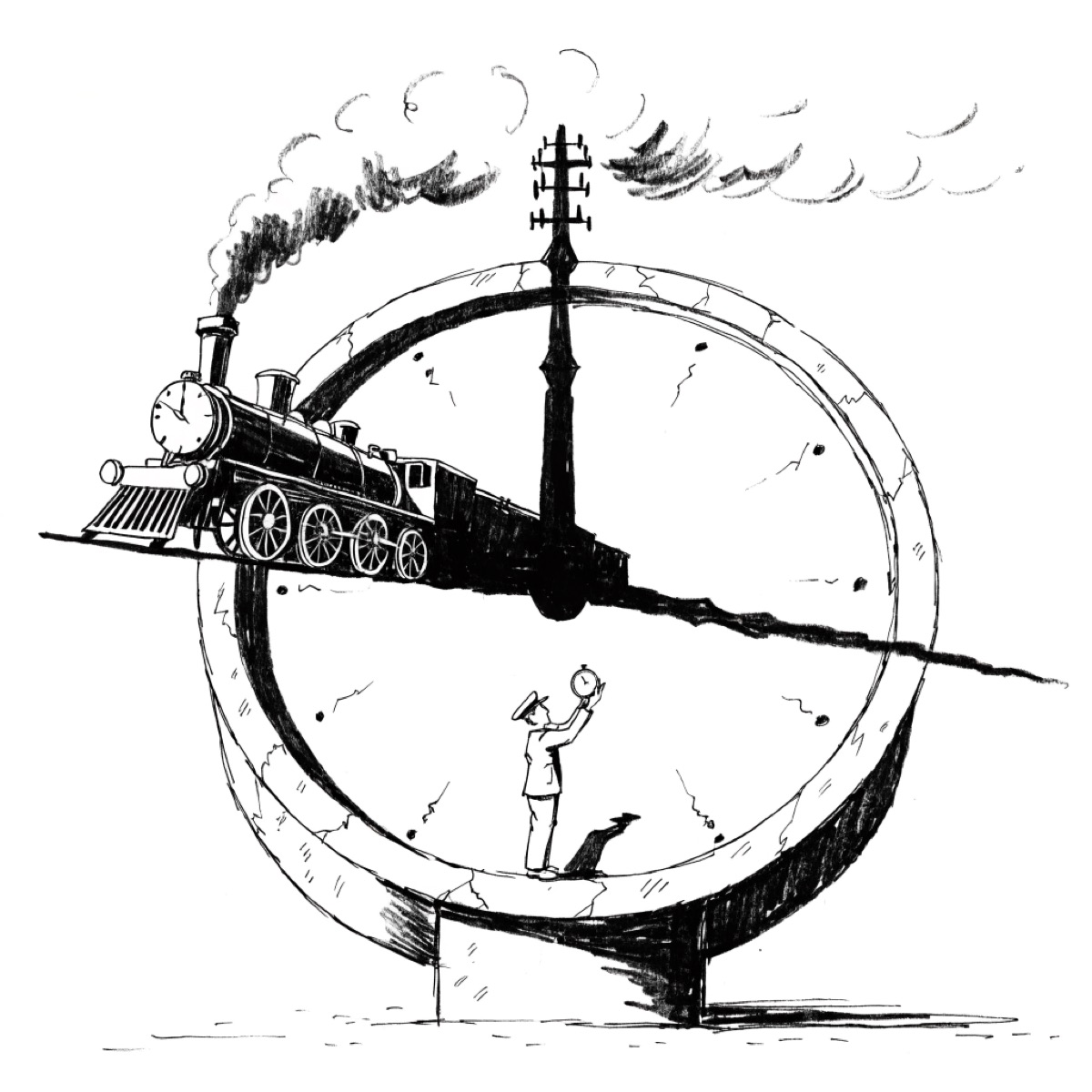
Before standardized time, noon was a local observation. When the sun crossed a town’s meridian, the town clock could be set to twelve. Two places separated east to west therefore kept slightly different times, even when they were near each other. The difference was usually tolerable when travel and communication moved slowly.
Railways and telegraphs changed the cost of that variation. A railway timetable connecting many towns could not easily use a separate clock for each station. Telegraph networks could transmit a reference time much faster than people or goods moved. During the nineteenth century, these systems helped turn time from a local astronomical convention into coordinated infrastructure.
The transition was not a single international decree. Rail companies, observatories, cities, national legislatures, and an international conference made different decisions for different purposes. Standardization spread unevenly, and political borders continued to reshape the supposedly geometric map of time.
When noon belonged to each town
Local apparent solar time follows the observed sun, but the length of an apparent solar day varies slightly over the year because of Earth’s orbit and axial tilt. Clockmakers and astronomers therefore used mean solar time, an averaged scale. Even then, mean noon depended on longitude: Earth rotates 360 degrees in roughly 24 hours, so one degree of longitude corresponds to about four minutes of time.
In a town-centered economy, a public clock could coordinate markets, worship, and work locally. Travelers reset watches on arrival. The system was plural but intelligible because most activities did not require distant clocks to agree to the minute.
Britain’s Royal Observatory at Greenwich had supplied astronomical observations and time information for navigation since the seventeenth century. Greenwich Mean Time became increasingly useful to mariners and mapmakers, but usefulness at sea did not automatically make it civil time everywhere on land.
The practical pressure came from networks. Once a missed interpretation of a timetable could place trains on the same track, clock differences became an operational hazard. The relevant unit was no longer the town. It was the railway system.
Railways turn local variation into an operating problem
British railways began adopting London or Greenwich time in the 1840s. Companies coordinated their own stations before all municipalities changed their public clocks. For a period, some clocks displayed both local and railway time, making the overlap visible.
The Great Western Railway adopted London time in 1840, and other British lines followed during that decade. The Electric Telegraph Company began distributing Greenwich time signals in the 1850s. These dates show why the North American change of 1883 should not be described as the origin of standard time worldwide: it was a major continental implementation within a longer sequence.
North America presented a larger problem. Lines crossed many degrees of longitude and used numerous railway times. On November 18, 1883, railways in the United States and Canada implemented a system based on meridians separated by one hour. The National Institute of Standards and Technology’s history of timekeeping identifies that date as the introduction of the Standard Railway Time System.
Contemporary proceedings from the 1884 International Meridian Conference record that the rail companies adopted mean local times of the 75th, 90th, 105th, and 120th meridians west of Greenwich for their operations. The familiar story of four continental zones is therefore grounded in an industry coordination decision, not initially a federal statute.
Railway standardization did not instantly compel every town or resident to agree. Cities adopted the system at different rates, and local controversy continued. In the United States, Congress made standard time a matter of federal law in 1918, more than three decades after railway adoption.
Telegraphs distribute a shared reference
A standard is useful only if clocks can be compared with it. Telegraphy made time signals distributable. An observatory could determine time astronomically, maintain it with precision clocks, and send an electrical signal to stations over long distances. Railways could then synchronize clocks along a route.
This relationship was reciprocal. Rail companies owned communication lines and needed time coordination; observatories had time expertise and wanted broader scientific coordination. Meteorologists also needed observations taken at comparable times, while geodesists and astronomers needed shared reference systems.
The telegraph did not eliminate measurement error. Signal transmission, relay procedures, clock quality, and human handling all mattered. But it sharply reduced the delay involved in carrying time physically. Later radio broadcasts extended the same principle without a dedicated wire.
Describing this process as technology “creating” standard time would be too strong. Astronomical methods, administrative rules, and shared units already existed. Rail and telegraph networks changed the incentives and made a common reference operationally enforceable across distance.
Standard time becomes a political choice
The 1884 International Meridian Conference in Washington addressed a prime meridian and a universal day, especially for navigation and scientific calculation. Delegates voted to use the Greenwich meridian as the initial meridian for longitude. The conference did not draw every modern civil time-zone boundary or force nations to adopt Greenwich civil time.
The voting also reflected existing use. A large share of nautical charts already referenced Greenwich, which reduced the cost of international conversion. That practical advantage did not make the choice culturally neutral. A prime meridian is mathematically arbitrary; the selected line embodied the naval, commercial, and cartographic power of the period.
France abstained on the main Greenwich resolution, and adoption remained a matter of national practice. The universal day proposed by the conference was a reference for global calculation; local civil days could still begin at local midnight.
Time zones are often illustrated as 24 straight slices of 15 degrees each. NIST notes that this is an average geometric relation, not a description of actual borders. Governments bend zone boundaries around populations, commerce, and territory. Some use half-hour or quarter-hour offsets. Large countries may use one civil time across longitudes that could geometrically support several.
Daylight saving time added another political layer. It changes the civil offset seasonally; it does not alter Earth’s rotation or the underlying longitude. Debates about it concern health, energy, commerce, and social schedules—questions not resolved by the nineteenth-century choice of a prime meridian.
What standardization did and did not settle
The established history is that faster transport and communication made local-time differences costly, railways adopted common operating times, telegraph networks distributed reference signals, and governments later formalized civil standards. The 1883 North American railway change and the 1884 meridian conference were major steps, but they solved different coordination problems.
Historians differ over emphasis. A railway-centered account can understate the roles of observatories, navigation, meteorology, state administration, and earlier British practice. A conference-centered account can make an incremental and contested process look like a single command.
The remaining choices are still political. Satellite navigation and networked computers now distribute precise time at a scale nineteenth-century organizers could not achieve, yet societies decide which clock time schools, markets, and workdays will follow. Even the scientific time scale UTC includes decisions about how atomic time relates to Earth’s irregular rotation.
Standard time did not abolish local solar experience. Sunrise still occurs at different civil-clock hours across a zone. What changed was the governing priority: clocks were asked to coordinate networks first and represent local noon second. That trade made timetables and long-distance systems more manageable, while leaving the boundaries of civil time open to negotiation.