Business · 6 min read
How Small Demand Changes Become Large Supply-Chain Swings
A system walkthrough of forecasting, lead times, batching, promotions, rationing, delayed feedback, and mitigation tradeoffs.
How Small Demand Changes Become Large Supply-Chain Swings
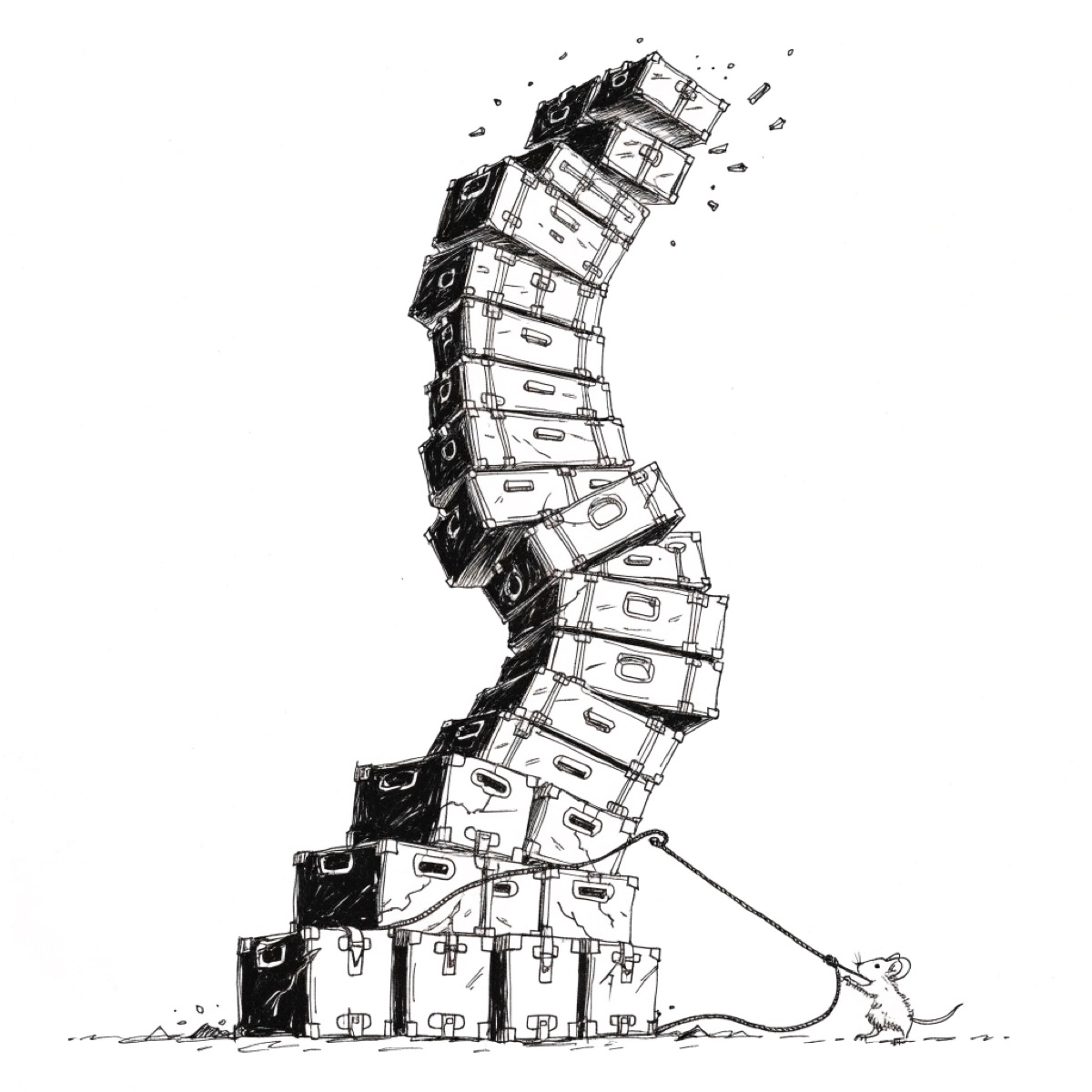
A retailer sells roughly 100 units a week, then sales rise to 110. The wholesaler may receive an order for more than 110, and the manufacturer may see a still larger increase. When sales settle, upstream orders can collapse below final demand. This amplification of variability from customer purchases toward suppliers is called the bullwhip effect.
The phrase does not mean every supply chain amplifies every change. It names a measurable pattern: under certain demand, forecasting, lead-time, batching, pricing, and allocation conditions, the variance of orders exceeds the variance of sales and can increase upstream. Hau Lee, V. Padmanabhan, and Seungjin Whang’s 1997 analysis organized four major causes: demand-signal processing, order batching, price variation, and rationing games.
The effect can arise even when participants try to behave sensibly with limited information. It can also be intensified by poor decisions. A system walkthrough helps distinguish the mechanism from the metaphor.
A small retail change enters the chain
Consider four stages: customer, retailer, wholesaler, and manufacturer. Each business sees orders from the stage below and sends orders to the stage above. Goods take time to travel, and orders already placed remain in a pipeline. Each stage holds inventory and may accumulate backorders.
Suppose customer demand rises by 10 units. The retailer must cover the new sales and may also rebuild inventory depleted during the surprise. If replenishment takes two weeks, it may order more than the current increase to protect against another stockout. The wholesaler sees the retailer’s order, not the underlying point-of-sale history. It can interpret that larger order as evidence of a stronger market shift, then add its own safety response.
By the time the signal reaches the manufacturer, one modest change may have produced a temporary surge. Production and transport capacity respond with delay. Extra goods arrive after downstream inventories have recovered, causing orders to fall sharply. The oscillation can continue because each stage reacts to delayed consequences of earlier actions.
Inventory, orders, and sales are therefore different variables. A report that “orders fell 30 percent” does not establish that consumers bought 30 percent less. Customers may be buying steadily while intermediaries reduce excess stock.
Forecast updating amplifies the signal
Firms forecast because future demand is uncertain. A common method gives recent observations more weight than older ones. When an order spike arrives, the forecast rises. The firm then orders to meet the higher expected demand plus a target inventory position. Longer replenishment lead times magnify this response because the forecast covers more future periods.
Lee and colleagues showed analytically how rational updating can increase order variance. The result depends on the demand process and ordering policy; amplification is not a law without conditions. Later work by Fangruo Chen and colleagues quantified the effect in a simple two-stage chain and examined how centralized demand information can reduce, but not necessarily eliminate, it.
The phrase “information distortion” can suggest that someone falsified data. Often the distortion is structural. An order combines information about sales, desired inventory, expected lead time, batch size, and perceived risk. Treating it as a clean measure of consumer demand mixes those components.
Batches, promotions, and rationing add variance
Ordering has fixed costs. A buyer may wait and place a truckload or monthly order rather than ordering each unit as it sells. Batching converts smooth consumption into pulses. Upstream suppliers serving many customers may see those pulses coincide, especially around common review dates or transport schedules.
Price promotions shift purchases across time. A retailer may buy extra during a discount and draw down that stock later. Manufacturer shipments surge, then fall, although consumer use changes little. Stable pricing or pricing based on actual consumption can reduce this source, but promotions may serve other commercial goals.
Rationing creates a strategic problem. When supply is scarce and a producer fills only part of each order, customers may inflate requests to secure a larger allocation. Once scarcity ends, they cancel or reduce the excess. The producer observes apparent demand that exceeds intended purchases. Allocation based on past sales rather than current orders can reduce the incentive, though it may disadvantage genuinely growing customers.
These mechanisms can coexist. A single episode cannot be diagnosed from amplification alone. Investigators need point-of-sale data, inventory positions, lead times, promotion calendars, allocation rules, cancellations, and ordering policies.
The beer-distribution experiment isolates feedback
The MIT beer-distribution game places participants in retailer, wholesaler, distributor, and factory roles. They manage inventory and orders while shipments are delayed and communication is restricted. In John Sterman’s experiments, participants commonly generated large oscillations even though customer demand changed in a simple way.
The game demonstrates how people misperceive delayed feedback. Participants often underweight inventory already in transit, react strongly to backlogs, and continue ordering before previous orders arrive. Because each role sees only local information, one person’s correction becomes another person’s disturbance.
The experiment does not prove that real managers behave identically. Real supply chains use software, contracts, shared data, and professional forecasts; they also face product substitution, capacity limits, and shocks absent from the classroom. Its value is diagnostic. It shows that instability can emerge without malicious actors, irrational consumers, or volatile final demand.
Mitigation changes information and incentives
Sharing point-of-sale data lets upstream firms distinguish consumer purchases from a customer’s replenishment decision. Shorter and more reliable lead times reduce the horizon that safety orders must cover. Smaller batches smooth orders. Everyday pricing can reduce forward buying. Clear allocation rules can reduce strategic inflation during shortages.
Coordination also changes who bears risk. Vendor-managed inventory gives a supplier more visibility and control, but customers may resist sharing sensitive data. Smaller shipments can raise transport cost or emissions. Extra capacity improves responsiveness but is expensive when idle. A policy that reduces order variance is not automatically the best overall business decision.
Modern analytics do not repeal the mechanism. Forecasts still depend on assumptions, and automated systems can react to the same delayed or biased signals at high speed. Shared data help only if participants interpret definitions consistently and trust that information will not be used opportunistically.
Regular stress tests can also reveal amplification before a disruption. Teams can simulate a demand step, trace outstanding orders, and compare local rules with the response of the chain as a whole.
What is established is that order amplification can arise from identifiable operational mechanisms and has been derived in models, observed in experiments, and documented in practice. What is contested is the contribution of each cause in a given chain and how much coordination is economical. What remains unknown during a live disruption is often the hardest fact: how much of an upstream swing reflects final demand, inventory correction, strategic ordering, or data error.
The bullwhip effect is useful because it directs attention away from the loudest order and toward the system that produced it. A small change becomes large not through one mysterious leap, but through repeated forecasting, delay, batching, and incentive responses at connected stages.
Sources
3 sources, every one with a link you can follow.
- Hau L. Lee, V. Padmanabhan, and Seungjin Whang, “Information Distortion in a Supply Chain: The Bullwhip Effect”, Management Science (1997).
- John D. Sterman, “Modeling Managerial Behavior: Misperceptions of Feedback in a Dynamic Decision Making Experiment”, Management Science (1989).
- Fangruo Chen and colleagues, “Quantifying the Bullwhip Effect in a Simple Supply Chain”, Management Science (2000).