Environment · 6 min read
Rewetting Peatlands: Carbon Gains and Methane Tradeoffs
Why raising peatland water tables reduces continuing carbon loss while creating site-specific methane tradeoffs.
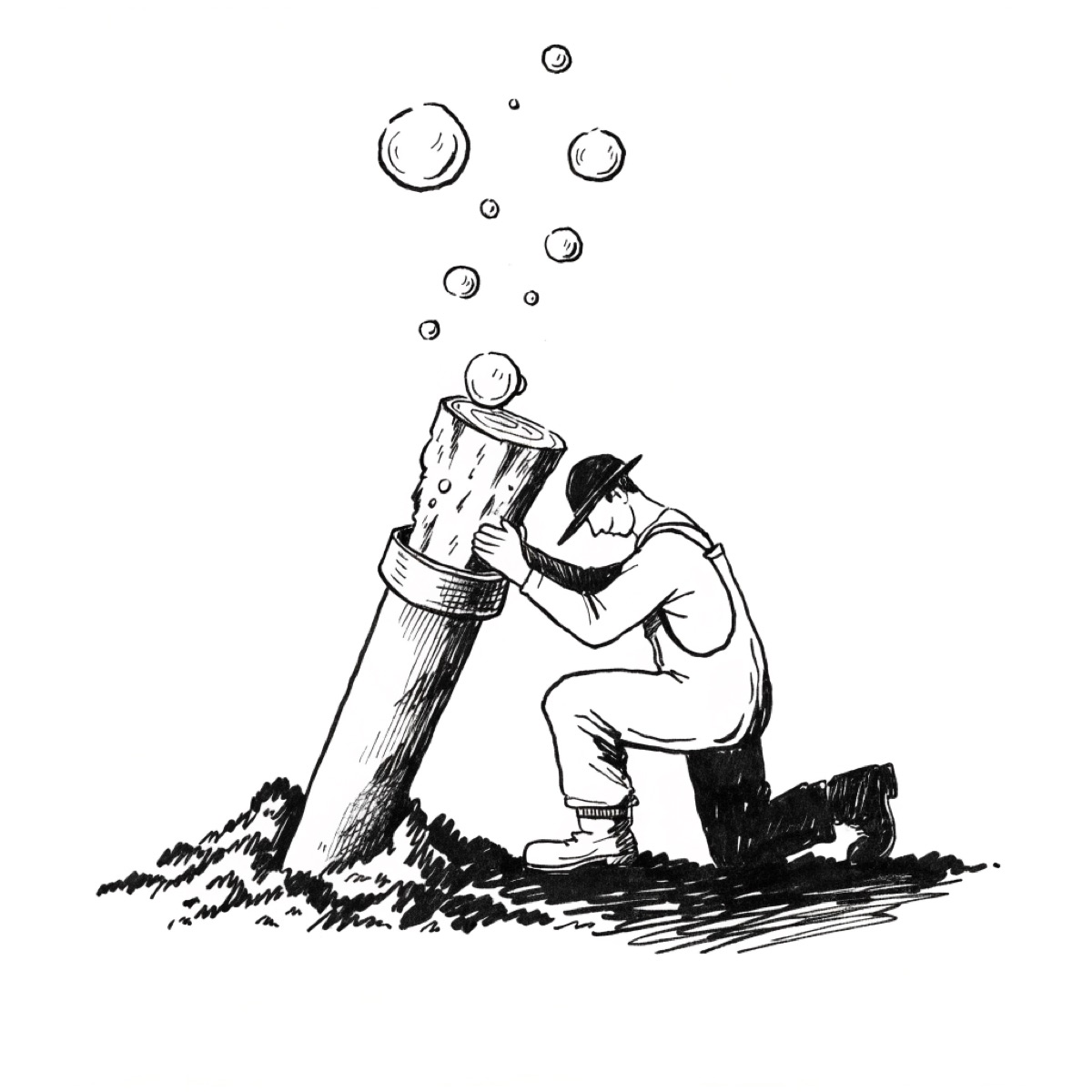
Draining peat changes a long carbon accumulation process
Peat forms where waterlogged conditions slow the decomposition of plant remains. Over centuries or millennia, partially decomposed organic matter accumulates as soil. When people drain peatlands for farming, forestry, fuel extraction, or construction, air enters pores that were saturated. Microbes can then decompose stored organic carbon more rapidly, releasing carbon dioxide and causing the surface to subside.
Rewetting raises the water table to slow that aerobic decomposition. The central climate case is strong in one respect: stopping continuing carbon dioxide emissions from drained peat can avoid a long stream of future warming. The uncertainty lies in how quickly a particular site responds, how much methane rises after flooding, whether peat-forming vegetation returns, and whether management keeps the water table in the intended range.
The question is therefore not simply whether a rewetted site “stores carbon.” A project may remain a net greenhouse-gas source for years while still producing less future warming than continued drainage. Carbon dioxide, methane, and nitrous oxide have different atmospheric lifetimes and warming effects. A credible assessment needs gas-specific measurements and a time horizon.
Raising the water table slows carbon dioxide loss
Drainage creates a persistent emission source because the peat itself is the fuel for microbial respiration. Unlike emissions from a one-time machinery operation, oxidation can continue as long as drained organic soil remains exposed and carbon is available. Subsidence can deepen the management problem: maintaining agriculture may require further drainage as the surface falls.
Rewetting blocks much of the oxygen supply and can sharply reduce soil carbon dioxide emissions. It may also reduce nitrous oxide where drainage and fertilization had supported its production. The 2013 Wetlands Supplement to the Intergovernmental Panel on Climate Change's inventory guidelines synthesizes emission factors by climate, land use, and drainage status. Those factors are averages for national accounting, not predictions for each field.
A site can still emit carbon dioxide after rewetting. Plants respire, recently produced organic matter decomposes, and water levels fluctuate. Researchers distinguish ecosystem exchange from fossil or deep-peat loss, and they must account for carbon exported in water. A chamber measurement made on one patch or one season cannot by itself establish an annual whole-site budget.
The most immediate, well-supported objective is avoided loss: keep old peat from continued oxidation. Restoring net peat accumulation is a slower ecological outcome. Sphagnum mosses in many northern bogs, sedges in fens, and swamp-forest species in tropical systems create different pathways. Rewetting without appropriate vegetation or hydrology may halt some damage without recreating the former ecosystem.
Methane creates a real but time-dependent tradeoff
Waterlogged, oxygen-poor soils favor microorganisms that produce methane. Rewetting can therefore increase methane emissions, especially when fresh plant material supplies easily decomposed carbon. Very high water tables, inundation, nutrient conditions, and vegetation with gas-conducting tissues can influence the flux. Methane can move by diffusion, bubbling, or through plants.
Methane is a powerful warming agent but remains in the atmosphere for much less time than carbon dioxide. Carbon dioxide from ongoing peat oxidation accumulates and affects climate over much longer periods. This difference makes a one-year comparison of carbon-dioxide-equivalent emissions sensitive to the chosen metric.
Franziska Günther and colleagues modeled this temporal issue in a 2020 Nature Communications study using IPCC emission factors. They concluded that prompt rewetting of drained peatlands reduces long-term warming despite increased methane emissions, and that delay adds avoidable carbon dioxide. This is a model-based synthesis rather than a field trial of every peatland. Its result depends on assumed emission factors, trajectories, and climate metrics, but it explains why a short methane spike does not necessarily negate avoided continuing carbon dioxide.
The phrase “methane spike” can itself overgeneralize. Some sites show a large post-rewetting increase, some a smaller one, and changes can persist or vary. Open drainage ditches and shallow flooded areas may become methane hotspots. Projects can sometimes reduce emissions by avoiding prolonged surface flooding and by managing vegetation, but hydrological control is constrained by rainfall, topography, neighboring land, and infrastructure.
Outcomes differ by place and previous use
“Peatland” covers boreal bogs, temperate fens, tropical peat swamp forests, agricultural peat soils, and cutover extraction sites. Their temperatures, plant communities, nutrients, depths, and histories differ. A restored northern bog cannot supply the emission factor for a tropical plantation.
Previous use matters because it changes physical structure and carbon availability. Peat extraction may remove the living surface and leave compacted layers. Intensive agriculture adds nutrients and may degrade peat deeply. Forestry alters drainage and vegetation. Fire can remove carbon quickly and change surface properties. Rewetting reduces one pressure but may not reverse these changes.
Climate change adds another uncertainty. Drought can lower water tables during critical periods; extreme rainfall can flood a site beyond target levels. Warming can accelerate microbial processes and change vegetation. A project described as rewetted at completion needs long-term hydrological monitoring to show that the condition persists.
Leakage also matters at the system level. If rewetting takes cropland out of production and the same demand drives drainage elsewhere, project boundaries will overstate the global benefit. Paludiculture—the production of biomass or crops suited to wet peat—aims to maintain economic use without deep drainage. It is promising for some species and markets, but evidence on profitability, processing, and full life-cycle emissions remains context-specific.
Measurement is the current bottleneck
Field researchers use chambers to measure gas exchange over small areas and eddy-covariance towers to infer fluxes over larger footprints. Water-table loggers, vegetation surveys, subsidence measurements, and water chemistry add process information. Each method samples space and time differently. Methane ebullition can be episodic, while tower estimates may have gaps during certain atmospheric conditions.
National inventories often use Tier 1 default factors when local data are unavailable. More detailed Tier 2 or Tier 3 approaches use country-specific factors or models. Defaults permit consistent reporting but can hide large project-level variation. Verification for carbon finance raises a further question: how much measurement is enough to credit a reduction without making monitoring cost prohibitive?
Baselines are counterfactual. A project must estimate what emissions would have occurred without rewetting. Continued deep drainage, partial abandonment, fire, or spontaneous water-table rise produce different baselines. Permanence is also not binary. Pumps can fail, governance can change, and neighboring drainage can pull water across property lines.
The strongest monitoring designs combine pre-restoration data, nearby comparison sites where feasible, continuous water levels, repeated gas measurements across microtopography, and transparent uncertainty intervals. Even then, annual weather variation can delay confidence about a trend.
The climate benefit is credible, not numerically universal
Established evidence supports protecting intact peat first: avoiding drainage prevents large stored carbon stocks from becoming continuing sources and avoids the ecological disruption that restoration must later address. For already drained peat, raising the water table generally reduces carbon dioxide loss from oxidation. Methane may increase, and local water quality, biodiversity, and land-use outcomes can move in different directions.
The leading synthesis indicates that prompt rewetting usually offers a climate advantage over continued drainage when evaluated over time. The exact break-even date and magnitude are not universal. They depend on initial emissions, post-rewetting methane, vegetation, climate, water level, and the metric used.
The largest unknown for implementation is not the basic anaerobic mechanism. It is performance across heterogeneous sites under future weather and long-term management. Projects should therefore be judged by measured water tables and gas trajectories, not by the act of blocking a ditch alone. Rewetting can stop a persistent source and sometimes restart accumulation, but the evidence does not support one carbon number for every restored hectare.
Sources and review note
3 sources, every one with a link you can follow.
- The accounting foundation is the IPCC's 2013 Wetlands Supplement.
- The time-dependent methane tradeoff is analyzed by Günther and colleagues in Nature Communications.
- Current practice and measurement are synthesized in the IUCN UK Peatland Programme's briefing on peatlands and methane.
The load-bearing uncertainty is site-specific post-rewetting methane, which default emission factors cannot predict precisely.