Environment · 7 min read
What Rewilding Can and Cannot Restore
In 1995, wolves returned to Yellowstone and the world cheered—but the ecosystem they walked back into had already been hollowed out beyond recognition. The real story of rewilding is not triumph over loss; it is something stranger, more honest, and more necessary.
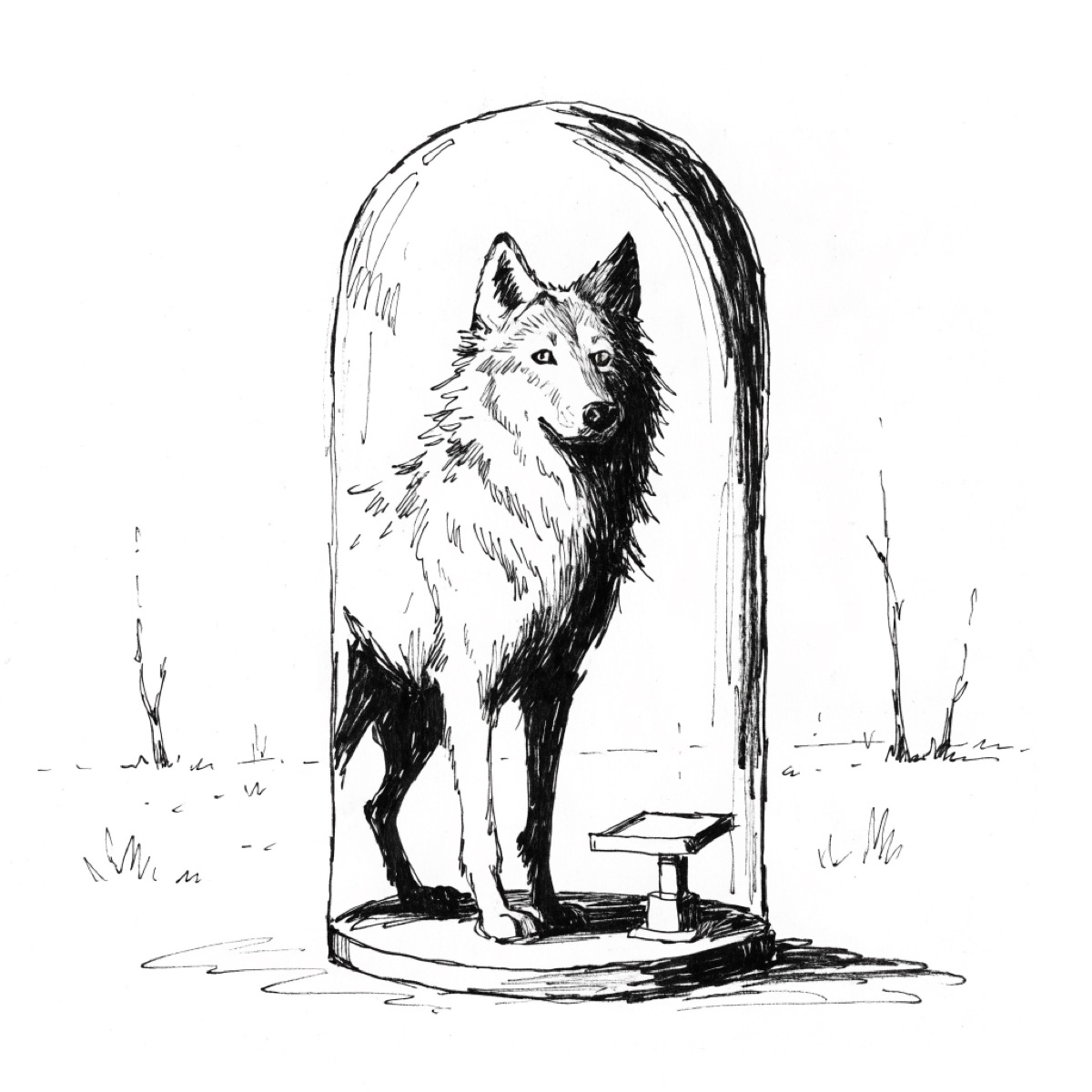
In March 1995, wildlife biologists released the first gray wolves into Yellowstone National Park—eight animals from Alberta, Canada, part of a fourteen-wolf reintroduction that also placed wolves in central Idaho. What followed became conservation's most-told success story: elk herds moved differently, riverbanks stabilized, willows and aspens recovered, and beavers returned. Scientists named it a "trophic cascade." Journalists called it proof that nature heals itself. The Yellowstone wolf reintroduction became the gold standard, the story rewilding tells about itself when it needs to believe in something.
But look closer at what the wolves actually walked into. The beaver colonies that would have shaped the pre-1800s hydrological landscape were already gone. The native grasses had been displaced by decades of cattle grazing. The Indigenous Shoshone, Bannock, and Crow peoples whose land-management practices had co-evolved with the ecosystem for millennia had been removed by force. The wolves did not restore Yellowstone. They were reintroduced into a place that was already, in some fundamental sense, a ruin—and the ruin predated their absence.
This raises a question that rewilding's most enthusiastic advocates tend to sidestep: If the baseline was already broken before the restoration began, what exactly did we restore?
The Shifting Baseline Problem: Science's Uncomfortable Secret
In 1995—the same year the Yellowstone wolves arrived—fisheries biologist Daniel Pauly named something that ecologists had been quietly living with for decades. He called it "shifting baseline syndrome." The idea is straightforward and quietly devastating: each generation of scientists calibrates their sense of "normal" to the degraded world they first observed, and so the perceived scale of historical loss keeps compressing. What looks like recovery to one generation would look like catastrophe to their great-grandparents.
Pauly's own field offers the starkest illustration. When North Atlantic cod stocks collapsed in the early 1990s, the disaster was measured against 1960s abundance levels. But those 1960s populations were themselves a fraction of pre-industrial numbers—some estimates suggest the northwest Atlantic once held cod stocks ten to twenty times larger than anything seen in the twentieth century. The collapse was real, but the benchmark for recovery had already been silently lowered before anyone declared an emergency.
The same logic haunts every rewilding project. The success metrics—how many wolves, what elk density, which plant communities—are written against a baseline that is itself already a record of loss. This means a project can meet every measurable target, be declared a success, and still represent an ecosystem standing in its own wreckage, tidied up but not rebuilt.
What Rewilding Actually Promises (And What It Quietly Cannot)
Rewilding is not a single idea. It clusters around three distinct models, each making a slightly different bet on how recoverable the past is.
Pleistocene rewilding is the most ambitious: reintroduce large mammals as functional proxies for extinct megafauna—using African elephants or horses to stand in for woolly mammoths and restore grassland dynamics that vanished ten thousand years ago. Trophic rewilding is more modest in timescale but equally confident in mechanism: bring back keystone predators like wolves or lynx, and their cascading effects will reorganize the ecosystem toward health. Passive rewilding is the most hands-off—remove fences, stop farming, walk away, and trust the land to remember what it was.
All three share a philosophical assumption that rarely gets stated plainly: that nature has a recoverable default state toward which it will trend, either if humans intervene strategically or simply stop interfering. It is an optimistic cosmology. It imagines ecosystems as springs, compressed by human pressure, ready to expand back into their original shape once the weight is lifted.
The scientific problem is that ecological systems do not work this way. They are non-equilibrium, path-dependent, and prone to threshold effects—meaning the path you took to get somewhere matters as much as where you are, and some transitions cannot be reversed by retracing your steps. There is no magnetic original state pulling the landscape home. The land has its own traumatic memory, and it does not necessarily want to go back.
Grieving as Method: The Emotional Logic Beneath the Science
In 2003, philosopher Glenn Albrecht coined the term solastalgia—the grief of watching a home environment change beyond recognition while you are still living in it. More recently, climate psychologist Ashlee Cunsolo has developed the concept of "ecological grief" as a clinical and cultural reality: the mourning people feel for species, landscapes, and ecological relationships that are disappearing within their lifetimes. Conservation scientists have been slower to acknowledge that they are mourning too—that their work is not only empirical but elegiac.
Rewilding projects function, at least in part, as rituals of mourning. The reintroduction of wolves, lynx, or bison is as much a symbolic act of cultural repair as an ecological one. This is not a weakness or a contamination of the science. It is an honest acknowledgment that we are living in the aftermath of something, and that the impulse to bring things back is inseparable from the grief of having lost them.
Nowhere is this clearer—or more controversial—than in the Oostvaardersplassen in the Netherlands. In the 1980s, ecologists introduced Heck cattle, Konik horses, and red deer to a tract of recently reclaimed polderland southeast of Amsterdam, intending to recreate a Pleistocene-like landscape of open grassland and grazing megafauna. The project was scientifically celebrated for decades. It was also, on closer inspection, animated by a fantasy: the polders had never hosted these animals in any recorded or pre-recorded history. The "lost world" being restored had never existed there. When thousands of animals starved during harsh winters—and the Dutch public watched on webcams—the project collapsed into political crisis, its incoherence suddenly visible. The rewilders had been grieving for an imagined past rather than a documented one, and the animals paid the price.
The Receding Horizon: Rewilding in the Age of Climate Change
Just as rewilding scientists were developing more sophisticated baselines and more honest success metrics, climate change began moving the target. Ecologists now talk about "no-analog ecosystems"—ecological communities assembling in combinations with no historical precedent, driven by shifting temperature and rainfall zones, invasive species moving into newly hospitable territory, and disturbance regimes like wildfire that no longer behave as historical records suggest. The Sonoran Desert is not becoming what it was. The Scottish Highlands are not becoming what they were. They are becoming something that has never existed before.
This makes the shifting baseline problem exponential rather than linear. We are not simply restoring toward a past state that has been misremembered or underestimated. We are restoring toward a past state that the future climate will make physically impossible to sustain even if we achieve it. The wolves can return to Yellowstone, and Yellowstone can still become unsuitable wolf habitat within a century due to drought-driven prey collapse and vegetation shifts.
A counter-philosophy is emerging in conservation, associated with writers like Emma Marris, whose 2011 book Rambunctious Garden argued that the goal of restoration ecology should not be recreating the past but building resilient, functional ecosystems suited to the world that is actually arriving—what she and others call "novel ecosystem" or "forward-looking" management. The resistance this idea meets from conservation traditionalists is fierce and revealing. Critics call it ecological surrender, a capitulation that licenses further destruction by accepting degradation as the new normal. The argument is not resolved. But the anger with which it is contested suggests that something more than scientific disagreement is at stake—that the traditionalists are defending not just an ecological standard but a way of grieving, a refusal to let go.
Why the Incoherence Matters—And Why We Should Keep Going Anyway
The policy stakes here are real and underappreciated. Legal frameworks like the EU Nature Restoration Law and the recovery standards embedded in the U.S. Endangered Species Act depend on the existence of a definable, defensible baseline against which progress can be measured and funding justified. If "restoration to prior state" is scientifically incoherent—if the baseline is always already a ruin, always already receding—then the legal and bureaucratic architecture of conservation is built on an unstable foundation. This is not a reason to abandon these frameworks. It is a reason to be honest about what they are actually doing.
What they are doing, at their best, is generating complexity. Every wolf reintroduction adds a predator-prey dynamic that cascades unpredictably through a food web. Every fenced wildlife corridor creates conditions for genetic exchange that no one can fully model. Every passive rewilding site becomes an experiment in what life assembles when humans stop directing the outcome. None of these interventions restore a lost world. But they create conditions in which more things become possible—in which the ecosystem retains options that total simplification would permanently foreclose.
Rewilding, understood honestly, is not a technology for traveling back in time. It is a practice of controlled grieving—a way of acknowledging what was lost while refusing to let that loss be total. The wolves in Yellowstone did not restore a pristine past. They introduced friction, unpredictability, and ecological conversation into a landscape that had gone quiet. That is not nothing. In a century of accelerating biological silence, it may be the most important thing we know how to do.
The most honest conservation scientists understand that they are not archaeologists of nature, uncovering what was always there beneath the damage. They are more like people who have lost someone and are learning, carefully and imperfectly, how to carry that loss forward without being paralyzed by it—how to build something real in the full knowledge that it is not the same as what was lost, and never will be.