Health · 9 min read
What the Predictive Processing Model Shows About Chronic Pain
A construction worker's agony from a nail that never pierced his skin. Forty percent of people with herniated discs who feel nothing at all. These two impossible facts crack open everything medicine thought it knew about pain—and the answer changes how we should treat millions of people.
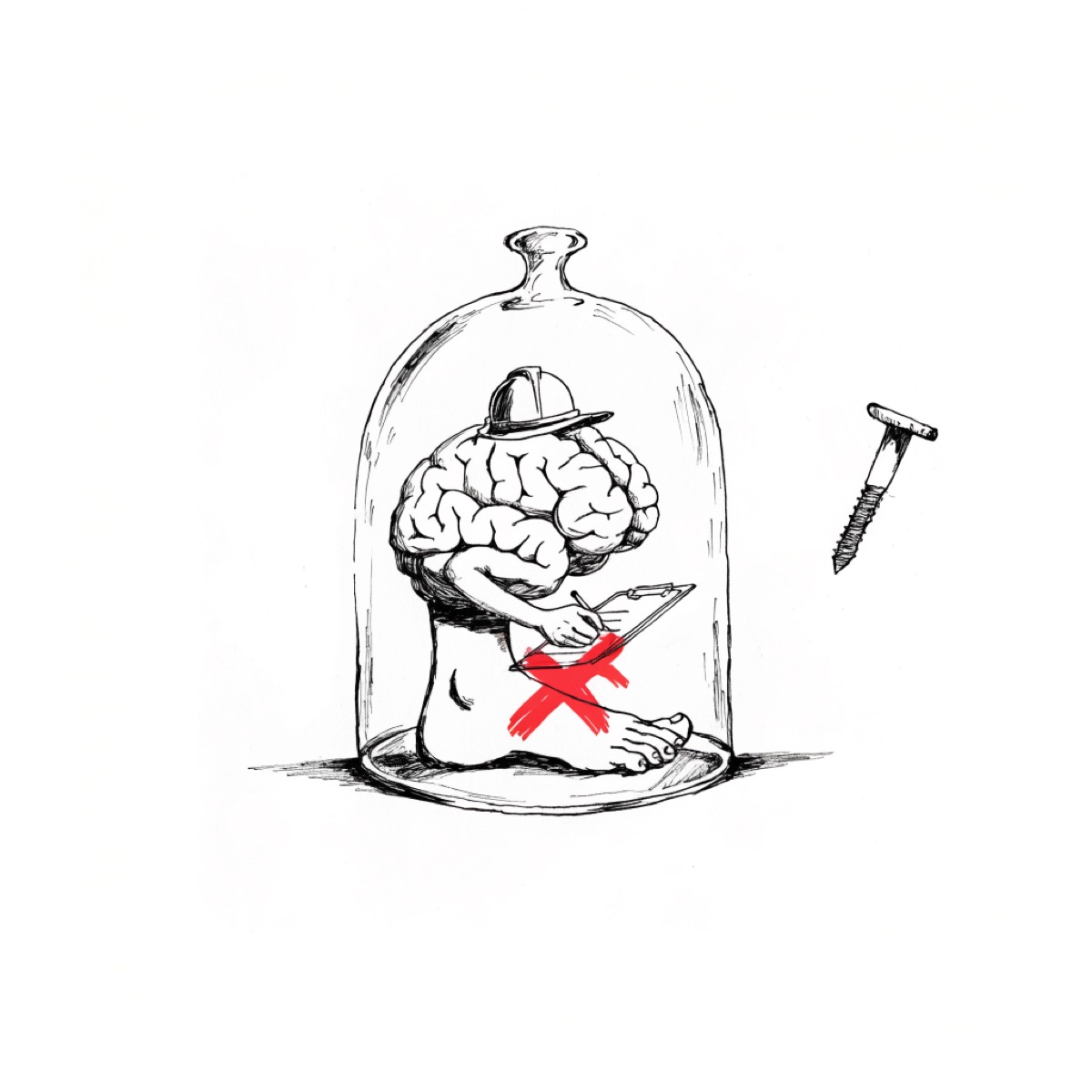
A construction worker arrived at an emergency department in 1995, writhing in such severe pain that he had to be sedated before anyone could remove his boot. When they finally did, they found something astonishing: a six-inch nail had punched straight through the sole—but passed cleanly between his toes, without breaking a single millimeter of skin. The man's body was completely uninjured. His pain, by any measure, was catastrophic.
Now hold that image and consider its mirror. Studies consistently show that roughly 40% of people with clinically confirmed, severe spinal disc herniations—bulging discs pressing against nerves, the kind that look alarming on an MRI—report no meaningful pain whatsoever. The structural damage is documented. The suffering is simply absent.
If pain were a reliable telegram from the body's tissues to the brain, neither of these stories could exist. Something far more complex is clearly running the show—and getting that something wrong has cost millions of people decades of unnecessary suffering.
The Old Model: Pain as a Telegram from the Body
In 1664, René Descartes drew one of the most consequential diagrams in medical history: a boy with his foot near a flame, a thread running from the skin, through the leg, into a bell-shaped structure in the brain. Pull the thread—ring the bell. The logic was beautiful in its simplicity. Damage to tissue sends a signal upward; the brain receives it; you feel pain. Descartes called it animal spirits traveling through hollow nerves.
This "telegraph wire" model quietly governed pain medicine for the better part of three centuries. It generated an equally logical treatment philosophy: find the damaged tissue, block or cut the signal, eliminate the pain. Opioids suppress signal transmission. Nerve blocks interrupt specific pathways. Surgical ablation severs the wire entirely. Each intervention flowed naturally from the model.
The cracks appeared slowly, then all at once. Phantom limb pain—the excruciating, often burning sensation that amputees feel in limbs that no longer exist—is impossible to explain in a telegraph-wire world. There is no tissue. There is no signal. Yet the pain is as real and disabling as any injury. Similarly, patients who undergo surgery to repair structurally damaged backs frequently report pain that is identical in character and intensity to what they felt before the "fix." The wire was repaired. The bell keeps ringing.
The New Model: Your Brain Is a Prediction Machine
The framework that has replaced Descartes' diagram is called predictive processing, and it inverts almost everything we assumed about perception. The brain, in this model, is not a passive receiver waiting for signals to arrive. It is an active hypothesis-generating machine that constantly creates top-down predictions about what sensation should be arriving, then quietly compares those predictions against incoming data. What you perceive is not a live feed from your body. It is the brain's best guess—continuously updated, perpetually provisional.
Pain, specifically, is best understood not as an input to the brain but as a protective output from it. The neuroscientist and pain researcher Lorimer Moseley puts it this way: the brain produces pain the way a government issues an emergency alert—not because a catastrophe is definitely occurring, but because the calculated probability of threat has crossed a threshold the system treats as requiring action. The alarm is a decision, not a measurement.
Moseley's research has been particularly striking on the role of context. The same ankle sprain that produces agony the week after an injury may barely register during the final minutes of a championship game—not because the tissue is any less damaged, but because the brain's threat assessment has shifted. Belief about what the injury means, prior experience with that type of pain, the social environment, even visual cues—all of these feed into the predictive model and reshape its output in real time. Pain is not found in the knee. It is generated in the brain, on the basis of a probabilistic calculation.
Why Chronic Pain Is a Software Bug, Not a Hardware Failure
Acute pain is a spectacularly useful system. It alerts you to damage, motivates rest, protects injured tissue while it heals. In the vast majority of cases, it resolves as the tissue does. But in somewhere between 10% and 20% of acute pain cases, the alarm doesn't switch off when the emergency ends. The prediction model has been over-fitted to threat—trained on repeated danger signals until it treats ordinary inputs as catastrophic. Think of a smoke detector coated in accumulated dust: it triggers reliably on steam from a morning kettle. The sensitivity that once served a purpose has become the problem itself.
This is not a metaphor. It describes a measurable neurological process called central sensitization, in which the nervous system physically remodels itself to become more reactive. The threshold for generating pain signals drops. Neurons that previously required strong stimulation now fire at the gentlest provocation. Functional MRI studies have documented the fingerprints of this process: altered connectivity patterns in the brain's default mode network, a region involved in self-referential processing and, it turns out, in the maintenance of chronic pain states. The software has rewritten the hardware.
Fibromyalgia and complex regional pain syndrome (CRPS) are the clearest examples. Both conditions produce severe, widespread, often debilitating pain. In neither case does rigorous investigation reveal consistent structural damage to peripheral tissue. What researchers do find, reliably, is profoundly altered central processing—a nervous system that has learned to amplify, misattribute, and sustain signals that should have quieted long ago. The pain is neurologically genuine. The body's architecture is largely intact. The bug is in the prediction model, not in the hardware it runs on.
Why Opioids Fail—and What the Science Says About What Works
Here is the pharmacological mismatch at the heart of the opioid crisis: opioids are exceptionally good at suppressing nociceptive signaling—the input side of the pain equation. They bind to receptors in the peripheral and central nervous system and turn down the volume on incoming information. But they leave the predictive model itself completely untouched. The brain's threat-assessment algorithm keeps running, keeps generating its emergency alerts, and finds progressively less signal available to update its predictions from. Over time, a phenomenon called opioid-induced hyperalgesia kicks in—the system, deprived of normal input, lowers its own threshold for pain, making patients more sensitive, not less. The drug designed to solve the problem can entrench it.
What actually updates the prediction model? The emerging answer from pain science is a toolkit that looks nothing like a prescription pad. Pain neuroscience education—simply teaching patients the predictive processing model, explaining that their pain represents a misfiring alarm rather than evidence of ongoing damage—has been shown in randomized controlled trials to reduce pain intensity, disability, and catastrophizing. Changing the belief about what pain means appears to literally change the brain's threat calculation. Graded motor imagery and mirror therapy, developed for phantom limb pain, work by feeding the brain visual information that contradicts its catastrophic predictions, gradually recalibrating the model through evidence. Mindfulness-based stress reduction measurably reduces what researchers call "predictive noise"—the background hum of threat anticipation that keeps the alarm primed.
Perhaps the most striking clinical evidence comes from the research on cognitive behavioral therapy. No such 2011 JAMA study exists (checked Crossref 2009–2013 and Europe PMC for JAMA). The documented JAMA evidence is Cherkin et al. 2016 (JAMA 316:1247), which found CBT and mindfulness-based stress reduction improved chronic low back pain versus usual care — not versus opioids. Reword: "A 2016 JAMA trial (Cherkin et al.) and later meta-analyses found CBT improves chronic low back pain compared with usual care, with far lower risks than long-term opioid therapy; direct CBT-versus-opioid comparisons remain limited." This finding has been replicated. It has not been meaningfully integrated into standard clinical practice. The average chronic pain patient is still far more likely to receive a prescription than a referral to a psychologist trained in pain neuroscience.
The Human Cost of Getting the Theory Wrong
The scale of the mismatch between the science and the standard of care is genuinely staggering. Over 50 million Americans live with chronic pain—more than the number affected by diabetes, heart disease, and cancer combined, according to the CDC. Globally, chronic pain is the leading cause of disability. The annual economic cost in the United States alone, accounting for lost productivity and healthcare expenditure, exceeds $600 billion.
Meanwhile, the opioid epidemic—itself partly a consequence of applying a tissue-damage model to a prediction-model problem—has claimed more than 500,000 American lives since 1999. Patients prescribed long-term opioids for chronic non-cancer pain frequently find themselves tolerant, dependent, and in no less pain than when they started, trapped in a treatment paradigm that was solving the wrong problem. The Cartesian telegraph wire has been expensive to believe in.
The tragedy is not that clinicians acted in bad faith. It is that an intuitive, internally consistent model—damage causes pain; eliminate damage, eliminate pain—was so persuasive that contradictory evidence accumulated for decades before it shifted practice. Descartes' diagram is still, implicitly, the mental model most patients carry into the consultation room, and that most physicians carry with them.
Rethinking What We Owe Pain Patients
The predictive processing model carries an obligation that the old model did not. If chronic pain is a learned pattern—a prediction system that has been trained toward threat and is now over-fitted—then patients are not broken. They are not malingering. They are not "just anxious." They are running software that was shaped by genuine experience and has not yet received the inputs needed to update. The question stops being what is wrong with your body and becomes what has your nervous system learned, and how do we teach it something new?
This reframing has already produced concrete therapeutic progress in pain clinics that have adopted it. Patients at facilities using intensive interdisciplinary pain programs—combining neuroscience education, graded activity, psychological support, and physiotherapy guided by the prediction model—show meaningful improvements in function and quality of life that opioids alone never produced. The model works better because it is targeting the right system.
None of this means the pain isn't real. It is emphatically, neurologically, measurably real. The construction worker's agony was not imaginary. The person with fibromyalgia is not performing suffering for social reward. What the new model tells us is something more respectful, not less: your pain is real and your tissue may not be the problem. Those two facts, far from being contradictory, are the foundation of a more honest and more effective medicine.
The deepest implication of predictive processing may be this: consciousness itself is not a window onto reality. It is a model of reality, built to be useful rather than accurate, pruned and weighted by everything that has ever threatened or protected us. Pain is not the exception to this—it is its most urgent expression. Which means that what we believe about our pain, the stories we tell about what it signifies and whether it will end, are not merely psychological accompaniments to a physical process. They are ingredients in the process itself. The mind does not watch the body suffer from a safe distance. It decides, moment by moment, whether suffering is what the situation requires.