Environment · 6 min read
Why Forest Carbon Credits Often Overstate What They Protect
A single carbon credit—certified, traded, and filed in a corporate sustainability report—may represent a forest that has been logged three times over. The accounting looks clean. The atmosphere is not fooled.
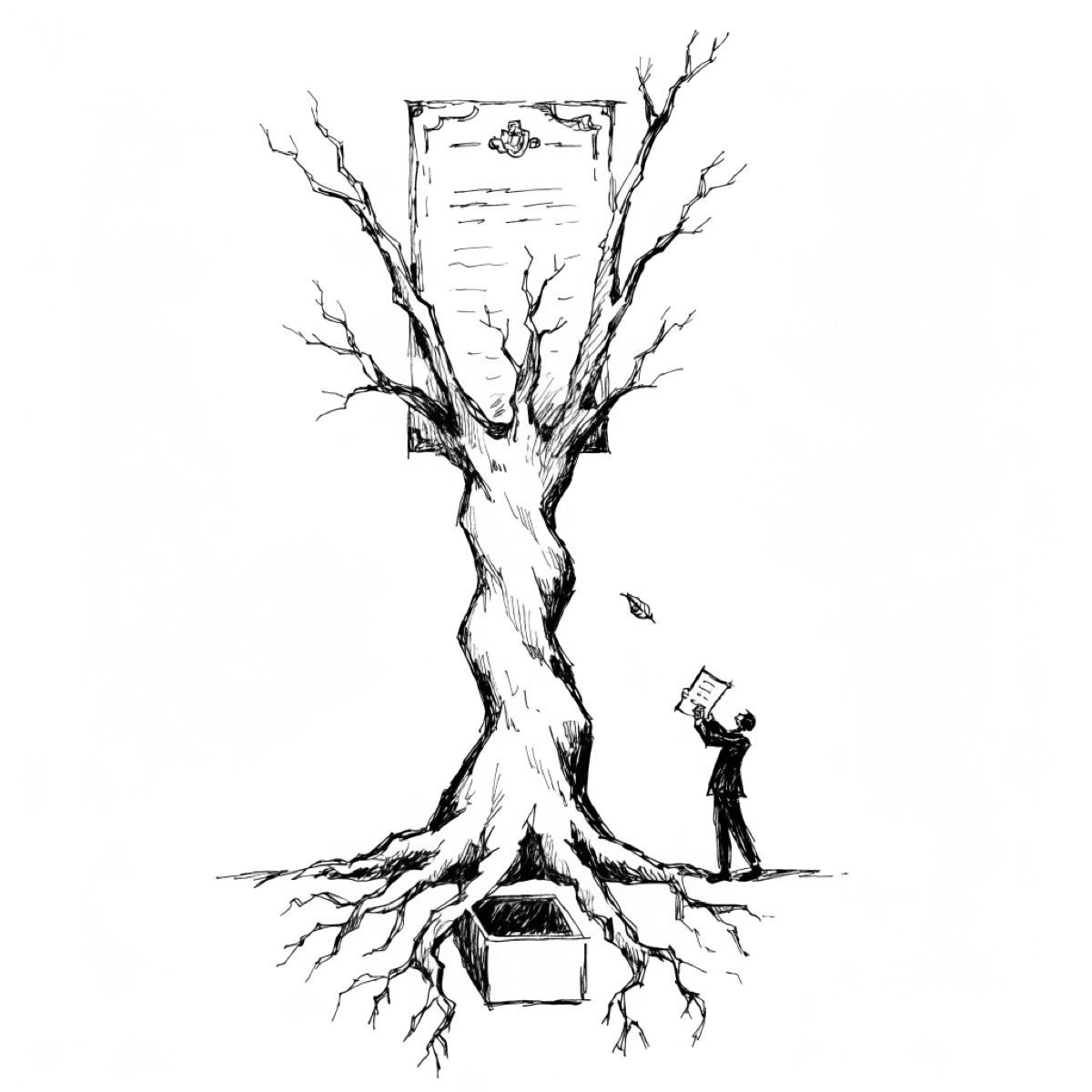
A single credit from a REDD+ project in the Congo Basin arrives in a corporate sustainability report stamped, certified, and valued at exactly one tonne of CO₂ avoided. The forest it represents has been logged, re-logged, and re-protected three times in the past thirty years. Nobody in the transaction chain is lying, exactly. They are all just working within a system whose foundational assumption was wrong from the beginning.
The question worth sitting with is this: is avoiding an emission the same thing as never emitting in the first place? And who decided it was?
Carbon offset markets rest on a single elegant economic idea — that forests are fungible, interchangeable units of atmospheric service. One protected hectare in Borneo cancels one tonne of carbon dioxide from a German power station. The ledger balances. The climate, unfortunately, does not read ledgers.
The Economist's Elegant Simplification
The intellectual architecture traces back to Ronald Coase's landmark 1960 paper, The Problem of Social Cost, which argued that externalities — pollution, environmental damage — could be efficiently managed if property rights were clearly defined and tradeable. Coase didn't design carbon markets, but he handed economists the conceptual toolkit. By 1997, when the Kyoto Protocol introduced the Clean Development Mechanism, those tools had been sharpened into something specific: avoided deforestation as a tradeable commodity.
The model that emerged treated every hectare of forest as a standardized carbon-storage container. Identical in function to every other hectare, regardless of age, species composition, location, or the political stability of the government theoretically protecting it. A century-old primary rainforest and a twenty-year plantation of fast-growing eucalyptus could, within this framework, produce credits of equivalent value.
This wasn't negligence. It was a necessary simplification. Counting individual trees across 180 countries, auditing soil carbon, tracking fungal networks and hydrological cycles — it was impossible. The abstraction was a feature, not a bug. It just happened to be a feature that quietly broke the entire system.
The Forest Is Not a Carbon Tank
A Congolese rainforest is not a carbon tank with bark. It hosts thousands of interdependent species driving soil chemistry, seed dispersal, insect populations, and — critically — rainfall patterns. Protect it on paper and lose it anyway, and you haven't just lost a carbon-storage unit. You've destroyed an irreplaceable ecological engine whose functions we are only beginning to quantify.
One of those functions receives almost no attention in offset accounting: water. Tropical forests generate their own rainfall through transpiration, pumping moisture into the atmosphere in cycles that can extend thousands of kilometers inland. When a "protected" forest degrades — even slowly, even partially — downstream agricultural systems dependent on that moisture can collapse. That collapse has a climate cost, an economic cost, and a human cost. None of it appears on any carbon ledger.
Then there is the permanence problem, which is perhaps the most quietly devastating flaw in the entire architecture. A California redwood forest protected under a carbon contract today can burn in a megafire next decade. A Congolese concession can be re-opened by the next administration tomorrow. Carbon released by either event flows into the same atmosphere the credit claimed to protect — but the credit has already been spent, already counted, already filed.
The Leakage Nobody Counted
When a conservation project draws a line around a patch of forest, it does not make logging unprofitable. It makes logging happen somewhere else. Studies in Brazil and Indonesia have documented spatial leakage rates — the degree to which protected areas simply displace rather than prevent deforestation — ranging from 42% to 90%. The chainsaw moves next door. The net atmospheric benefit shrinks toward zero.
Temporal leakage is subtler but equally corrosive. Credits are issued today for forests whose protection is conditional on political will, funding cycles, and land tenure arrangements — none of which can be guaranteed across the 100-year timeframes carbon accounting requires. The credit is permanent. The protection is not.
Verification bodies audit what they can measure: tree density, biomass estimates derived from satellite imagery, project boundary compliance. They cannot easily audit governance fragility, corruption indices, or the probability that a civil conflict will render a protected area ungovernable within fifteen years. The audit becomes a performance of certainty. It is not certainty itself.
Certified, Auditable, and Largely Fictional
In 2023, a joint investigation by The Guardian, Die Zeit, and SourceMaterial examined the credit portfolio of Verra, the world's largest carbon offset certification body. Their finding was striking: more than 90% of Verra's rainforest offset credits appeared to be "phantom credits" — representing forests that faced no serious deforestation threat in the first place. The avoided deforestation had, in many cases, simply not needed avoiding.
This exposes what may be the deepest structural flaw in the whole enterprise: the counterfactual problem. Every offset is a bet on an alternative history — what would have happened to this forest without the project? There is no scientific methodology robust enough to establish that baseline reliably across complex socio-ecological systems at planetary scale. The number produced is, at best, an educated guess dressed in spreadsheet clothing and given a certification seal.
The commercial function of these credits, however, is entirely real. Companies purchasing them receive legal insulation against climate litigation, boosts to their ESG ratings, and the right to label their products as carbon-neutral or net-zero. The credits do not need to work atmospherically to work commercially. That asymmetry is not an accident. It is the market functioning exactly as designed.
What a Non-Fungible Forest Economy Could Look Like
The critique is damning, but the underlying problem — that deforestation must be slowed, and that wealthy emitters must pay for it — is real and urgent. The question is whether the solution requires abandoning markets or rebuilding them with less convenient assumptions baked in.
Several researchers and policy architects are pushing for differentiated credit classes: a tiering system in which credits carry fundamentally different weights depending on ecosystem type, measured biodiversity, political stability, verified co-benefits to local communities, and demonstrated permanence over time. A credit from a primary Amazonian rainforest under indigenous land tenure would not be equivalent to one from a managed plantation in a country with weak regulatory enforcement. The price difference would be massive — and that's the point.
Jurisdictional approaches offer another path. Rather than certifying individual projects, this model ties payments to national-level deforestation rates, making entire governments responsible for outcomes rather than creating isolated green islands surrounded by uncounted destruction. Norway's bilateral agreements with Brazil and Indonesia — paying for verified, country-wide emissions reductions — represent an early version of this logic.
Neither approach is elegant in the Coasian sense. Both require more data, more political negotiation, and less comfortable certainty in the final number. They are harder to file in a sustainability report.
The carbon credit was designed to solve a coordination problem between complex economies and complex ecosystems by treating the ecosystems as simple. That simplification bought twenty years of market infrastructure, corporate adoption, and policy momentum. It may also have bought twenty years of atmospheric complacency. The forest was never a tank. It was always a civilization — and we've been charging by the barrel.