Health · 7 min read
Why the Annual Physical Persists Despite Weak Evidence
The annual physical exam feels like timeless medical wisdom — but it was invented by a life insurance company in 1913, and decades of clinical trials suggest it may do more harm than good. Here's how a commercial product became sacred medicine, and what science actually recommends instead.
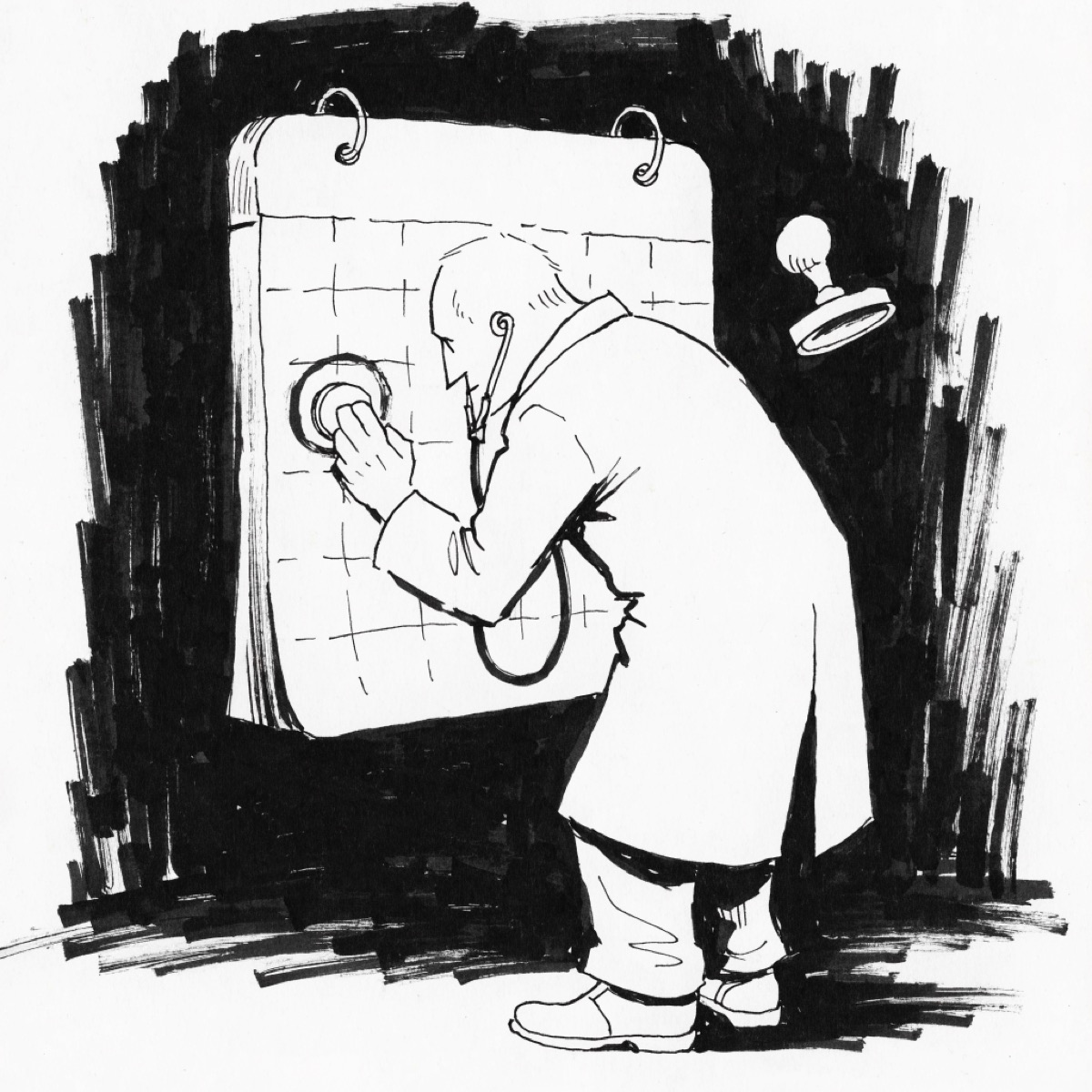
Picture a waiting room in early January. You're holding a clipboard, transferring your medical history onto yet another form, preparing for the oddly ceremonious experience of the annual physical — something between a religious confession and a car inspection. The doctor will listen to your heart, tap your knees, press your abdomen, and declare you either fine or in need of further investigation. It feels ancient. It feels authoritative. It feels, above all, like something medicine must surely have figured out long ago.
It hasn't. Americans spend an estimated $10 billion per year on routine annual physicals, making it one of the most expensive medical traditions with the least clinical justification. The yearly checkup isn't ancient wisdom — it was invented by actuaries, not physicians. And the science has been quietly dismantling it for decades.
A Salesman's Idea, Not a Doctor's Order
The annual physical was born not in a hospital but in a boardroom. In 1913, a commercial venture called the Life Extension Institute opened its doors in New York, backed by life insurance companies with a straightforward business interest: assess policyholder risk and sell corporate wellness programs to industrialists who wanted to know whether their employees were healthy enough to be worth insuring.
The institute's medical director, Eugene Lyman Fisk, became the evangelist for what he called the "periodic health examination." Fisk promoted the concept with the energy of a product launch, gathering testimonials from executives and industrialists rather than designing clinical trials to test whether the exams actually improved health. The pitch was compelling — find problems before they find you — but the evidence base was, to put it charitably, nonexistent.
The American Medical Association endorsed the concept in 1922, not after reviewing trial data but largely in response to public enthusiasm and, crucially, the professional opportunity the checkup created for general practitioners. Here was a reason to schedule visits with healthy people. The AMA's endorsement gave the commercial invention a medical imprimatur, and that combination — public appetite plus professional incentive — proved nearly impossible to dislodge.
How a Scheduling Artifact Became Sacred Medicine
After World War II, the checkup stopped being a product and became an institution. Employer health benefits, insurance reimbursement codes, and public health campaigns during the 1950s and '60s wove the annual physical into the financial and bureaucratic infrastructure of American medicine, making it self-perpetuating in a way that had nothing to do with its clinical merit.
The psychology reinforced it. Annual cadence mimicked familiar rhythms — tax season, school enrollment, the car going in for its service — making the checkup feel medically rational even in the absence of evidence. Regularity got confused with efficacy. Something done every year must be worth doing every year.
Once the annual physical was coded into billing systems, taught in medical schools as standard of care, and expected by patients, questioning it became professionally awkward. A doctor who challenged it wasn't raising a scientific objection — they were disrupting a ritual. This is a near-perfect case study in how institutional inertia shapes clinical practice: the infrastructure built around a practice becomes the primary argument for the practice's continuation.
What Fifty Years of Randomized Trials Actually Show
The evidence, when researchers finally gathered it systematically, was not kind to the annual physical. The 2012 Cochrane Review — a landmark meta-analysis of 14 randomized controlled trials covering more than 182,000 patients — found that general health checks did not reduce mortality. Not overall death rates. Not deaths from cardiovascular disease. Not deaths from cancer. The annual physical, at scale, wasn't saving lives.
Part of the problem is what researchers call the "incidentalome" — the ecosystem of false positives and incidental findings that routine physicals reliably produce. When you examine a healthy person head to toe and run a standard battery of tests, you will find things. Shadows on imaging. Borderline values. Ambiguous lumps. These findings trigger cascading tests, procedures, anxiety, and in some cases unnecessary treatment — turning healthy people into patients without measurably improving their outcomes. The harm isn't dramatic; it's diffuse, expensive, and largely invisible.
The U.S. Preventive Services Task Force — the independent panel that evaluates preventive care — does not recommend the general physical exam for asymptomatic adults. What the evidence does support is something entirely different: targeted, age- and risk-specific screenings. A 45-year-old getting a colorectal cancer screen. A hypertensive patient having blood pressure monitored regularly. A smoker being counseled on cessation. These are not components of a routine physical; they are a different model of care altogether.
Why Smart, Well-Meaning Doctors Still Schedule Them
To be fair to physicians who continue scheduling annual physicals, some of their arguments have genuine merit. The yearly visit is often the only sustained interaction a doctor has with a patient. It's a chance to update medication lists, catch symptoms the patient hasn't mentioned, screen for depression and domestic stress, and build the kind of relationship that makes patients more likely to seek care when they actually need it. These are real functions. They just don't require a full head-to-toe physical exam to accomplish.
The financial incentives are less defensible. Hospitals and health systems depend on the revenue stream that annual wellness visits generate. Primary care practices use them as scheduling anchors that keep patient panels stable. Insurers cover them at 100% not because the evidence demands it but because the perception of prevention is a powerful marketing tool — people feel better about their insurer when it covers something that feels wholesome and responsible.
Then there's the most underappreciated force in the room: patient expectation. People arrive wanting to be examined. They want the stethoscope on the chest, the reflex hammer on the knee, the doctor's hands pressing their abdomen. A physician who skips these steps risks seeming negligent — not because the steps are clinically necessary, but because patients have been trained for a century to expect them. In the exam room, patient expectations can override clinical evidence with remarkable ease.
What Should Replace the Annual Physical
The evidence-based alternative isn't no care — it's risk-stratified, interval-based care calibrated to what actually works. Colorectal cancer screening starting at 45. Blood pressure checks every one to two years for adults with normal readings. Lipid panels triggered by risk factors, not the calendar. Depression screening during primary care visits. These interventions have evidence behind them; they are targeted, not theatrical.
Some health systems have already made this shift. Kaiser Permanente and certain NHS models in the UK use structured prevention checklists that take around 20 minutes and target only interventions with proven benefit — achieving better outcomes at lower cost than the traditional hour-long physical. The model works by separating what's clinically necessary from what's culturally expected, which turns out to be a surprisingly difficult separation to make.
The language matters, too. Patients need a way to ask for evidence-based preventive care without feeling like they're being reckless about their health. The reframe that helps: surveillance means monitoring known risks in specific populations with proven screening tools. Ritual means doing something annually because it feels responsible. Medicine needs to offer more of the former and less of the latter — and patients who understand the distinction are in a far better position to ask for the right kind of care.
The Deeper Lesson About Medical Authority
The history of the annual physical is really a story about how medical authority and commercial interest can fuse so completely that the seam disappears. Fisk's insurance-backed product became an AMA-endorsed standard became a billing code became a cultural ritual — and at each step, the lack of evidence mattered a little less than the momentum of the step before.
This pattern repeats throughout medicine. Practices get institutionalized before they get tested, and once they're embedded in infrastructure, professional identity, and patient expectation, the bar for dislodging them becomes impossibly high. The science isn't the problem; scientists figured out the annual physical's limitations decades ago. The problem is that medicine is also a social institution, and social institutions run on legitimacy and habit as much as evidence.
The most unsettling thing about the annual physical isn't that it doesn't work. It's that it didn't need to work to become mandatory. Which raises an uncomfortable question worth sitting with the next time you find yourself in that January waiting room, clipboard in hand: how many other things in medicine feel like science but are actually just very old habits that got there first?