Literature · 6 min read
How Critical Readings of Nella Larsen's Passing Expanded After 1929
How republication and new critical questions broadened readings of Passing without resolving its deliberately uncertain ending.
How Critical Readings of Nella Larsen's Passing Expanded After 1929
Nella Larsen's Passing follows Irene Redfield's renewed contact with Clare Kendry, a childhood acquaintance who lives as white and is married to a white man who does not know her ancestry. Published by Alfred A. Knopf in 1929, the novel received serious contemporary notice but did not remain continuously central to American literary study. Its critical position changed after Black studies, feminist criticism, and the recovery of Harlem Renaissance writing brought it into new editions and classrooms.
The later attention did more than declare an overlooked book important. Critics asked different questions about narration, marriage, desire, class, and the final scene. That range is grounded in the novel's controlled uncertainty, but the history of interpretation should not be simplified into an ignored masterpiece suddenly understood in one correct way.
A novel built around unstable knowledge
Most of the narrative stays close to Irene, a Black physician's wife living in Harlem. Her perception organizes what readers learn about Clare, Irene's husband Brian, and the social circle around them. Yet Irene's inferences are not consistently confirmed. She watches, suspects, remembers, and revises. Larsen's third-person narration creates intimacy with Irene's thought without granting it neutral authority.
Passing operates on several levels. Clare crosses the socially enforced color line in daily life. Irene can pass situationally, as in the opening encounter at a whites-only hotel, but returns to a Black identity and community. Brian speaks of leaving the United States for Brazil. The novel also depicts forms of social performance within marriage, motherhood, class, and respectability. The title names a racial practice directly while allowing critics to examine adjacent acts of concealment and belonging.
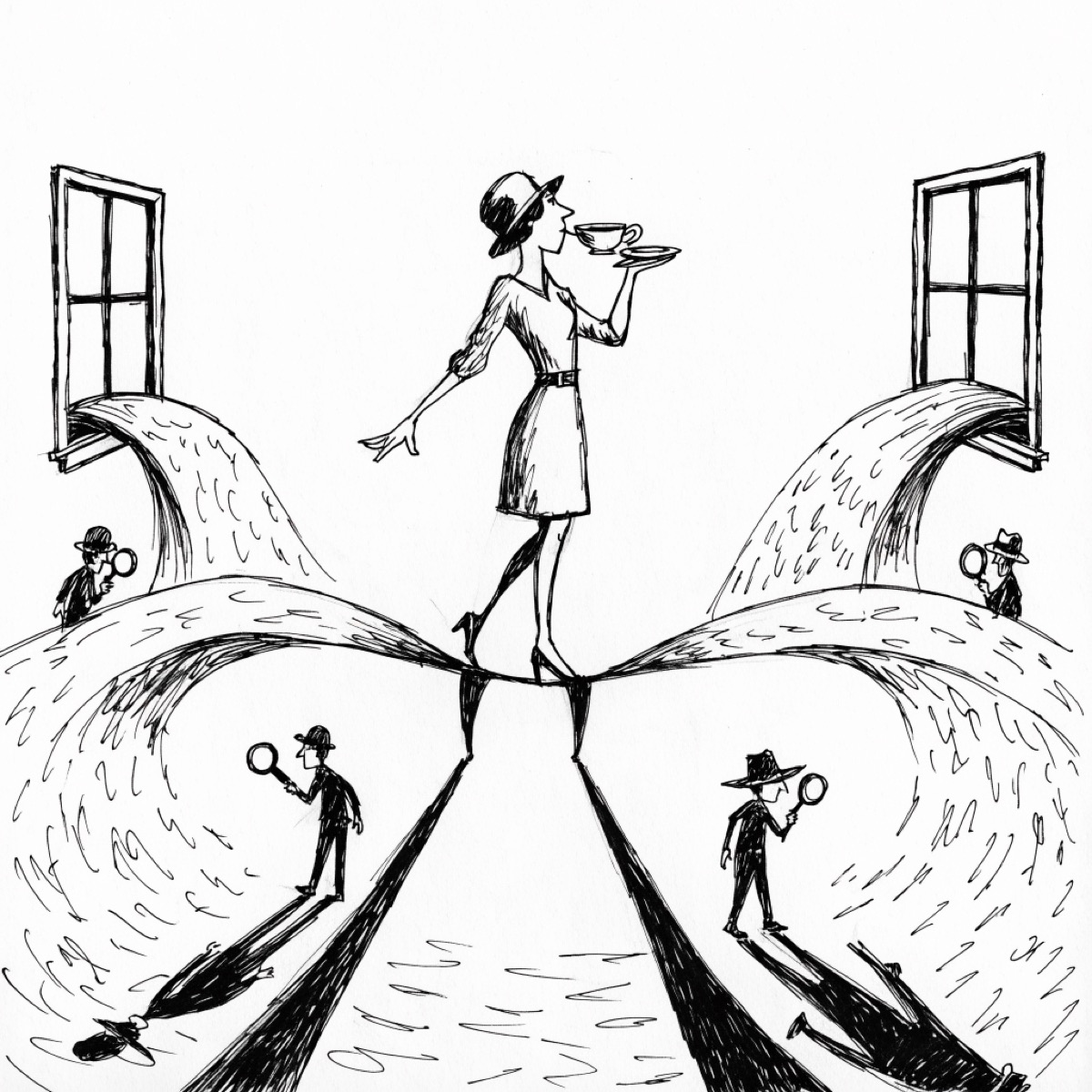
The final party concentrates the uncertainty. After Clare's husband discovers her racial identity, Clare falls from a high window. The text does not settle whether she jumps, is pushed by Irene, is pushed by her husband, or falls accidentally. Irene's fragmentary perception and physical position permit suspicion without supplying a courtroom account. Any interpretation must explain both the evidence pointing toward Irene's agency and the narration's refusal to confirm it.
Contemporary praise did not create lasting circulation
Larsen had published Quicksand in 1928 and received the Harmon Foundation's bronze award for literature. Passing appeared the following April. Contemporary reviewers recognized her control and psychological focus, though they differed over the plot and treatment of racial passing. Alice Dunbar-Nelson's review in The Washington Eagle praised Larsen's second novel. Other notices treated its ending as melodramatic or its subject as socially narrow.
The reception needs calibration. Larsen was neither unknown nor uniformly celebrated. Knopf issued small printings, and sales were modest by mass-market standards. She received a Guggenheim Fellowship in 1930, the first awarded to an African American woman, evidence of institutional recognition. After a plagiarism accusation concerning her short story “Sanctuary” and the rejection of a later novel, she published little more. She eventually returned to nursing and died in 1964.
It is tempting to make one controversy explain her withdrawal, but biographical evidence does not support a single cause. Larsen's marriage ended; her literary network changed; publishing opportunities narrowed during the Depression; and her proposed work did not reach print. The surviving record cannot reconstruct every private decision. Her books became difficult to obtain, while anthologies and literary histories often centered other Harlem Renaissance figures.
Recovery changed the questions critics asked
The growth of Black studies and feminist literary scholarship in the 1970s and 1980s altered what universities collected and taught. Claudia Tate's 1980 essay called Passing “a problem of interpretation,” emphasizing that the apparent racial plot does not exhaust Irene's psychological conflict. Cheryl Wall examined the relationship between passing, identity, and the constraints placed on Black women in Larsen's novels.
Deborah McDowell's 1986 Rutgers University Press edition of Quicksand and Passing was especially consequential. Its introduction situated Larsen within the Harlem Renaissance while reading sexuality and gender as central rather than supplementary. Rutgers identifies the volume as one of its enduring bestsellers. Availability mattered: a teachable edition placed both novels in classrooms and gave later critics a shared textual and bibliographic point of reference.
Thadious Davis's 1994 biography, Nella Larsen, Novelist of the Harlem Renaissance, reconstructed family, employment, publishing, and social contexts from archival evidence. Biography corrected earlier errors and showed how Larsen's Danish West Indian mother, mixed family, library work, nursing, and Harlem affiliations informed but did not mechanically dictate her fiction.
Later scholarship connected the novel to modernism, queer reading, affect, law, and histories of racial classification. Adaptations, including Rebecca Hall's 2021 film, created another interpretive object: a film can foreground looks, sound, and bodies where prose preserves interior uncertainty. Adaptation renewed attention but should not be used as evidence for what the 1929 text unambiguously means.
Ambiguity supports several readings but not any reading
One line of criticism treats Irene's desire for security as the narrative motor. Clare threatens a carefully maintained household because she is mobile, charismatic, and willing to cross boundaries. Irene fears an affair between Clare and Brian, but the text never directly confirms one. Her jealousy may disclose events, distort them, or both.
Queer readings focus on the intensity and physical detail of Irene's attention to Clare. McDowell argued that the novel's sexual subtext complicates the overt racial plot. Such readings do not require labeling a fictional person with a settled modern identity. They trace desire, repression, and the language through which Irene apprehends another woman. Critics disagree over whether erotic attraction, identification, rivalry, or a combination best accounts for the pattern.
Another debate concerns Clare's agency. A reading centered only on tragic punishment can reproduce the convention that a person who passes must be exposed and removed. Yet Clare actively seeks contact with Harlem and accepts risk; she is not merely an abstract symbol. Irene, too, is more than a stable opposite. She sometimes passes, suppresses information, and attempts to manage Brian's and her sons' knowledge.
Race remains structurally central. The danger comes from a legal and social order that assigns rights, safety, and kinship through racial categories while allowing appearance to make those categories unstable. Gender and class do not replace that structure. The strongest interpretations show how the categories constrain one another rather than announcing that the book is “really” about only one.
Not all ambiguity is limitless. The narration provides dates, places, actions, and repeated motifs. A claim that John Bellew knowingly supports Clare's passing, for example, conflicts with his racist speech and shock. A claim that the ending identifies a killer overlooks its syntax and interrupted perception. Critical pluralism remains accountable to words on the page and to historical evidence.
What critical history can establish
Publication records and reviews establish that Passing had an attentive but bounded reception in 1929. Edition history and scholarship show a marked expansion of critical attention in the later twentieth century, with the 1986 Rutgers edition serving as an important vehicle. Later critics did not simply add prestige; they made narrative unreliability, sexuality, domesticity, and overlapping social performances harder to exclude from interpretation.
What remains contested is how those elements should be weighted and what occurs at the window. Larsen designed the focalization so that certainty is unavailable. The novel's recovery is therefore not a story in which new scholarship solves an old text. It is a history of better access and broader questions, bounded by an ending whose missing fact is part of the work's form.
Sources
5 sources, 2 of them with a link you can follow.
- Nella Larsen, Passing (Alfred A. Knopf, 1929).
- Deborah E. McDowell, introduction to Quicksand and Passing (Rutgers University Press, 1986).
- Claudia Tate, “Nella Larsen's Passing: A Problem of Interpretation,” Black American Literature Forum 14 (1980), doi:10.2307/3041665.
- Cheryl A. Wall, “Passing for What? Aspects of Identity in Nella Larsen's Novels,” Black American Literature Forum 20 (1986), doi:10.2307/2904554.
- Thadious M. Davis, Nella Larsen, Novelist of the Harlem Renaissance (Louisiana State University Press, 1994).