Art · 7 min read
How Rhythmic Cues Help Parkinson's Patients Walk
A Parkinson's patient stands frozen mid-stride in a hospital corridor, feet locked, brain unable to fire the next command—until a therapist taps a beat on a drum pad, and he walks. What happens next reveals that music isn't decoration for the human nervous system: it's part of the foundation.
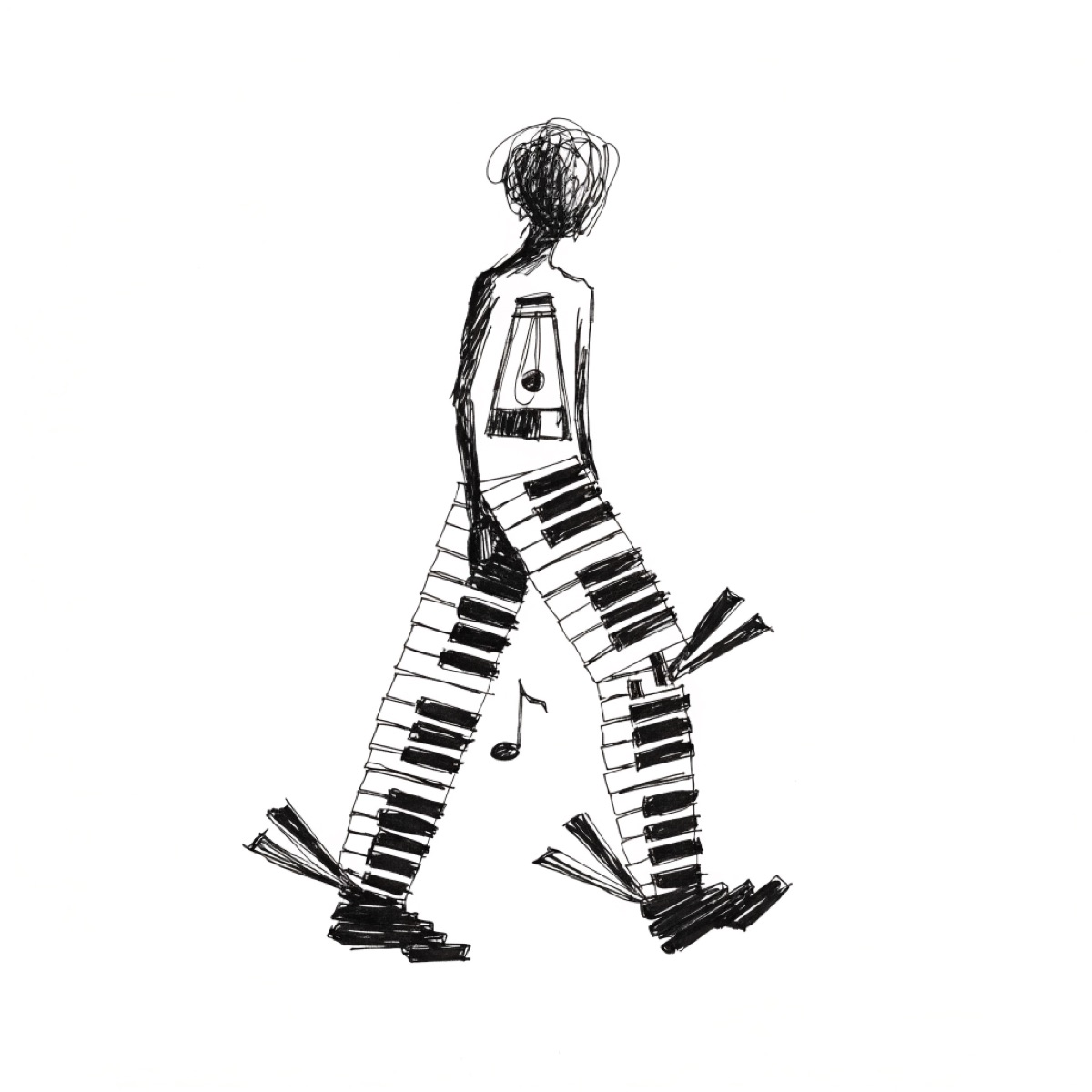
He is standing in the middle of the corridor, going nowhere. His feet are planted on the linoleum as though nailed there, his upper body leaning forward, arms slightly raised—the posture of a man who has told his legs to move and received no answer. A physical therapist crouches beside him, sets a small drum pad on the floor, and begins to tap. One beat, two beats, a steady pulse. Within seconds, his feet begin to lift, his stride resumes, and he walks the length of the hallway as though nothing had happened.
The neurological damage hasn't changed. His muscles are exactly as they were. What changed was the air around him—a pattern of sound pressure waves, organized into a beat—and somehow that was enough to reorganize a broken system and restore motion.
This is not a feel-good anecdote. It is a crack in the wall between art and biology, and if you look through it carefully, you can see something that rewrites what we thought art was for.
The Frozen Body: What Parkinson's Reveals About Movement
Parkinson's disease is typically described as a movement disorder, which is accurate but incomplete. The deeper problem is a timing disorder. As the dopaminergic neurons of the substantia nigra degrade, they disrupt the basal ganglia—a cluster of subcortical structures that, among other functions, serve as the brain's internal metronome, generating the rhythmic timing signals that sequence voluntary movement. Without those signals, movement doesn't simply slow down. It can stop entirely.
This is what clinicians call "freezing of gait," or FOG—a sudden, transient inability to initiate or continue walking. The muscles are capable. The motor pathways are mostly intact. The wiring is there; the pulse is gone. It is, in a precise sense, a failure of rhythmic infrastructure.
The clinical stakes are serious. FOG affects roughly 50 percent of Parkinson's patients in later disease stages and is one of the leading causes of dangerous falls. A patient who freezes on a staircase, near traffic, or in a crowded public space faces real physical peril. Any intervention that reliably interrupts or prevents FOG isn't a curiosity—it's medically significant.
The Intervention: Rhythmic Auditory Stimulation
Rhythmic Auditory Stimulation, or RAS, is not simply playing music for patients. The term refers to a specific clinical technique: structured auditory input with a metronomic pulse, calibrated to slightly exceed the patient's natural—and degraded—walking cadence. Typically, the target tempo is set 10 to 15 percent faster than the patient's baseline gait, creating a gentle forward pull on the system.
The evidence for its effectiveness is substantial. Neuroscientist Michael Thaut and his colleagues at the University of Toronto have spent decades documenting what happens when Parkinson's patients are exposed to RAS. Their work, supported by multiple meta-analyses of RAS trials, shows measurable improvements in stride length, walking speed, and cadence symmetry—sometimes within a single session. These are not marginal effects. Some patients who could barely shuffle while freezing repeatedly can walk with near-normal gait patterns while an external rhythm is present.
What makes this genuinely remarkable is the mechanism. RAS works by recruiting the auditory-motor pathway—a neural route projecting from the auditory cortex directly into motor planning regions, including the supplementary motor area and the cerebellum. This pathway does not run through the basal ganglia. The rhythm is not restoring the broken circuit; it is routing around it entirely. There is no pharmaceutical equivalent to that. No drug currently available builds a detour around damaged basal ganglia and restores functional gait timing in minutes.
The Neural Bypass: Why Rhythm Has Its Own Highway
To understand why this detour works, it helps to understand what it is made of. Neurons in the auditory cortex do not merely detect beats—they fire in synchrony with them, locking onto external rhythmic pulses with remarkable precision. These synchronized signals travel downstream to motor planning regions, particularly the supplementary motor area and the cerebellum, which together can coordinate movement sequences without needing the basal ganglia's internal timing signal. The external beat, in effect, becomes a borrowed internal metronome.
Why does this pathway exist? The most compelling evolutionary account ties it to vocal learning. The ability to synchronize motor output with auditory input—essential for mimicking sounds, and ultimately for language—appears to require exactly this kind of tight auditory-motor coupling. Animals with vocal learning circuitry, including humans, parrots, cetaceans, and some other species, tend to show spontaneous rhythmic entrainment. Animals without it largely do not. This suggests the auditory-motor highway is not a general-purpose sound processing feature but a specific adaptation, ancient and conserved, wired into the brain long before culture existed to use it.
The conceptual pivot here is significant. If rhythmic entrainment is a product of this ancient biological architecture, then the capacity to lock onto an external beat is not a learned cultural skill that humans happen to have developed. It is a biological default—something the brain is structurally built to do. Rhythm isn't something we imposed on biology. Biology invented rhythm first, and culture found it waiting.
Art as Neurological Calibration: The Harder Implication
The standard humanities account of art treats it as something layered on top of cognition. Art expresses emotion, represents experience, constructs meaning, communicates culture. All of these frameworks, whether structuralist or psychoanalytic or anthropological, share a foundational assumption: that art is something human minds do with the material of experience, an elaboration, a luxury layer that sits above the basic business of survival and function.
The Parkinson's data pushes hard against this assumption. If rhythmic structure can reroute neural signaling and restore motor function—if it operates at the level of neural timing and pathway recruitment—then rhythm is not decoration. It is infrastructure. And if rhythm is infrastructure, then art forms built around rhythmic structure may have evolved not merely as communication but as calibration—mechanisms by which nervous systems tune, synchronize, and maintain coherence.
Think about what this might mean beyond music. Meter in poetry imposes a temporal pattern on language, organizing the listener's neural processing into rhythmic windows. Tempo and repetition in dance coordinate bodies across shared time. Perspective in visual art structures the spatial processing of a scene, creating a coherent and navigable perceptual order. Narrative arc—tension, release, resolution—maps onto the nervous system's anticipation and reward machinery with extraordinary precision. Ask yourself: what if aesthetic pleasure, at least in part, is the sensation of a nervous system clicking into alignment? What if beauty is partly what calibration feels like from the inside?
The Broader Evidence: Rhythm's Reach Across the Body and Brain
The picture that emerges from Parkinson's research is not an isolated phenomenon. Rhythmic music has been shown to reduce perceived exertion during exercise—Costas Karageorghis's research at Brunel University has documented this effect across multiple sports and physical tasks, with some studies showing reductions in perceived effort of up to 12 percent. In post-stroke rehabilitation, rhythmic auditory cuing accelerates the recovery of motor function in patients whose damage, like Parkinson's, involves timing circuitry. In pain research, music has demonstrated measurable analgesic effects in clinical settings, reducing the need for pharmaceutical intervention after surgery and during procedural discomfort.
Perhaps most striking is what happens between people. Studies measuring heart rate and breathing patterns among listeners attending the same live music performance have found physiological synchronization across audience members—people who are strangers, sitting separately, begin to breathe and pulse in coordinated rhythms as the music organizes them into a shared temporal experience. The rhythm is not just inside the nervous system. It propagates between nervous systems.
Then there are the infants. Neonates as young as two to three days old show neural entrainment to rhythmic beats, locking their brain oscillations to an external pulse before any cultural exposure is possible. This is not something they learned from their parents or their culture. It is there from the beginning, suggesting the substrate is prenatal—built before birth, waiting for beats to synchronize with. And outside the human world, parrots and some other vocal learners spontaneously entrain to musical rhythms, bobbing and swaying in time—not because they appreciate music in any cultural sense but because they share the vocal-learning circuitry that appears to be rhythm's neurological home.
What the Walking Patient Teaches Us
Return for a moment to that hospital corridor. The man is frozen. His basal ganglia cannot generate the timing signal his legs need. Then a beat starts, and his auditory cortex locks onto it, and the signal travels a different road, reaches the motor planning regions, and his feet lift. He walks.
What just happened is not a miracle, and it is not merely a medical curiosity. It is a demonstration, made visible by pathology, of something that was always true: the human nervous system does not experience rhythmic structure as ornamentation. It uses it. The brain reaches for external beats the way a drowning person reaches for a rope—not because the rope is beautiful, though it might be, but because the biological architecture was built to grab it.
We have long described art as a reflection of what it means to be human. The more interesting possibility, suggested by a man walking down a hallway because someone tapped a drum, is that art is partly how being human is maintained—a set of tools the nervous system has always used to tune itself, synchronize with others, and stay coherent in a noisy world. We didn't invent music and then discover it was good for us. We were already built for it. The art came later. The biology was always there, waiting to be asked the right question.