Culture · 6 min read
How Standard Time Moved from Railway Timetables to Public Clocks
Railways, telegraphy, observatories, and law made shared clock time a public standard in stages.
How Standard Time Moved from Railway Timetables to Public Clocks
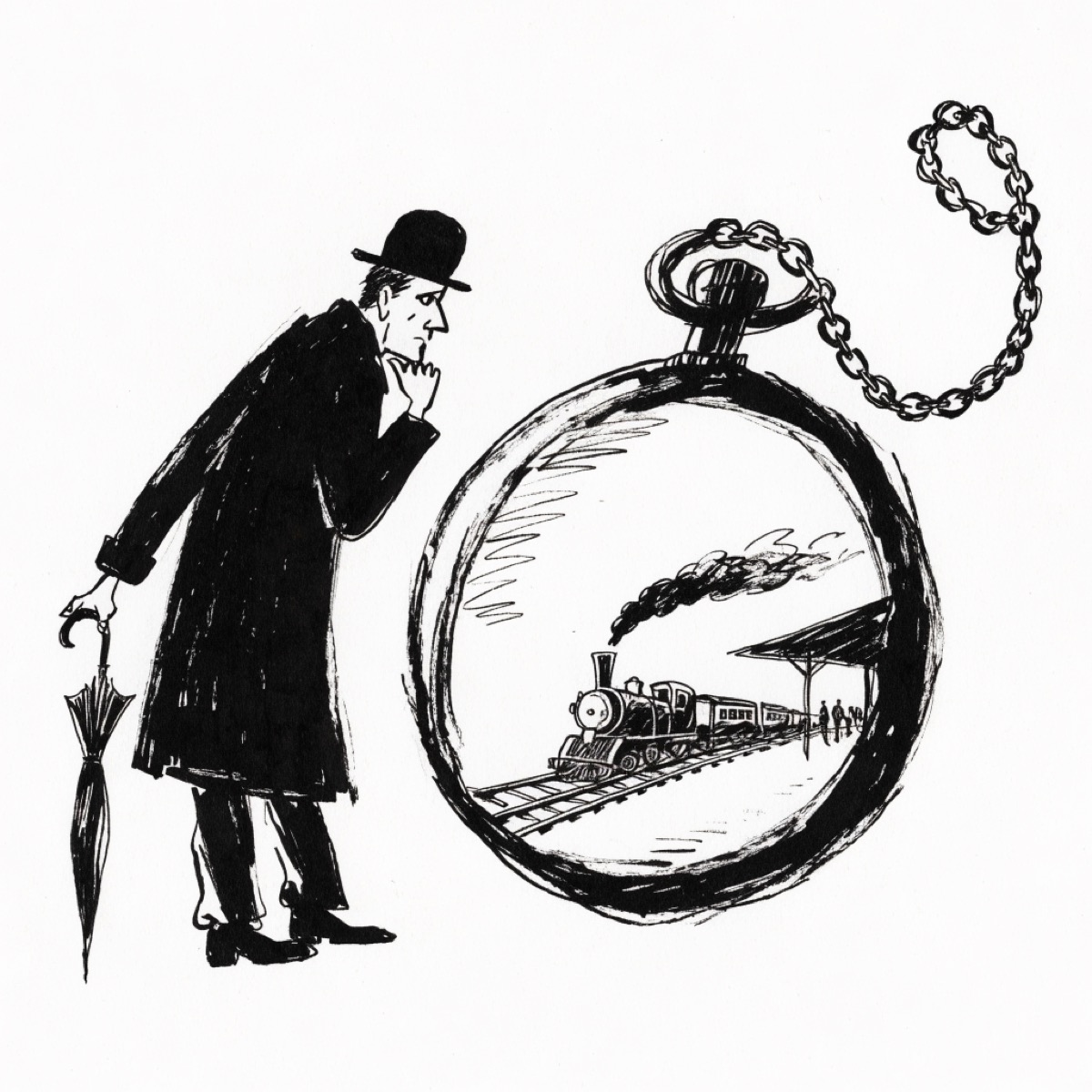
For most of human history, noon was a local observation: the moment when the Sun reached its highest point in a particular sky. A town could set a public clock from that event without needing to agree with a town farther east or west. The arrangement became costly when railways connected places whose clocks differed by minutes. A timetable could list each locality's time, but every added connection increased the opportunity for a missed train, a mistaken dispatch, or an unsafe movement on a shared track.
Standard time emerged from that coordination problem. It was not created in a single conference or imposed on the world at once. Railways, telegraph companies, observatories, governments, and ordinary clock users adopted shared time in different sequences. The familiar map of zones is the result of those negotiations, not a direct transcription of astronomy.
Local noon worked at local speed
Earth turns 360 degrees in about 24 hours, so a difference of one degree of longitude corresponds to roughly four minutes of mean solar time. Before rapid transport, that difference was often inconsequential. A traveler could reset a watch on arrival, and civic life could follow a church, town-hall, or observatory clock.
Mechanical clocks already separated daily timekeeping from direct observation of the Sun. Mean solar time smooths the seasonal variation in apparent solar days, and observatories calculated and distributed increasingly precise time. Yet a shared clock still needed a reason and a channel. The railway supplied the reason; electrical telegraphy supplied a channel fast enough to make distant synchronization practical.
Britain offers an early sequence. Railway companies increasingly used Greenwich time in their schedules during the 1840s, while towns did not immediately abandon local time. A station clock might show railway time while a nearby public clock retained local time. The distinction matters: an operating standard can become common before civil law catches up.
A timetable became a network standard
Railways changed the scale of the problem. Trains had to pass, meet, and clear one another on infrastructure where a few minutes could matter. Companies could use their own standards, but passengers and connecting lines then had to translate among them. Telegraph signals allowed a reference clock to be transmitted along the same corridors that trains used.
North American railroads faced a particularly fragmented system. The Smithsonian National Museum of American History's timekeeping collection documents schedules before and after standard railway time, showing how a zone-based scheme simplified publication. On November 18, 1883, major United States and Canadian railways shifted to coordinated standards based on meridians one hour apart. The contiguous United States used Eastern, Central, Mountain, and Pacific railway time.
This was a private operating agreement, not then a federal statute. The distinction corrects a durable short version of the story in which governments invented zones and railways obeyed. The railways had both the incentive and organizational machinery to move first. Cities and businesses often followed because a clock out of step with the transport network imposed daily friction.
The change was substantial without being uniform. Local authorities retained control of many public clocks, communities adopted at different rates, and the borders of zones were adjusted for commerce and administration. Astronomical longitude suggested a neat geometry; institutions produced irregular boundaries.
The 1884 conference chose a reference meridian
The International Meridian Conference met in Washington, D.C., in October 1884 with delegates from 26 nations. Its proceedings state the purpose as choosing a common zero of longitude and standard of time-reckoning. Delegates recommended the meridian through the Greenwich Observatory as the initial meridian and defined a universal day beginning at mean midnight at Greenwich.
The conference did not legislate the world's civil time-zone map. Its fourth resolution explicitly left the use of universal time for local purposes to national discretion. The Smithsonian's Time and Navigation project consequently describes the meeting's recommendations as contributing to gradual adoption. France, for example, did not promptly reorganize its civil time language around Greenwich.
This narrower account makes the conference more, not less, intelligible. Navigation, mapping, astronomical observation, and international communication benefited from a common reference even where local clocks remained politically controlled. A prime meridian provided a coordinate system. It did not determine whether a country should keep one time, several times, daylight saving, or an offset chosen for economic reasons.
Public time followed through law and habit
In the United States, federal law arrived decades after railway practice. The Standard Time Act of 1918 established standard zones in law and also introduced national daylight-saving provisions. The National Institute of Standards and Technology notes the 34-year interval between the 1884 conference and federal statutory recognition. The Bureau of Transportation Statistics now maps boundaries defined through federal regulation, but those boundaries still reflect political and commercial choices as well as longitude.
Other countries followed their own paths. Some states chose a single national time despite spanning several astronomical zones. Others used offsets of 30 or 45 minutes. Empires carried metropolitan standards into colonial administration, and later governments sometimes revised them to signal political alignment or simplify domestic coordination. These cases show why a zone should be understood as a rule for civil clocks rather than a natural region.
The physical source of the time also changed. Nineteenth-century standards depended on astronomical observation of Earth's rotation. Twentieth-century atomic clocks made it possible to realize the second more uniformly. Coordinated Universal Time, or UTC, combines atomic timekeeping with occasional leap-second adjustments intended to keep it near time derived from Earth's rotation. NIST and the U.S. Naval Observatory maintain closely aligned realizations of UTC for official United States time.
That modern precision does not remove the institutional layer. A phone can obtain a clock value traceable to atomic standards, then display it according to a time-zone database containing legislative decisions. When a government changes an offset or daylight-saving rule, software must change even though the underlying second has not.
What the history establishes
The strongest evidence supports a staged account. Local solar time was adequate when coordination was local. Railways made minute-scale differences operationally costly, telegraphy made synchronization feasible, and observatories supplied reference time. North American railways adopted zone standards in 1883. The 1884 conference recommended Greenwich as a common meridian and defined a universal day, while leaving local civil use to governments. Statutes and public practice consolidated the system later and unevenly.
Several popular details require caution. The conference did not draw the present zone boundaries, and a mathematically tidy set of 24 strips has not governed civil time in practice. Nor did a single inventor deliver the system intact. Sandford Fleming was an important advocate of universal and standard time, but railway managers, astronomers, telegraph operators, legislators, and many local authorities performed different parts of adoption.
What remains contingent is visible on any current time-zone map. Borders bend around states and trading relationships; offsets express administrative preferences; daylight-saving policies change. Astronomy explains why longitude and time are related. The history of standard time explains how societies chose to manage that relationship together.
Sources
5 sources, every one with a link you can follow.
- The 1884 International Meridian Conference proceedings, a primary record of the delegates' resolutions and debate.
- The National Institute of Standards and Technology, A Walk Through Time: World Time Scales.
- Smithsonian Institution, Time and Navigation timeline and Synchronizing Time.
- U.S. Bureau of Transportation Statistics, History of Time Zones and Daylight Saving Time.
- NIST, How UTC(NIST) relates to UTC, TAI, GMT, USNO time, and GPS time.