History · 9 min read
How the Black Death Reshaped Labor Relations in Europe
In six years, a bacterium killed half of Europe—and accidentally gave its survivors something no king, philosopher, or rebel had managed to deliver: leverage. This is the story of how the Black Death became the most effective labor organizer in history, and why almost nobody wanted it to be.
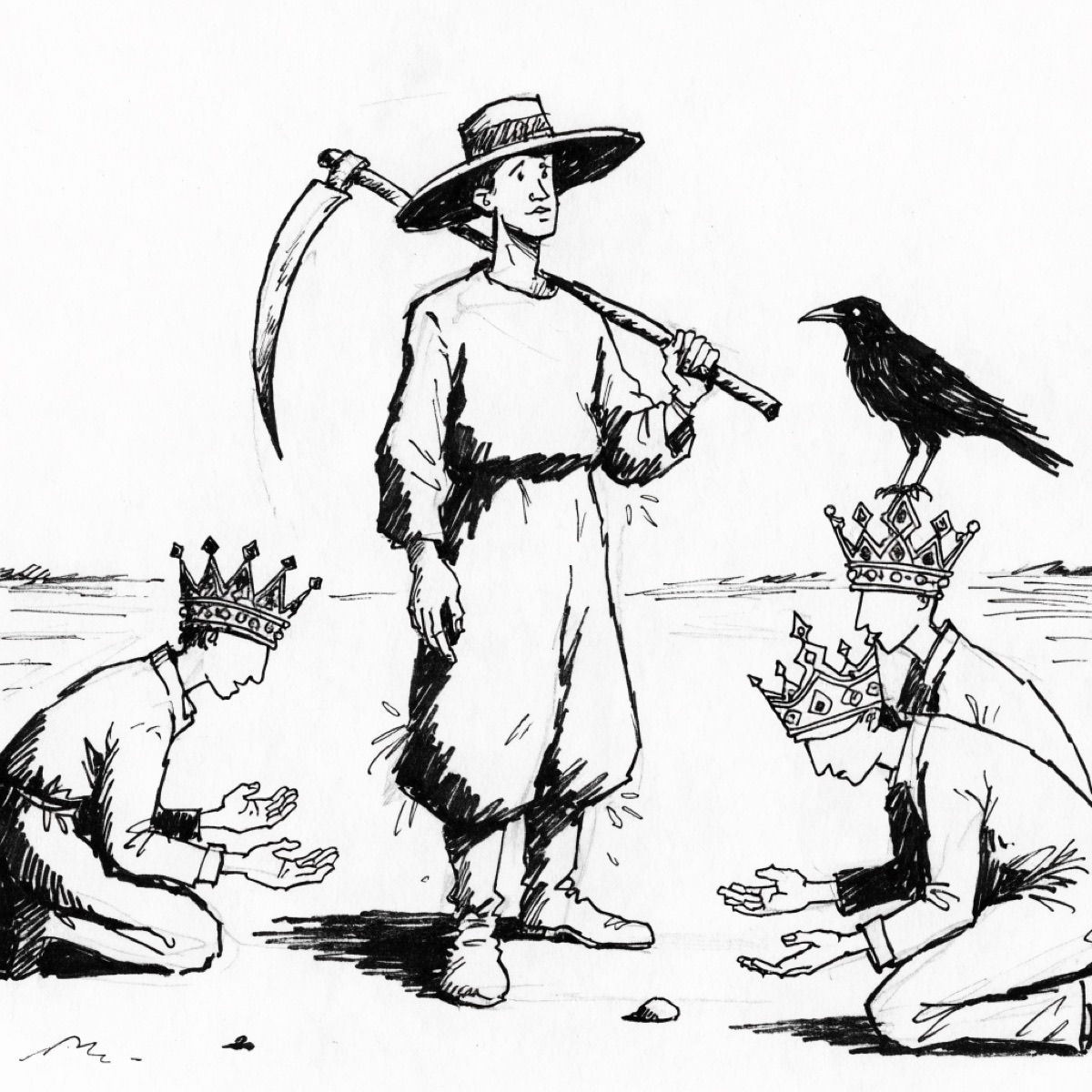
In 1348, an English serf named something like Thomas or William—we'll never know his name, because the law didn't think it worth recording—woke each morning to a life of near-total constraint. He couldn't leave his lord's land without permission. He couldn't marry off his daughter without paying a fine. He owed days of unpaid labor each week simply as the price of existing on soil he would never own. He had no meaningful recourse in court, no alternative employer, no ideological language to describe his situation as unjust. It simply was, the way seasons were, the way God's arrangement of the world was. He could not have imagined it changing.
His grandson, in 1381, was negotiating his own wage.
Between 1347 and 1353, the Black Death—Yersinia pestis, carried by fleas on rats, invisible to everyone it was destroying—killed an estimated 30 to 60 percent of Europe's total population. Some historians put the death toll at 25 million people in six years. Others go higher. The numbers are so large they lose meaning until you try to picture a village of forty families reduced to eighteen, a monastery of sixty monks reduced to eleven, a city losing a third of its inhabitants before the spring thaw. What followed was the greatest labor reform in medieval history—authored not by rebels, philosophers, or enlightened kings, but by a bacterium no one could see.
The World the Plague Destroyed
To understand what the plague disrupted, you have to understand what it disrupted into. Medieval serfdom is often described in terms of poverty, but poverty alone doesn't capture it. Serfs weren't simply poor. They were legally bound—to specific land, specific lords, specific obligations that had been accumulating for centuries.
The core mechanism was the corvée: obligatory unpaid labor owed to the lord, typically two or three days a week, on top of payments in produce and various fees that marked every life transition—birth, marriage, death, inheritance. A serf who wanted to move to a nearby town needed his lord's permission. A serf's son who wanted to enter the priesthood often needed his lord's permission. In most of medieval Europe's legal systems, serfs had no standing to bring cases before royal courts. They existed, in the law's eyes, primarily as assets.
The lord's power wasn't just legal—it was structural. He controlled the land (obviously), but also the mill where grain was ground, the oven where bread was baked, the pond where fish were taken. These weren't incidental conveniences; they were monopolies embedded into the landscape itself. A serf who refused his obligations had nowhere to take his labor. There was no competing employer across the road. The system was closed.
What made it feel permanent was its ideological scaffolding. The Church's doctrine of the "three orders"—those who pray, those who fight, and those who work—gave cosmic justification to the arrangement. Each order served God in its proper sphere. Questioning whether you belonged in your sphere wasn't just socially dangerous; it was theologically suspicious. For centuries, no counter-narrative existed at the scale needed to dislodge the idea. The serf's trap was reinforced from heaven downward.
The Mortality Math
Then half the people died.
The immediate agricultural consequence was both obvious and staggering. Fields that had required dozens of laborers to plant, tend, and harvest now had a handful of survivors to work them. Grain rotted in the fields in some areas during the initial waves of mortality—not because people didn't want to eat, but because there simply weren't enough hands. Lords who had held absolute power over their workers the previous spring found themselves in an unprecedented position: desperate.
Surviving workers, displaying no particular political consciousness at first, did what anyone does when they discover they're suddenly in demand. They asked for more. Better conditions. The ability to move to a neighboring estate where the terms were slightly less terrible. They weren't operating from John Locke or anything remotely like political theory. They were operating from the simple, observable fact that the lord needed them, visibly and urgently, in a way he never had before. The plow didn't care about feudal hierarchy. The harvest didn't wait for legal precedent.
The effect wasn't uniform across Europe, and this unevenness is itself enormously revealing. In England, France, and much of Western Europe—areas devastated by repeated plague waves—feudal obligations began collapsing almost immediately under the pressure of labor scarcity. But in Eastern Europe, the story ran in a precisely opposite direction. In Poland, Prussia, and Russia, where population density was lower and labor had always been relatively scarcer, lords responded to the plague not by offering better terms but by legislating tighter controls. If your power depends on keeping workers from leaving, and workers start leaving, you don't give them freedom—you build higher walls. The same demographic pressure produced liberation in one half of Europe and the so-called "second serfdom" in the other. What determined the outcome wasn't mortality rates alone, but the pre-existing balance of alternatives.
The Panicked Reaction: Laws Written in Fear
The English crown's response is worth examining closely, not for what it accomplished, but for what its speed reveals. The Black Death's worst English mortality occurred in 1348 and 1349. The Statute of Laborers was passed in 1351. Three years. In a medieval state with no telegraph, no newspaper, no rapid legislative apparatus, the ruling class managed to pass emergency wage-control legislation in roughly thirty-six months.
The statute did several things, all of them desperate. It legally froze wages at pre-plague levels—the levels from before half the workforce had died. It criminalized workers who demanded more than those rates. It required "idle" survivors to accept employment from any lord who wanted them, effectively trying to re-attach mobile labor to the soil by legal fiat. Reading it now, you can almost feel the panic underneath the formal Latin. This was not confident governance. This was a ruling class watching its entire economic foundation wobble and reaching for whatever legislative lever it could find.
France issued similar ordonnances in 1351. Castile passed comparable decrees. Italian city-states—which had their own complex relationships with guild labor and urban workers—attempted various forms of wage suppression and mobility restriction. The geography of these laws maps almost perfectly onto the geography of ruling-class anxiety. Where plague mortality was highest, the legislation was most urgent and most punitive.
The laws mostly failed. This isn't surprising in retrospect, but it's worth dwelling on why. You can legislate a price ceiling, but you cannot legislate away scarcity. The law said wages must stay at 1346 levels. The harvest said otherwise. Lords who loudly supported the Statute of Laborers in Parliament were, quietly, paying above-statute wages on their own estates because if they didn't, their workers walked to someone who would. Enforcement was patchy, inconsistent, and perpetually undermined by the very people it was meant to protect. A workforce that had discovered it could simply disappear into the next county, or the next town, or the expanding labor market of a city, was not going to be legislated back into compliance by men who needed their labor to survive the winter.
The Peasants Knew What They Had
The Peasants' Revolt of 1381 is often taught as a sudden eruption—as if English peasants woke up one day with political ideas and took to the roads. But by 1381, the revolt had three decades of accumulated context. Workers had spent thirty years discovering, incrementally, that they had leverage. The poll tax of 1381 and the attempted re-imposition of labor controls weren't provoking people who had accepted their condition. They were provoking people who had already tasted something different and were being asked to give it back.
Wat Tyler's rebels were remarkably specific in their demands, which tells you a great deal about their motivations. They wanted serfdom abolished outright. They wanted rents fixed at low rates. They wanted the freedom to buy and sell labor wherever they chose. These were not the demands of a philosophically radicalized movement. They were the demands of workers who had experienced—for thirty years—a world in which those things were practically, if not legally, already happening in many places. The revolt was, at its core, a demand that the law catch up to economic reality.
The quieter revolutions were just as consequential, and far less visible. Across France, Germany, and northern Italy, serfs who didn't rebel simply disappeared into towns—legally, semi-legally, or illegally, they migrated toward urban labor markets that were hungry for workers and less invested in enforcing rural obligations. Monasteries, desperate for agricultural labor, began offering incoming workers tenancies under free conditions rather than serf conditions. Lords who couldn't find laborers to work their estates under traditional terms began quietly commuting labor dues to cash rents, because a tenant who paid money was better than land that sat empty.
John Ball, the radical priest who wandered the roads of England preaching equality—"When Adam delved and Eve span, who was then the gentleman?"—is often treated as a cause of the 1381 uprising. He was more accurately a symptom of it. The economic reality had already changed; Ball was providing ideological language for something that had been happening in the fields and on the road verges for a generation. The plague created the leverage; the theology caught up when it had to.
The Long Unraveling
By the late fourteenth and early fifteenth centuries, the dominant model in Western Europe had shifted in ways that would have been unrecognizable to the pre-plague world. Labor dues—the obligatory days of unpaid work at the lord's direction—were giving way, village by village, estate by estate, to cash rents. The serf who owed three days' unpaid labor per week was being replaced by the tenant who paid a fixed rent in money and kept the rest of his time as his own.
This sounds like a subtle technical change. It wasn't. The labor due was the mechanism of control—it put the lord physically in command of the worker's time and body. The cash rent, by contrast, made the worker something closer to a contractor. He owed money, not obedience. He could work his land as he chose, sell his surplus where he liked, and save toward mobility that had been legally impossible a generation before. It didn't create modern freedom in any recognizable sense. But it dissolved the specific architecture of servile bondage that had defined rural life for centuries.
The Eastern European divergence sharpens the picture. In Poland and Prussia, the same demographic pressures that had loosened Western serfdom were channeled into what historians call the "second serfdom"—a tightening of legal controls on peasant movement, an extension of labor obligations, and a suppression of urban alternatives. By the sixteenth century, Polish noble estates were running on systems of obligatory labor that would have looked more restrictive, not less, than pre-plague Western arrangements. Russia's serfdom hardened further still, reaching its most rigid form in the seventeenth century and surviving, in attenuated legal form, until 1861. The Black Death didn't create freedom. It created conditions in which freedom could be extracted by those with enough leverage to demand it. Where those conditions didn't exist, the same logic ran in reverse.
The deepest lesson here isn't about plague, or labor economics, or medieval law. It's about how structural change actually happens. The serf's grandson who negotiated his own wage in 1381 had no theory of labor rights. He had a dead half-village and a lord who needed someone to bring in the harvest. The entire ideological apparatus—the revolts, the radical priests, the slowly reforming law—followed an economic reality that a bacterium had already created. Freedom, in this case, didn't descend from enlightenment. It rose from scarcity. And the most unsettling implication is this: the people who benefited from the old order would have preserved it forever if nature hadn't made preservation impossible. It took 25 million deaths to make surplus human beings scarce enough to matter.