Art · 6 min read
How the Sistine Chapel Cleaning Changed Views of Michelangelo's Color
How removing deposits revealed Michelangelo's bright palette while sustaining a dispute over dry finishing and conservation boundaries.
How the Sistine Chapel Cleaning Changed Views of Michelangelo's Color
Cleaning changed both the surface and the interpretation
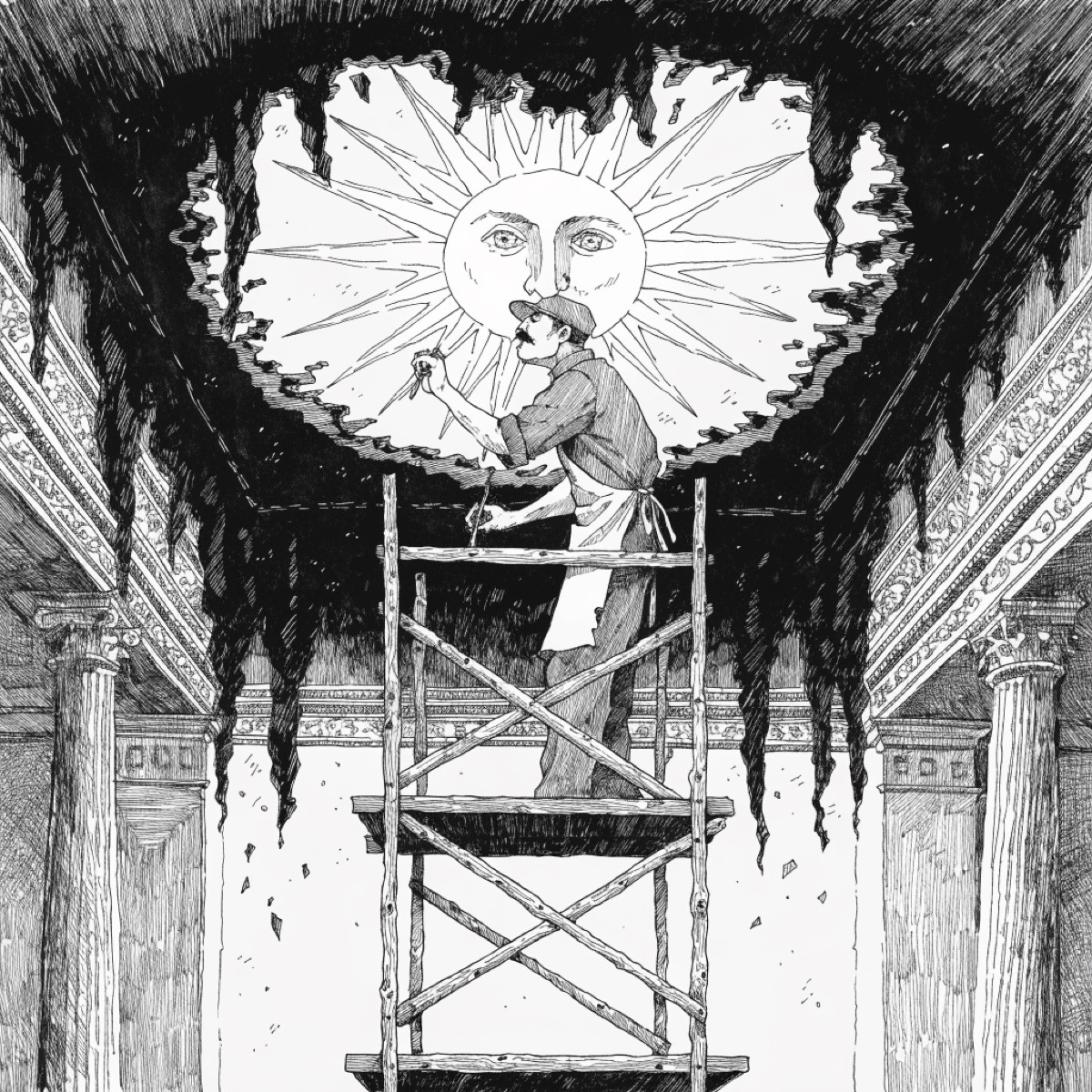
Michelangelo painted the Sistine Chapel ceiling between 1508 and 1512. By the late twentieth century, viewers knew it through a surface darkened by soot, dust, glue, oils, earlier repairs, and centuries of exposure. A major conservation campaign began with preliminary work in 1979, moved to the ceiling in the 1980s, and culminated with the cleaning of The Last Judgment, completed in 1994. Related chapel work continued through the decade.
The restoration revealed intense pinks, greens, oranges, blues, and yellows, along with sharper separations among figures and architectural forms. The visual change was so large that it altered accounts of Michelangelo as a painter. A familiar image of a sculptor working in somber, heavily modeled tones gave way to one of a colorist whose combinations could be compared with Florentine painting and whose forms were legible from the chapel floor.
That interpretation rests on a material intervention. Restorers did not simply uncover a neutral original. They examined layers, decided which materials belonged to Michelangelo's work, selected cleaning methods, and stopped at chosen boundaries. Most specialists accept that the campaign removed extensive contamination and exposed important original color. Critics dispute whether it also removed some intentional retouching and shading.
Restorers worked from a specific account of fresco technique
In true fresco, pigment dispersed in water is applied to fresh lime plaster. As the plaster carbonates, color becomes bound into the wall. Artists work in daily sections, or giornate, because each area must be painted while wet. Details can also be added after drying with binders in a technique broadly called a secco. Those additions can be more vulnerable to moisture and cleaning.
The Vatican team, led on the ceiling by chief restorer Gianluigi Colalucci, used photography, ultraviolet examination, chemical analysis, and tests on limited areas. The working conclusion was that much of the dark coating consisted of deposits and materials from previous maintenance, including animal glue applied in attempts to revive color. The main cleaning employed an aqueous solution formulated to remove those layers, followed by rinsing and drying under controlled conditions.
The treatment proceeded in stages that allowed comparison between cleaned and uncleaned surfaces. International advisory experts reviewed the work, and Nippon Television funded the project in exchange for image rights. Documentation was extensive by the standards of large mural conservation, though access to all technical records and the effect of media rights became part of the public controversy.
Any treatment faced risk. Leaving grime in place would preserve later accretions that obscured color and could interact with the plaster. Removing it could take fragile original material. The question was not intervention versus nonintervention, but which altered state offered the strongest evidence of the work while protecting it physically.
Bright colors challenged the familiar dark Michelangelo
Cleaned lunettes and ceiling figures displayed color contrasts that had been hard to see. Michelangelo placed complementary or near-complementary colors beside one another and changed hues across modeled drapery. Forms that once seemed unified by brown shadow appeared articulated by shifts in color. Details of faces, textiles, and small figures became legible at viewing distance.
Supporters connected the palette to Michelangelo's training in the workshop of Domenico Ghirlandaio and to central Italian fresco practice. They argued that accumulated soot had encouraged later viewers to project a nineteenth- or twentieth-century preference for a dark, sculptural master backward onto the sixteenth century. The cleaning therefore changed not only reproduction but attribution of artistic identity.
Photographic comparison requires caution. Film stocks, lighting, printing, digital white balance, and varnish-like surface effects can exaggerate differences. The chapel's current environmental controls and lighting also differ from historical candles and daylight. A published before-and-after image is evidence of surface change, not a direct simulation of what Pope Julius II saw in 1512.
The cleaning also exposed working changes. Incised lines, pouncing, brushwork, and boundaries between daily plaster sections helped researchers reconstruct the sequence of execution. These findings support the view that Michelangelo planned carefully while adjusting figures during painting. They do not settle how he intended the entire ceiling to look under original illumination.
Critics disputed what the cleaning may have removed
The central objection concerned a secco additions. Art historian James Beck and artists including Frank Mason argued that Michelangelo used dry applications of carbon black or glue-bound pigment to deepen shadows and unify forms. If so, a method designed to remove later glue and grime might also remove original final touches. Critics pointed to areas where modeling seemed flatter after treatment and to dark details visible in earlier photographs.
The Vatican team responded that technical examination found little evidence of a systematic original a secco finishing layer on the ceiling. They distinguished isolated original corrections from widespread glue coatings and soot. They also argued that Michelangelo created much of his modeling within the fresco through pigment and the light color of plaster, not through a final dark glaze.
The disagreement contains different kinds of evidence. Material samples can identify substances and stratigraphy at the sampled point, but a mural cannot be sampled everywhere. Historical knowledge of fresco practice can establish what was possible, not what Michelangelo did in each passage. Visual coherence can guide interpretation but is influenced by expectations formed from the dirty surface. No single type of evidence resolves all areas.
Conservation ethics have also evolved. Current practice emphasizes minimal intervention, reversibility where possible, full documentation, and recognition that cleaning is irreversible. A removed deposit cannot be restored to the wall. Yet "minimal" does not specify a universal stopping point, and an unstable or obscuring layer may justify removal. The Sistine project remains a case through which conservators teach that technical decisions carry art-historical consequences.
Later maintenance clarifies condition, not original intention
The chapel continues to change after restoration. Millions of annual visitors contribute humidity, carbon dioxide, dust, fibers, and airborne particles. The Vatican installed climate-control and monitoring systems and conducts maintenance rather than waiting centuries for another campaign. In 2026, conservators removed a whitish film from The Last Judgment with Japanese paper and distilled water. The Vatican Museums described the visual recovery as returning the fresco to the condition achieved after the 1994 restoration.
That recent work supports the claim that deposited material can rapidly alter perception. It does not retrospectively prove that every layer removed in the earlier campaign was foreign. Nor does the bright current surface by itself reveal Michelangelo's complete intention. Original appearance includes variables that survive poorly: final dry touches, lighting, neighboring decoration, and the viewer's position.
What is established is that the campaign removed substantial non-original deposits, revealed an extensive bright palette, and produced technical documentation of Michelangelo's working process. What is contested is whether some original dry finishing was lost and whether the post-cleaning balance of color and modeling best represents the completed ceiling. What remains unknown cannot be recovered by confidence alone. The restoration made more original material visible while making its interpretive boundary permanently consequential.
Sources and review note
4 sources, none of them with a link, so treat them as reading, not proof.
- Gianluigi Colalucci, technical accounts of the Sistine Chapel restoration, including "On the Science of Art Restoration" (1994).
- Vatican Museums, Conservation Office history and documentation of the Sistine Chapel campaign and 2026 extraordinary maintenance of The Last Judgment.
- Fabrizio Mancinelli, The Sistine Chapel: The Art, the History, and the Restoration (Harmony Books, 1986), project scholarship from the Vatican Museums.
- James Beck and Michael Daley, Art Restoration: The Culture, the Business and the Scandal (1993), consulted as a prominent critical account rather than as technical consensus.