History · 7 min read
What Byzantine Diplomatic Forgery Shows About Information Control
For seven centuries, the Byzantine Empire ran a sophisticated disinformation operation so embedded in its bureaucracy that forgery was essentially a job description. What they invented looks disturbingly familiar today.
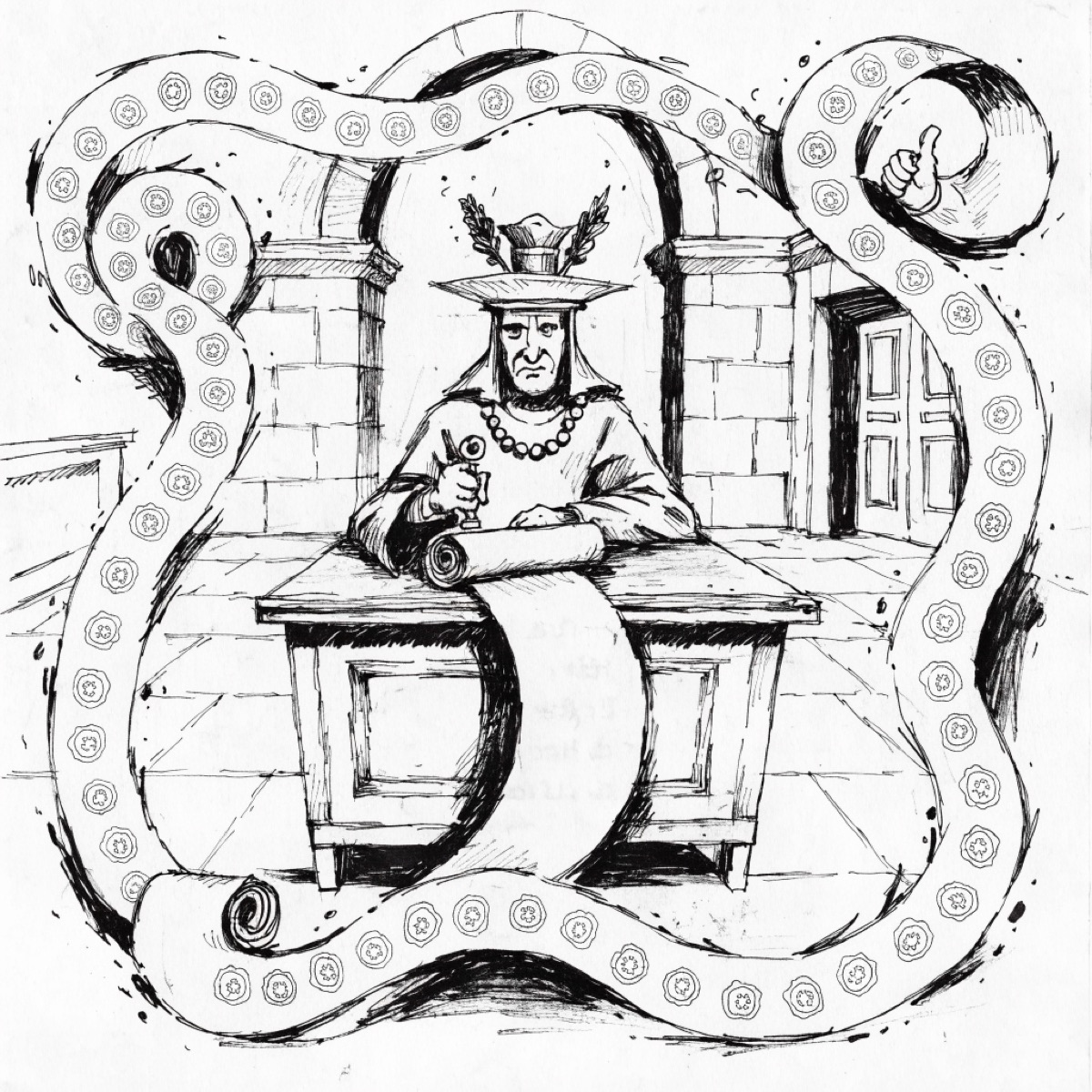
In 968 CE, Bishop Liutprand of Cremona arrived in Constantinople on a diplomatic mission from Holy Roman Emperor Otto I, confident he was carrying — and had previously received — legitimate papal correspondence. He left furious, writing one of the most entertainingly bitter diplomatic memoirs in medieval history. The reason for his rage: he had discovered that a letter he believed to be authentic had been quietly, surgically altered. Key phrases had been rewritten to reframe Otto not as an equal sovereign but as a subordinate petitioner.
Liutprand only caught the manipulation because he had memorized the original wording. In his Relatio de Legatione Constantinopolitana, he described the Byzantine court with phrases that don't survive translation into polite English — but his account survives as one of our clearest windows into how Constantinople conducted business. His outrage, interestingly, was not that forgery existed. It was that he'd been caught believing it.
Which raises the obvious question: what if this wasn't a rogue clerk's clever Tuesday afternoon improvisation? What if it was just Tuesday?
The Skrinion: Byzantium's Ministry of Manufactured Truth
The institution at the center of Byzantine foreign communications was called the skrinion barbaron — literally, the "bureau of barbarians." Despite its blunt name, it was anything but crude. Staffed by professional translators, scribes, and diplomatic specialists, it operated under the authority of the logothetes tou dromou, the minister responsible for the imperial postal network and foreign affairs. This bureaucratic architecture is important: it meant that the infrastructure for systematic forgery wasn't improvised. It was organizational.
The bureau maintained comprehensive archives. Foreign rulers' authentic seals, their characteristic rhetorical flourishes, their preferred honorifics, the particular diplomatic formulas their chanceries used — all of it was catalogued and preserved. This was officially justified as reference material for drafting appropriate responses to incoming correspondence. It also happened to be exactly what you would need to produce a convincing forgery.
What makes this different from the modern assumption about document fraud is the question of intent. We tend to imagine forgery as a crime requiring deliberate criminal purpose — someone deciding to do a bad thing. Byzantine bureaucratic culture created a different structure: clerks who produced effective outcomes advanced their careers. The empire rewarded results. Manipulation was not a deviation from the job description. In many cases, it was the job description.
Four Favorite Tools in the Byzantine Disinformation Toolkit
Fabricated diplomatic correspondence was perhaps the cleanest instrument in the arsenal. Constantinople would dispatch forged letters attributed to one foreign ruler — telling a Bulgarian khan, for instance, that his Rus ally had written privately to the emperor mocking the Bulgars' military capacity, or questioning the khan's legitimacy. No soldiers required. The enemies would do the rest. The beauty of this approach was its deniability: if the deception unraveled, the empire could simply express diplomatic horror that someone had apparently forged correspondence in the name of both parties.
Seeded false intelligence through staged "defectors" was more operationally complex but well-documented. The empire maintained a practice of dispatching soldiers, merchants, or minor officials who appeared — convincingly — to be fleeing Byzantine territory under genuine duress. These individuals carried carefully curated disinformation: inflated troop strength numbers, false information about supply route vulnerabilities, planted rumors about succession crises. Before the Battle of Anchialos in 917 CE, Byzantine sources and their cross-referencing with Bulgarian accounts suggest this tactic was deployed specifically to mislead Bulgarian commander Symeon I about imperial military readiness. It didn't work that time — Symeon won decisively — but the attempted use is recorded.
Manufactured miracles operated in a different register entirely, blurring the line between propaganda and psychological warfare in ways that were entirely deliberate. The acheiropoieta — icons described as "not made by human hands," supposedly of divine origin — were deployed at city walls during sieges. The narratives that accompanied these deployments were not spontaneous popular devotion. The imperial court actively engineered the stories, ensured they reached enemy camps through intelligence networks, and timed the "miraculous appearances" to coincide with moments of maximum psychological vulnerability among besieging forces. It worked partly because the Byzantines believed it themselves — faith and strategic communication were not, for them, mutually exclusive categories.
The Silk Road as an Information Highway (That Constantinople Controlled)
Byzantium occupied the single most advantageous position in the medieval information ecosystem. Sitting at the crossroads of Eurasian trade and diplomacy, the empire was the dominant clearinghouse for news, intelligence, and interpretation for rulers stretching from Ethiopia to Scandinavia. A Frankish king who wanted to know what was happening in Persia, or a Scandinavian prince curious about Arab military movements, had few reliable alternatives to Byzantine sources. Constantinople exploited this dependency with systematic thoroughness.
Foreign ambassadors visiting Constantinople — and they came constantly, because the city was simultaneously the most glamorous, technologically advanced, and commercially essential destination in the medieval world — were housed in monitored residences. Their conversations were noted. Their correspondence was opened, read, and resealed. The tagmata, the elite imperial guard units, included intelligence functions that modern analysts would recognize immediately. The ambassadors generally knew they were being watched, which created its own useful dynamic: they became cautious, deferential, and dependent on official Byzantine channels for information — which is precisely what the empire wanted.
This is what historians have called the "prestige trap." To access Byzantine trade networks, military technology, or the religious legitimacy that came from Constantinople's ecclesiastical authority, foreign rulers had to maintain permanent embassies in the city. This was not a vulnerability the empire reluctantly accepted. It was a continuous, self-funding surveillance and influence operation. The foreigners paid for their own monitoring by wanting to be there.
Why Scholars Kept Missing This
The fundamental evidentiary problem is elegant in its circularity: Byzantine sources were written by the imperial bureaucracy. The forgers did not leave memos titled "Forgery Program, Q3 Report." Researchers seeking to understand systematic Byzantine disinformation had to triangulate from external records — Armenian chronicles, Arab historians, Frankish annals, the diplomatic records of the Abbasid caliphate — that noted, often with confusion or outrage, that they had received documents which seemed inconsistent with other evidence, or which arrived with suspiciously convenient timing.
There is also what we might call the "civilization bias" problem in Western historiography. For centuries, Byzantium was framed as a decadent, static civilization in slow decline from Roman glory — a place of eunuchs, palace intrigue, and elaborate ritual signifying nothing much. This framing, which owes more to Edward Gibbon's contemptuous eighteenth-century portraiture than to evidence, made it intellectually convenient to dismiss Byzantine strategic sophistication as mere "Eastern cunning" — a phrase that told you more about the historian than about the Byzantines. Scholars like Anthony Kaldellis at the University of Chicago and Averil Cameron at Oxford have spent decades systematically dismantling this framework, insisting that Byzantium be analyzed as a functioning, adaptive state rather than a cautionary tale.
The methodological breakthrough came from cross-referencing. When researchers placed Constantine VII's Book of Ceremonies — a remarkable operational manual for imperial governance covering everything from court ritual to diplomatic protocol — against foreign diplomatic records from multiple independent traditions, patterns emerged. The same rhetorical "errors" appeared in documents from different decades. The same formulaic distortions recurred across unrelated diplomatic incidents. This is not what coincidence looks like. This is what template use looks like.
The Modern Mirror: What We Recognize Now
Reading Byzantine operational history in 2024 produces a specific kind of cognitive vertigo — the sensation of recognizing something you thought was new. The infrastructure: a professional bureau with archival resources and career incentives aligned toward effective manipulation. The methods: forged correspondence, staged defectors carrying curated misinformation, manufactured divine endorsements amplified through controlled channels. The structural advantage: controlling the information environment that rivals depend on, so that the targets come to you and pay for the privilege of being influenced.
None of this required Byzantine officials to think of themselves as propagandists in any modern sense. The logothetes tou dromou probably thought of himself as doing statecraft — managing relationships, protecting imperial interests, deploying available tools. The clerks in the skrinion probably thought of themselves as skilled professionals producing excellent work. The line between information management and disinformation was not something the Byzantine state recognized as meaningful, because the distinction assumes that the baseline is truth-telling, and the Byzantine diplomatic tradition made no such assumption.
What the empire understood — and what keeps getting rediscovered — is that information is not neutral infrastructure. It is territory. And territory, in Byzantine strategic thinking, was always worth taking.