Art · 6 min read
What Operation Night Watch Reveals About Rembrandt’s Working Process
What imaging and materials analysis reveal about Rembrandt’s sketch, revisions, ground, and pigments.
What Operation Night Watch Reveals About Rembrandt’s Working Process
Rembrandt van Rijn completed the painting commonly called The Night Watch in 1642 for an Amsterdam civic guard company. Its present appearance is the product of his materials and revisions, later varnishes and treatments, aging, damage, and a major alteration in 1715, when sections were cut from the edges to fit a new location. Looking at the canvas does not provide unmediated access to the moment of creation.
Operation Night Watch, begun by the Rijksmuseum in July 2019, joined conservation with a large technical study. Researchers mapped the painting before deciding on treatment, using high-resolution photography, X-radiography, macro X-ray fluorescence scanning, reflectance imaging spectroscopy, microscopy, and paint analysis. The findings revise some assumptions about how Rembrandt prepared and changed the work. They do not convert material evidence into a complete record of his intentions.
The project began with condition, not biography
The immediate concern was the painting's physical state. Changes observed in the dog and other areas, deformation of the canvas, and the history of earlier treatments called for a systematic condition assessment. The museum built a glass chamber around the enormous painting—about 3.8 by 4.5 meters—so research and treatment could occur in public while controlling access and environment.
Imaging a work at that scale required more than pointing an instrument at it. A 2021 paper by Victor Gonzalez and colleagues describes how reflectance imaging spectroscopy was adapted to the chamber and how thousands of measurements were aligned. Different methods respond to different properties. X-rays are absorbed strongly by heavier elements. X-ray fluorescence maps elements near the surface. Infrared wavelengths can penetrate some paint layers. Spectroscopy helps distinguish materials by how they absorb and reflect light.
The resulting maps are not pictures of separate, clean stages. A signal may come from an underlayer, a final stroke, a restoration, or several at once. Researchers interpret patterns using samples, historical knowledge, and agreement among methods. Technical images extend vision; they do not remove inference.
A preparatory sketch emerged beneath the paint
In 2021 the Rijksmuseum announced evidence of a light-colored preparatory sketch rich in calcium. The lines establish an early layout for figures, weapons, clothing, and architecture. Rembrandt then changed elements while painting. The discovery matters because scholars had debated how extensively he drew on the canvas before applying paint.
Several revisions are visible in the combined data. A set of feathers was initially planned for the helmet of Claes van Cruijsbergen but omitted in the final image. The position of a leg belonging to Rombout Kemp changed. Additional spears appeared in the early design. Rembrandt adjusted the distribution of figures and objects rather than mechanically filling a fixed cartoon.
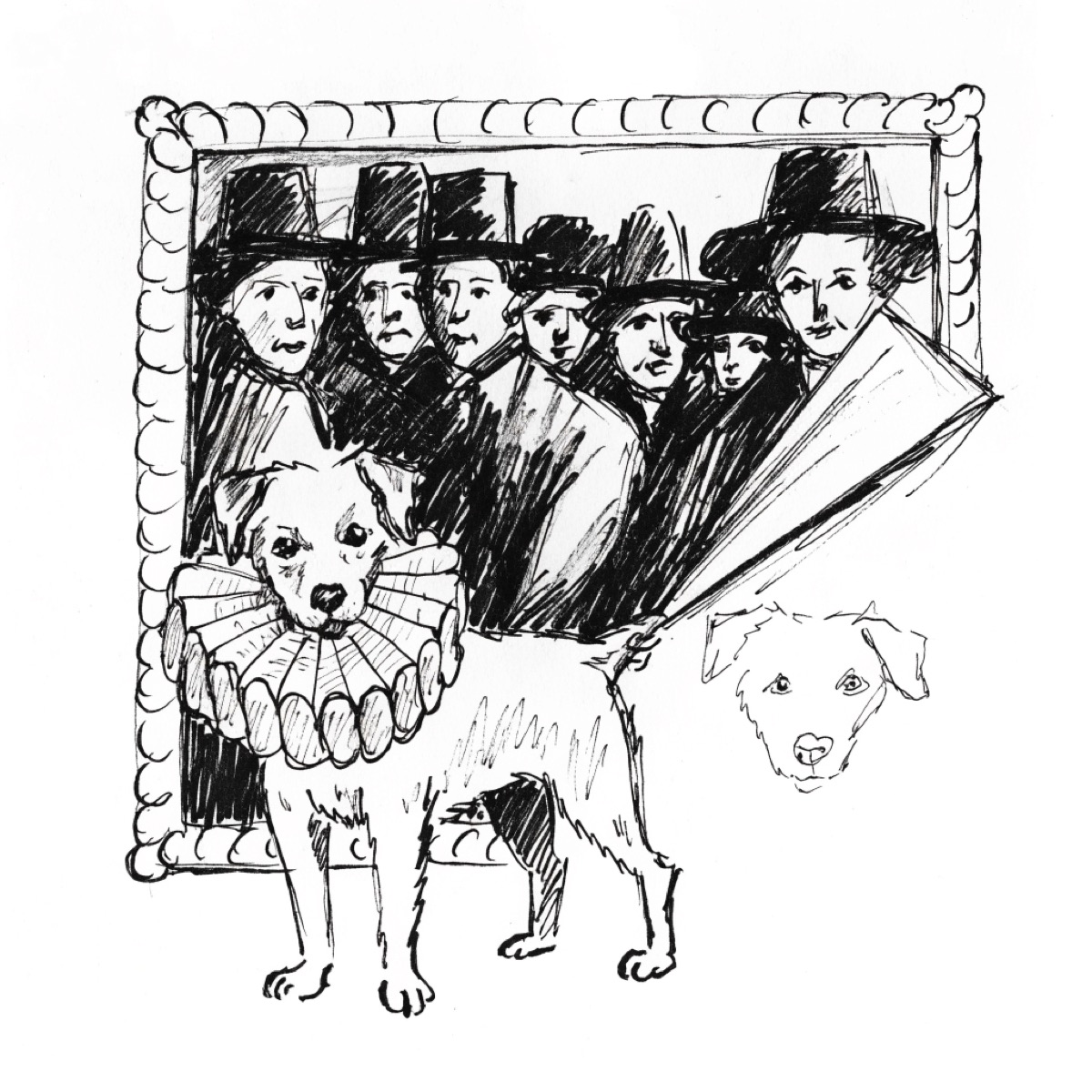
The dog illustrates the need for caution. The preparatory form is now more visible in places because upper paint has worn. That can make the animal look lighter and more linear than Rembrandt's finished effect. A technical finding about attrition changes how conservators understand the current image, but it does not authorize repainting every inferred loss. Conservation decisions weigh stability, reversibility, visual coherence, and the difference between original material and reconstruction.
Later research added another source for the dog. Rijksmuseum curator Anne Lenders identified a close resemblance to a dog in a 1619 drawing by Adriaen van de Venne, reproduced in a book by Jacob Cats. The pose, head angle, open mouth, ears, and collar align closely enough to support the inference that Rembrandt used the image. Artists' reuse of printed and drawn motifs was ordinary workshop practice. The finding complicates a romantic picture of spontaneous invention without diminishing the choices Rembrandt made in scale, color, placement, and function.
The ground was unusual for a large commission
Beneath paint, artists applied ground layers to prepare a support. Analysis of The Night Watch identified a quartz-clay ground rather than the more familiar grounds documented in other Rembrandt paintings. The mixture included quartz-rich clay and was applied over a lead-containing impregnation layer.
In 2023, researchers reported the lead layer in Science Advances. They combined macro X-ray fluorescence, X-ray powder diffraction, and analysis of a small historical sample. The distribution suggested that a lead-rich oil was applied across the canvas before the ground, possibly to protect it from moisture. The painting was commissioned for the great hall of the Kloveniersdoelen, where a large exterior wall may have presented damp conditions.
“Possibly” carries real weight here. The material and distribution are measured. Moisture protection is an interpretation supported by historical recipes and the building context. The evidence cannot recover the precise conversation in which the preparation was selected. It may also have affected handling or drying.
The scale of the work likely shaped material choices. A ground suitable for a panel-sized painting might be expensive, heavy, or slow across a vast canvas. Technical art history connects workshop decisions to supply, architecture, and labor. It shifts analysis from a solitary painter's gesture toward a production system without denying individual authorship.
Unexpected pigments changed readings of color and light
Operation Night Watch also found arsenic sulfide pigments in the golden embroidery on Lieutenant Willem van Ruytenburch's costume. Researchers identified pararealgar and semi-amorphous pararealgar, materials related to yellow and orange arsenic sulfides. These compounds are uncommon in the Rembrandt palette documented before the project.
The team argued that Rembrandt combined them with other pigments to create a glittering golden effect. That is a material explanation of an optical result, not proof that every warm passage contains the same mixture. Pigments can transform with light and time. Their current chemistry may include degradation products, so reconstruction requires knowledge of both original manufacture and aging.
The finding also warns against identifying materials from color alone. Two yellow passages can use different pigments; one pigment can appear different depending on particle size, binder, mixture, and alteration. Instrumental analysis revises the vocabulary available to connoisseurship, but it does not make visual study obsolete. Researchers need both the mapped signal and its place in the composition.
Treatment turns evidence into a decision
After roughly five years of research, the Rijksmuseum began removing a synthetic varnish applied during the 1975–76 treatment. The coating had aged and could be removed with a specially selected nonwoven material and solvent system. Treatment proceeded incrementally, with the team observing how the surface responded.
There is no purely technical answer to how a seventeenth-century painting should look today. Measurements can identify instability and altered coatings. Historical photographs can document earlier states. Samples can show layer sequences. Conservators still must decide how much intervention is justified and how to preserve original paint while addressing later changes.
Operation Night Watch has established several points: Rembrandt used a preparatory sketch, revised the composition during painting, employed an unusual ground and lead-rich impregnation, and used materials not previously associated so clearly with this work. It has also documented wear that affects current interpretation.
What remains contested concerns meaning and intention. A changed spear may reflect compositional adjustment, practical correction, or both. An unusual pigment may signal experimentation, availability, collaboration, or a workshop recipe not otherwise preserved. Technical evidence can reject some stories and support others, but it cannot read the painter's mind.
The reconsideration is therefore methodological. The Night Watch is not a fixed image plus a biography. It is a layered physical object whose manufacture and survival can be investigated. The better the instruments become, the more important it is to state where measurement ends and interpretation begins.
Sources consulted
4 sources, every one with a link you can follow.
- Rijksmuseum, “Preparatory Sketch Discovered Beneath The Night Watch” (2021).
- Victor Gonzalez and colleagues, “Reflectance Imaging Spectroscopy for Operation Night Watch,” Sensors (2021).
- Fréderique Broers and colleagues, “Rembrandt's Lead-Based Impregnation Layer in The Night Watch,” Science Advances (2023).
- Rijksmuseum, “Operation Night Watch,” research and treatment documentation.