Art · 6 min read
What Technical Examination Revealed About Girl with a Pearl Earring
The pigments, working sequence, faded curtain, fine eyelashes, and unresolved identity behind Vermeer's familiar painting.
What Technical Examination Revealed About Girl with a Pearl Earring
The painting viewers see is also a record of change
Johannes Vermeer's Girl with a Pearl Earring, painted around 1665, presents a figure turning toward the viewer against what now looks like an empty dark field. The image seems direct: blue and yellow clothing, moist lips, a bright eye, and a large earring assembled from a few strokes. Technical examination has made that apparent simplicity more complicated without resolving the sitter's identity or turning the picture into a hidden narrative.
In February and March 2018, the Mauritshuis placed the painting behind glass in its Golden Room and convened an international team for "The Girl in the Spotlight." The project was non-invasive: researchers did not remove new paint samples during the public examination. They combined high-resolution photography, microscopy, X-radiography, macro X-ray fluorescence scanning, reflectance imaging, and optical coherence tomography with analysis of tiny samples taken during an earlier 1994 treatment.
The results distinguish three kinds of knowledge. Instruments can identify chemical elements and map materials, conservators can infer a likely sequence of work, and art historians can interpret why those choices matter. The first is direct measurement; the second and third involve progressively more judgment.
Instruments map different parts of the object
No single scan looks "through" a painting in a complete way. X-radiography records how materials absorb X-rays and is especially sensitive to heavy elements. Macro X-ray fluorescence, or MA-XRF, detects characteristic emissions from elements such as lead, mercury, iron, and copper, allowing researchers to map where associated pigments occur. The map is not automatically a color image: an element can appear in several compounds, and mixtures complicate interpretation.
Reflectance imaging spectroscopy records how the surface reflects many wavelengths, including infrared. It can distinguish some pigments and reveal features hidden by later darkening. Optical coherence tomography uses reflected light to examine transparent and semi-transparent layers near the surface. A 3D digital microscope records topography at very high magnification, showing ridges, cracks, brush hairs, and particles.
Researchers aligned these datasets so a feature in one map could be compared with the same location in another. Existing cross-sections—microscopic stacks of paint removed in 1994—provided direct evidence about layer order. The Mauritshuis and partner institutions emphasize that the combined method, rather than one spectacular image, produced the reconstruction.
Vermeer prepared a colored ground and built forms in stages
The support is a fine plain-weave canvas. Beneath the visible image, researchers identified preparatory layers including a light ground and a darker underlayer. Infrared-related methods and elemental maps revealed broad brown and black sketching used to position the figure. Vermeer adjusted contours as he worked, including edges around the headscarf, neck, ear, and back of the garment. These changes are normal evidence of construction, not proof of uncertainty about the whole design.
The palette joined expensive imported materials with common pigments. Natural ultramarine, made from lapis lazuli, supplied the blue headscarf. Lead white created highlights and mixtures. Yellow areas include lead-tin yellow and yellow lake; the lips contain red lake and vermilion-related material. Blacks and earth pigments shape shadows. Researchers identified indigo in parts of the clothing and background mixtures.
Material names do not by themselves tell us exactly what Vermeer intended viewers to notice. They do show deliberate layering. The blue cloth, for example, gains volume from underpaint, ultramarine layers, and highlights rather than a single flat application. The skin uses transitions placed beside one another and softened at selected edges. Under magnification, the image is more economical than its smooth appearance at normal viewing distance suggests.
A green curtain became a dark field
One of the project's clearest findings concerns the background. Elemental and reflectance data support a folded green curtain extending behind the figure. Diagonal and vertical features survive below the present appearance. The original green probably combined indigo with a yellow organic lake over a dark underlayer.
Organic yellow colorants can fade, while some components and binding media become more transparent or darken. As the yellow lake degraded, the green curtain lost much of its distinction and the background came to look nearly uniform and black. The finding changes the picture's spatial setting: the figure was placed before fabric, not necessarily in featureless darkness.
It would be too strong to publish a digitally reconstructed background as the painting's exact original appearance. Pigment identification, aging studies, and surviving traces constrain a reconstruction, but original saturation, gloss, and lighting cannot be measured directly after more than three centuries. The established claim is that curtain-like forms and green components were present.
The examination also found eyelashes. They are faint in the current painting but visible with magnification and imaging. This corrects the statement that Vermeer depicted none; it does not make the work a conventional portrait. The Mauritshuis classifies it as a tronie, a study of a character or type in imagined dress, rather than a commissioned likeness identified by name.
The pearl is an optical construction
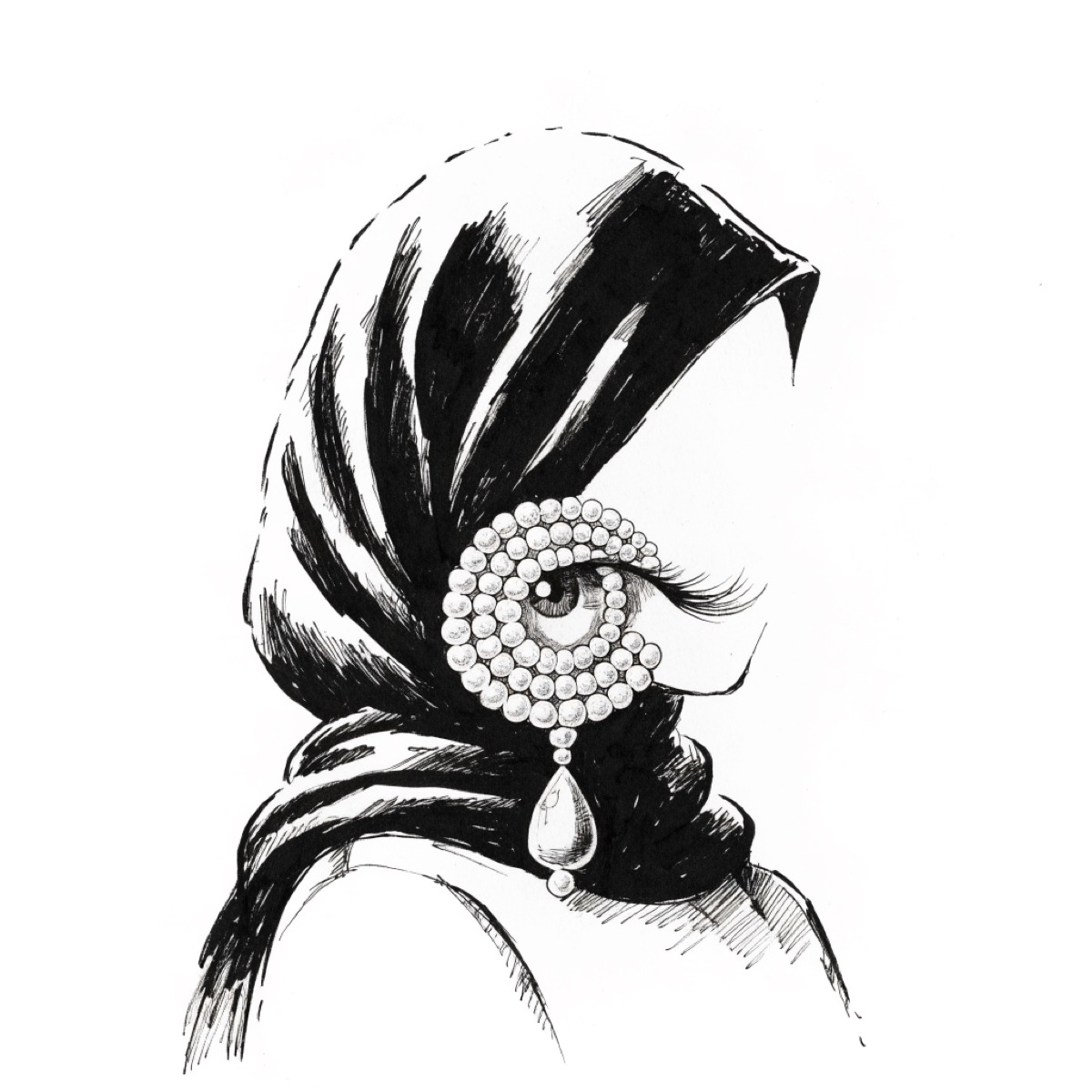
The earring contains no painted hook attaching it to the ear. Vermeer suggested the object with a bright highlight and a softer reflection beneath it, leaving surrounding ground to complete the form perceptually. Technical imaging reinforces what close visual inspection already indicates: the "pearl" is made with sparse lead-white strokes rather than a carefully drawn sphere.
Its material identity remains debatable. The scale is unusually large for a natural pearl, and some scholars have suggested polished silver, glass, or an imitation pearl. The painting supplies too little diagnostic detail to decide. The title Girl with a Pearl Earring is modern; earlier inventory descriptions used other terms, and the Mauritshuis adopted the familiar title in the late twentieth century.
This uncertainty is useful. Scientific analysis can map the paint that represents the object, but it cannot chemically test the represented earring. Confusing those levels would turn a result about lead white on canvas into a claim about jewelry in the imagined scene.
Technical evidence narrows interpretation without finishing it
The 2018 project clarified materials, working order, condition, and changes over time. It revealed that Vermeer revised contours, used a wider range of pigments than the restrained image suggests, placed the girl before a green curtain, and painted fine eyelashes. It also documented the surface so future conservators can compare changes.
The examination did not identify the model, establish a narrative, or discover a concealed second composition. Nor can pigment origin prove where Vermeer bought a particular material without documentary evidence. Attribution to Vermeer rests on connoisseurship, provenance, and the broader technical record, not on one chemical signature.
Reconsidering the painting through conservation shifts attention from a supposedly timeless image to a material object. Some of what viewers call Vermeer's dramatic darkness was produced jointly by the artist's design and centuries of chemical change. What is established lies in mapped elements, surviving layers, and documented features. The original balance of color and the identity of the person and earring remain outside what the instruments can recover.
Sources and review note
4 sources, none of them with a link, so treat them as reading, not proof.
- Mauritshuis, "Closer to Vermeer and the Girl," official results of The Girl in the Spotlight (2018-2020).
- Abbie Vandivere et al., technical articles from The Girl in the Spotlight: Vermeer's Girl with a Pearl Earring Re-examined, Heritage Science 7-8 (2019-2020).
- National Gallery of Art and Delft University of Technology partner reports on reflectance imaging, microscopy, and MA-XRF methods.
- Mauritshuis collection record for Johannes Vermeer, Girl with a Pearl Earring, circa 1665.
The draft distinguishes measured paint from represented objects. "Curtain" is the research team's interpretation of mapped folds and green components; exact original color and the earring's depicted material remain uncertain.