History · 10 min read
What the Fall of Rome Actually Looked Like
In 476 CE, the Western Roman Empire "fell"—and almost nobody noticed. The real story isn't one of collapse, but of a vast, sophisticated machine being quietly stripped for parts by the very people who were supposed to run it.
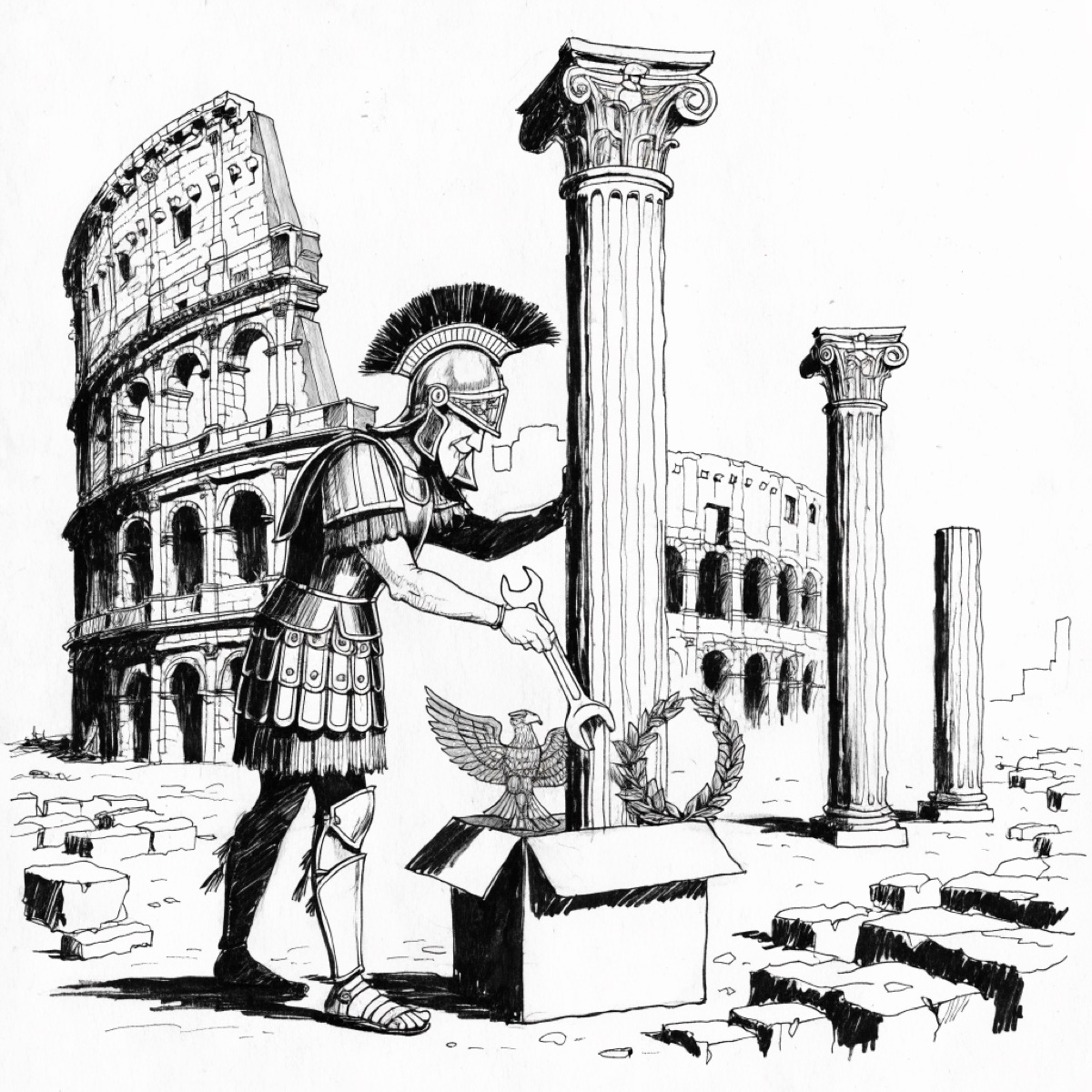
On September 4th, 476 CE, a teenage emperor named Romulus Augustulus was quietly removed from power by a Germanic military commander, given a pension, and sent to live in a villa in Campania. No one burned the city. No senate lamented the end of civilization. The Eastern Empire in Constantinople didn't even bother to send condolences—they simply stopped recognizing the Western throne as a separate institution. Across most provinces, the sun rose the next morning on the same roads, the same tax collectors, and the same landlords.
So why do we remember this moment as one of the greatest catastrophes in human history?
The honest answer is that we were told to. And the story we were told—of a glorious civilization extinguished by barbarian fire and Christian passivity—was always less a historical account than a political one. Recent historians, including Peter Heather, Bryan Ward-Perkins, and most provocatively Guy Halsall, have spent decades unpicking the seams of that narrative. What they've found underneath is stranger and more interesting: not a collapse, but a deliberate disassembly—a slow, rational stripping of a machine whose component parts had become worth more than the whole.
The Myth We Inherited: Gibbon's Bonfire
Edward Gibbon's The History of the Decline and Fall of the Roman Empire, published beginning in 1776, is one of the most consequential works of historical imagination ever written. Spanning six volumes and roughly a millennium of history, it gave the Western world its definitive account of Rome's end: a tragedy of overextension, moral softening, and civilizational surrender to forces from without and within. The prose was magnificent. The argument was intoxicating. And it locked a particular metaphor into the Western historical imagination—not a slow dismantling, but a bonfire.
The problem with a bonfire narrative is that it demands a spark. So historians, following Gibbon's lead, spent the next two centuries arguing about which spark mattered most. Was it the Huns, who pushed the Goths across the Danube? The Visigoths who sacked Rome in 410? Lead pipes leaching into drinking water? Falling birth rates? Christian pacifism? The list of culprits grew longer with each generation, each reflecting the anxieties of the scholars doing the blaming more than the evidence on the ground.
What the bonfire metaphor obscured was the quieter, more mundane truth: by the time the barbarian groups crossed the frontiers in force, much of the structure they supposedly destroyed had already been quietly vacated. The people who should have been defending the machine had been picking it apart from the inside for decades—not out of malice, but out of straightforward self-interest.
Gibbon's narrative also had a political life entirely separate from its historical accuracy. Writing for an 18th-century European audience watching empires expand and strain, he delivered a cautionary tale about overreach that every subsequent era has recycled for its own purposes. Victorian Britain read it as a warning about decadence. Post-war America read it as an anxiety about military overextension. The story proved too emotionally and politically useful to question rigorously—which is often the fate of the best historical myths.
The Provincial Elites: First to Pick Up the Wrench
In the 460s and 470s CE, a Gallo-Roman aristocrat named Sidonius Apollinaris was doing something that doesn't fit neatly into the collapse narrative: he was writing poetry. Witty, allusive, heavily Latinized poetry, sent to friends across Gaul in letters that discussed vintages, dinner party seating arrangements, and the management of country estates. This was the period when, according to the traditional story, Roman civilization was being extinguished. Sidonius himself eventually became Bishop of Clermont and negotiated with the Visigothic king Euric—not as a defeated subject, but as a peer.
Sidonius was not exceptional. He was representative. Across Gaul, Hispania, and Italy, the provincial senatorial class navigated the transition from imperial to Germanic rule with remarkable pragmatism. They traded their Roman administrative expertise—their knowledge of land registers, legal codes, and tax systems—for guaranteed protection of their estates and legal standing under the new regimes. This was less a conquest than a corporate merger, with the Roman elites retaining their assets in exchange for helping the new management understand how the filing system worked.
The crucial trigger for this accommodation was financial. In 429 CE, the Vandals crossed into North Africa under Gaiseric and, by 439, had taken Carthage. This wasn't just a military embarrassment—it was a fiscal catastrophe. North Africa had been the empire's breadbasket and one of its most productive tax territories. When those revenues evaporated, the imperial government's ability to pay armies, maintain infrastructure, and enforce loyalty collapsed with them. For provincial elites who had always found Roman taxation more burden than benefit, this was the moment the calculus changed permanently. The central administration began to look less like a source of order and more like an expensive habit worth kicking.
The Generals Who Became the Government
Long before the Western Empire's formal end, real power had migrated away from the emperors and into the hands of the magistri militum—the masters of soldiers who commanded the actual armies. Men like Stilicho, who effectively ran the Western Empire in the early 5th century; Aetius, who defeated Attila at the Catalaunian Plains in 451 but was murdered by the emperor he served; and Ricimer, who spent the 460s installing and removing Western emperors with the casual authority of a CEO reshuffling a board. The emperors became ceremonial assets—useful for legitimacy, disposable when inconvenient.
The roots of this shift go back to Diocletian and Constantine, whose military reforms professionalized the army in ways that had profound unintended consequences. The new mobile field armies—the comitatenses—were expensive, ethnically diverse, and loyal primarily to their commanders and their pay packets. The abstract ideal of Roma aeterna meant little to a soldier from the Danube frontier whose enlistment bonus had arrived three months late. When Adrianople arrived in 378 CE—when the Visigoths under Fritigern annihilated the Eastern Roman army and killed the emperor Valens—it was less a catastrophic military defeat than a management failure: a breakdown in the basic compact between an employer and an increasingly restless workforce.
Here is the structural irony that historians like Halsall have emphasized: the men who replaced the emperors didn't destroy Roman power. They became Roman power. Ricimer used Roman administrative titles. Theodoric later governed Italy using Roman law codes and Roman bureaucrats. The rebranding changed the logo but kept the franchise—wherever taxation, road maintenance, and legal arbitration remained profitable, they were preserved almost intact. The "fall" looks very different when you realize that most of the people notionally destroying the empire were doing so while wearing Roman uniforms and speaking Latin.
The Church: Inheriting the Blueprints
Of all the institutions that benefited from the Western Empire's slow hollowing-out, none did so more comprehensively—or more deliberately—than the Catholic Church. The fit between the Church and the imperial administrative skeleton was almost eerily precise. Dioceses mapped onto Roman administrative regions. Episcopal cities corresponded to old provincial capitals. The cursus publicus, Rome's celebrated communication and road network, was absorbed into ecclesiastical use. Latin, the language of imperial governance, became the language of the liturgy and scholarship, preserving a thread of administrative and intellectual continuity that would last centuries.
This wasn't coincidental. The Church had strong institutional reasons to welcome the decline of strong central secular authority. Under a powerful emperor, bishops were subordinate—Constantine called Church councils, settled theological disputes, and expected ecclesiastical compliance. As imperial authority fractured in the 5th century, the space for clerical power expanded dramatically. Ambrose of Milan famously forced the Emperor Theodosius to perform public penance in 390 CE—an act of political theater that would have been unimaginable a century earlier. Pope Leo I negotiated directly with Attila the Hun in 452, stepping into the power vacuum left by an emperor who lacked either the army or the authority to handle it himself.
Gibbon blamed Christianity for softening Roman civic virtue, for redirecting the energies of able men toward the afterlife rather than the defense of the state. It's a seductive argument, and not entirely without merit. But the dark irony is that the institution he accused of destroying Rome was arguably Rome's most efficient recycler—the entity that preserved Roman literacy, legal tradition, architectural knowledge, and administrative practice through the turbulent centuries that followed. The Church didn't just survive the fall. It composted it.
What "Barbarian Invasion" Actually Looked Like on the Ground
The word "invasion" conjures a specific image: foreign armies crossing a clear border into civilized territory, burning and displacing as they go. For the late Western Empire, this image is almost entirely wrong. The Visigoths, Vandals, Burgundians, and Ostrogoths who established successor kingdoms within former Roman territory were not strangers arriving from outside. They were, in most cases, people who had been living inside Roman borders, serving in Roman armies, and absorbing Roman culture for generations. The foederati system—Rome's long-standing practice of settling barbarian groups within the empire in exchange for military service—had essentially outsourced frontier defense to an increasingly confident contractor class. The 5th century was the moment those contractors decided to renegotiate the contract.
The Ostrogothic kingdom of Theodoric, who ruled Italy from 493 to 526 CE, is perhaps the cleanest illustration of this dynamic. Theodoric had been educated in Constantinople as a political hostage, spoke Greek, and governed Italy using Roman law, Roman bureaucrats, and Roman administrative machinery. His court at Ravenna employed Cassiodorus—one of the last great Latin administrators—to draft official correspondence in classical Latin prose. Theodoric minted coins that bore the Roman emperor's image. He repaired aqueducts and patronized the arts. By most observable metrics, his Italy was more "Roman" than the Italy of the chaotic decades that preceded him.
This is what makes the conventional collapse narrative so difficult to sustain on close examination: the "invaders" were often more committed to preserving Roman infrastructure than the Romans who had preceded them. Where things genuinely did collapse—in Britain, most dramatically, where cities were abandoned and literacy nearly vanished—the breakdown appears to have followed the withdrawal of Roman administration rather than its destruction by external force.
The Ledger of What Was Actually Lost
None of this is to say nothing was lost. Bryan Ward-Perkins, whose 2005 book The Fall of Rome and the End of Civilization serves as a useful corrective to overly benign revisionism, assembled archaeological evidence that tells a sobering story. Pottery quality collapsed. Building in stone became rare. Long-distance trade networks that had moved goods from Egypt to Scotland contracted dramatically. Skeletal evidence suggests declining nutrition and health across much of the former Western Empire during the 5th and 6th centuries. Whatever the political continuities, ordinary people in many regions experienced a genuine deterioration in material conditions.
The honest position sits between Gibbon's bonfire and the more sanguine revisionism. The political structure of the Western Empire dissolved, and the suffering that dissolution caused was unevenly distributed—falling hardest on those who had always been most dependent on the state's basic functions, and lightest on those wealthy and flexible enough to cut deals with whoever held local power. The aristocrats survived. The legions found new employers. The Church inherited the filing cabinets. The poor just got poorer.
The Disassembly and What It Means
What the new historiography of late antiquity has given us is something more uncomfortable than a simple story of loss or survival. It's a picture of a complex system whose components—military power, administrative knowledge, tax collection, cultural prestige—were progressively decoupled from the central structure that had originally integrated them, then reattached to whatever local or institutional framework could make use of them. Rome didn't fall. It was unbundled.
The empire persisted in its parts long after it ceased to exist as a whole: in Theodoric's law codes, in Leo I's papal ambitions, in Sidonius Apollinaris's dinner-party correspondence, in the diocesan maps that still roughly organize the Catholic Church today. The roads didn't stop being useful because the emperor who built them was gone. The legal tradition didn't become worthless when the last Western emperor was pensioned off to Campania.
Perhaps the most unsettling implication of this reading is what it suggests about institutional death more generally. Great structures rarely collapse because they are overwhelmed from outside. They hollow out from within, as the people best positioned to maintain them find better returns in extracting value than in sustaining the whole. The barbarians at the gate are almost always a secondary cause—convenient cover for an inside job that had been running for decades.
The Western Roman Empire wasn't murdered. It was liquidated by its stakeholders. And most of them did quite well out of it.