History · 6 min read
What Viking Age Evidence Shows About Horned Helmets
The material record weighs against routine combat horns while leaving some ceremonial images open to interpretation.
The horned figure is a modern composite
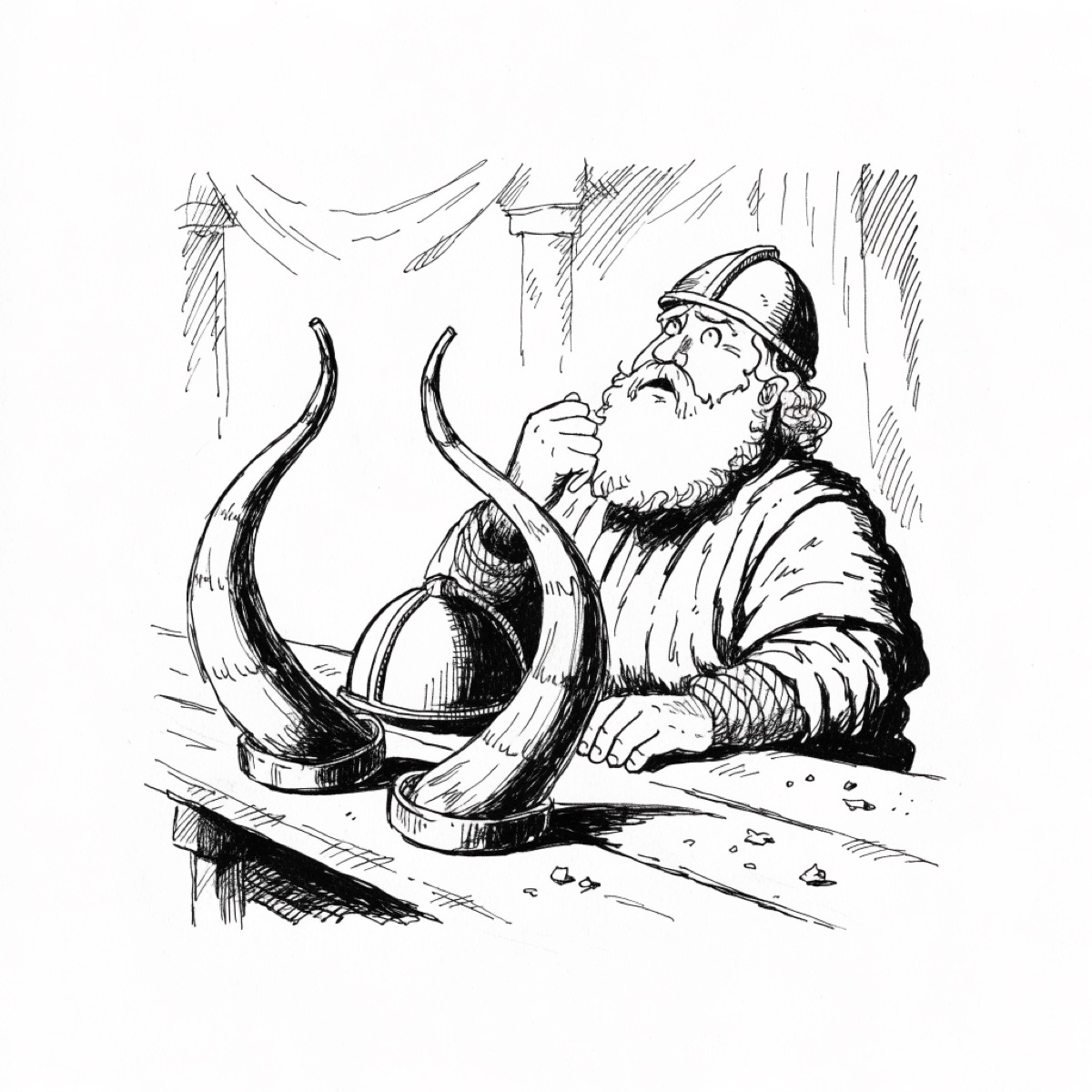
The horned helmet is one of the fastest visual signals for “Viking.” It appears on souvenir hats, sports mascots, cartoons, and stage costumes. Archaeology supports a narrower conclusion: the small surviving body of Viking Age helmets and helmet fragments does not show warriors using the familiar pair of projecting cattle horns in battle. That finding corrects a popular image, but it does not establish that no Scandinavian in the period ever wore any horned or bird-tipped headgear for any purpose.
Terms matter. “Viking Age” conventionally describes roughly the late eighth through eleventh centuries in Scandinavia and regions connected through raiding, settlement, and trade. “Viking” could describe an activity or participants in overseas expeditions rather than every Scandinavian person. An object made centuries earlier in what is now Denmark is not Viking equipment merely because it is Scandinavian and horned.
The National Museum of Denmark's account of helmets distinguishes archaeological fighting equipment from images that may represent ritual headgear. That distinction is a better guide than the slogan that horned helmets are either wholly real or wholly invented.
The material record is small and unhorned
The best-preserved Scandinavian Viking Age helmet was found in a burial at Gjermundbu in Norway in 1943. Dated to the tenth century, it was reconstructed from iron fragments. It has a rounded cap, a projecting nasal guard, and spectacle-like protection around the eyes. The University of Oslo's Museum of Cultural History describes it in an exhibition guide as the best-preserved Viking helmet in the world. It has no horns.
Other finds are fragmentary. Brow or eye guards from places including Tjele and Gevninge in Denmark indicate that helmets existed beyond the single Gjermundbu grave, but the evidence is too sparse to define one uniform “Viking helmet.” Preservation biases are severe. Iron corrodes, graves were disturbed, costly equipment could be inherited or recycled, and burial customs did not place the same objects in every grave. The sample likely overrepresents unusual deposits and underrepresents ordinary use.
Textiles and leather may also have been used for head protection, but organic material survives poorly. Later texts mention helmets, yet sagas recorded centuries after the events they narrate cannot be treated as inventories photographed from the Viking Age. Archaeologists combine object context, metallurgy, typology, images, and texts, while keeping the different evidentiary weights visible.
No excavated fighting helmet from a secure Viking Age context currently provides the familiar long lateral horns. Practical arguments reinforce the finding: projections can catch weapons and concentrate force. But practicality alone cannot settle historical use. People have worn cumbersome ceremonial objects in many societies. The archaeological record, not an intuition about sensible armor, carries the main claim.
Horned headgear existed outside the claimed category
Scandinavia has yielded genuine horned helmets from much earlier periods. The bronze Veksø helmets, found in a bog on Zealand, date to the Nordic Bronze Age, roughly a millennium and a half before the Viking Age. Their curved horns, eye-like bosses, and bird-beak fittings suggest a ceremonial function rather than ordinary battlefield protection. Treating them as Viking helmets collapses a long chronology.
Images nearer the Viking period complicate the simple myth. An embroidered textile fragment from the early ninth-century Oseberg ship burial in Norway includes processional figures, one of which appears to have horned headgear. Small metal figures and die-stamped plates from the broader Germanic world show dancers or warriors with horn- or bird-like projections. Interpretation is disputed: some terminals may represent birds, some figures may be deities or ritual specialists, and a depicted headdress is not necessarily a physical helmet used in combat.
These images establish that projecting headgear belonged to the visual vocabulary available around northern Europe. They do not establish what it was made from, who wore it, or whether the scene is literal. A representation of a supernatural or ceremonial figure cannot be transferred without argument to a raider's standard equipment.
There is also a classification problem at the edges of the period. The elaborate seventh-century helmet from Sutton Hoo in England predates the usual Viking Age and is Anglo-Saxon, though it shares artistic connections across northern Europe. Its imagery includes helmeted figures, but the object itself is not evidence for a universal Viking uniform. Modern displays often place “Germanic,” “Norse,” and “Viking” material near one another; popular memory then compresses them.
Stage design gave the horns a durable silhouette
The modern horned Viking did not arise from one artist at one moment. Nineteenth-century European nationalism, antiquarianism, Romantic art, and opera gradually assembled it. Costume designers wanted figures from a distant heroic north to read immediately from the back of a theatre. Horns created a strong silhouette and connected characters with an imagined pagan antiquity.
Richard Wagner's four-opera Ring cycle, first performed as a complete sequence at Bayreuth in 1876, is frequently named as the source. That shorthand overstates the case. Wagner's drama draws on medieval German and Old Norse material but is not a documentary about Viking raids. Carl Emil Doepler's costumes for the first Bayreuth production included winged and horned headpieces for some figures. Roberta Frank's reception study, “The Invention of the Viking Horned Helmet”, traces the motif through earlier antiquarian imagery as well as Doepler's influential designs. The production amplified and standardized an image rather than creating it from nothing.
Once established, the silhouette moved easily among illustrations, advertising, schoolbooks, political imagery, and entertainment. Repetition made it feel historically self-evident. The process shows how an image can be culturally authentic as a record of the nineteenth and twentieth centuries while remaining a poor reconstruction of early medieval battle equipment.
The myth also survived because evidence was not visually competitive. Rusted fragments and a reconstructed spectacle guard are harder to turn into a cheerful mascot than two symmetrical horns. Popular design rewards instant identification, not calibrated chronology.
Museum labels have changed as this distinction has become more familiar. That creates its own feedback loop: visitors arrive expecting horns, displays explain their absence, and the correction becomes part of modern Viking reception. Reenactors and experimental archaeologists can test how reconstructed helmets distribute weight or restrict vision, but a reconstruction tests plausibility, not historical frequency. Its accuracy depends on the fragments and assumptions used to complete missing parts.
What the evidence permits
Three propositions have different strengths. First, horned helmets existed in prehistoric Scandinavia: archaeological objects establish that. Second, projected or horn-like headgear appeared in some imagery near the Viking Age: surviving representations establish that, while their meaning remains contested. Third, Viking warriors routinely fought in horned helmets: the known material record does not support it.
Absence of evidence should be handled carefully when the sample is so small. It cannot prove that an exceptional ritual object never existed or that no person experimented with projections. It can weigh strongly against a claim of common military use. Common equipment should normally leave multiple forms of evidence—objects, repeated contemporary images, repair fragments, or clear descriptions. That converging pattern is missing for combat horns.
The correction therefore need not replace one caricature with another. Viking Age Scandinavia was not a single costume culture, helmets were probably scarce and varied, and headgear could have martial, ceremonial, or representational roles. The familiar horned warrior is best understood as a modern visual convention assembled from real ancient motifs, later artistic needs, and chronological compression. Archaeology narrows the military claim. It leaves some ritual images open.