Literature · 7 min read
How Copyright and Cost Shaped the Western Literary Canon
The books we were told are timeless classics may have survived not because of their genius, but because they were cheap. Follow the money behind the Western canon and you'll never read a syllabus the same way again.
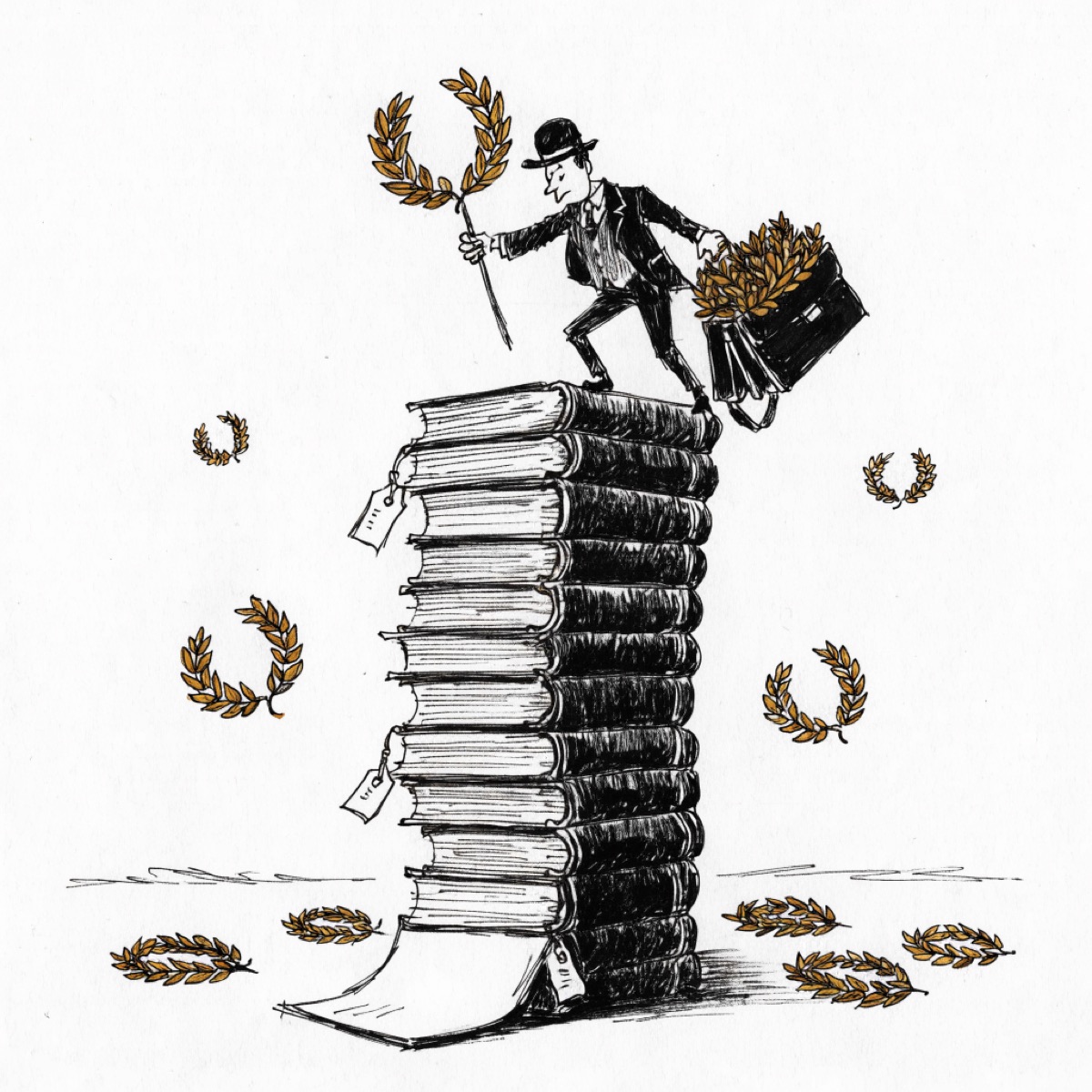
Picture a university purchasing committee in 1952, seated around a conference table with two novels in front of them. Both have received serious critical praise. Both are being considered for the introductory literature survey. One is under copyright; the other is not. The discussion about literary merit lasts perhaps ten minutes. The discussion about budget lasts considerably longer. The public-domain title gets the nod, the course packets are printed, and a reputation is quietly cemented for the next half-century.
This was not an unusual meeting. It was Tuesday.
By 1960, more than 70% of titles appearing on standard American literature syllabi were either in the public domain or controlled by publishers offering negotiated bulk academic discounts. The numbers were not the result of a grand conspiracy. They were the result of procurement offices doing what procurement offices do — minimizing cost, reducing legal exposure, and ordering enough copies for thirty undergraduates who would rather be somewhere else.
Which raises a question that should make every book lover slightly uncomfortable: What if the Western canon is less a monument to human genius and more a ledger entry that survived the audit?
When Publishers Became Taste-Makers
The early twentieth century gave rise to what publishers called the "course adoption" model, and it changed literary culture far more thoroughly than any manifesto. Instead of selling books one reader at a time, publishers began packaging novels, plays, and poetry into anthology products engineered for semester consumption — durable, standardized, and profitable at scale.
The Norton Anthology of English Literature, first published in 1962, is the most consequential example of this shift. A single editorial team, working with negotiated reprint rights, quietly determined which voices would reach millions of undergraduates across decades. The choices were not arbitrary, but they were constrained: by what rights were available, at what price, and by which selections could plausibly anchor a fourteen-week course.
The effect on scholarly attention was immediate and measurable. Authors included in early Norton editions saw citation rates and secondary scholarship spike almost immediately after publication — not because critics suddenly discovered these writers, but because inclusion created demand for critical apparatus, and critical apparatus created the appearance of longstanding importance. The anthology didn't reflect the canon. It produced it, then stepped aside to let the canon claim it had always been there.
The Copyright Accident That Made Shakespeare Unavoidable
Shakespeare's dominance of Anglophone literary education is usually explained as the inevitable recognition of transcendent genius. The Bard was simply too good to ignore. This is, at minimum, an incomplete story.
Shakespeare's works entered wide American pedagogical use not solely because of literary merit but because they were entirely free to reproduce. No royalties. No licensing negotiations. No letter from an estate's solicitor threatening action over unauthorized excerpts. For a cash-constrained school district or a university press assembling an affordable anthology, Shakespeare was not just great literature — he was a legal and financial gift.
Meanwhile, writers who were equally celebrated in their own lifetimes found their work priced out of mass adoption. Writers whose estates were active, whose publishers were protective, or whose rights situations were complicated faced a structural disadvantage that had nothing to do with the quality of their sentences. The self-reinforcing loop did the rest: free to teach, taught everywhere, studied by scholars, declared timeless, taught everywhere again. The flywheel of canonical status spun on, powered less by genius than by the absence of an invoice.
Semester Logic and the Mutilation of Complexity
Copyright was not the only hidden editorial force at work. The academic calendar has its own ruthless aesthetic preferences, and they have nothing to do with what is interesting or ambitious or alive.
Books that could be read, discussed, and examined within fourteen weeks were structurally favored over longer, stranger, or more formally experimental works. This pressure quietly eliminated entire categories of literature from standard curricula. Melville's Pierre — a book far more formally adventurous than Moby-Dick — essentially disappeared from syllabi. Late Henry James, with his labyrinthine subordinate clauses and refusal to resolve cleanly, became a graduate school curiosity rather than an undergraduate staple. Much of the magnificent sprawl of nineteenth-century serialized fiction, designed to be read across months and revisited, simply could not be made to fit the box.
The "teachable moment" bias compounded this. Texts that generate reliable essay prompts, that organize themselves into clean thematic units, that reward the kind of reading that produces a five-paragraph argument by Thursday — these texts were institutionally preferred. Legibility was rewarded. Ambition was penalized. Not by anyone in particular. Just by the shape of the semester.
The Voices Priced Out of Posterity
The economic mechanism of exclusion operated most brutally at the intersection of race, gender, and intellectual property law. Writers from marginalized communities who retained their own rights, self-published outside major commercial networks, or whose estates were actively protective found their work financially inaccessible for bulk academic reprinting.
Zora Neale Hurston is the example most literary historians reach for, and rightly so. Her absence from major anthologies for decades after her death in 1960 is regularly attributed to shifting taste — the dismissiveness of the male-dominated Harlem Renaissance establishment, the condescension of critics who found her work insufficiently "serious." All of that is real. But the practical economics were also real: licensing work from a living writer with an active estate costs money that an anthologist might spend instead on a safer, cheaper, more legally uncomplicated choice. Taste and economics were not separate forces. They were the same force in two different outfits.
The compounding effect is the cruelest part. If a writer isn't in the anthology, scholars don't write about her. If scholars don't write about her, there is no critical apparatus — no introductions, no contextualizing footnotes, no scholarly disagreements that signal importance. Without a critical apparatus, she cannot be introduced to students as someone worth knowing. The absence justifies itself, endlessly, and calls itself judgment.
The Digital Moment That Should Have Changed Everything (And Mostly Didn't)
When Project Gutenberg launched, and later when Google Books began its vast digitization project, a certain kind of optimism was irresistible. The economic gatekeeping of the canon was finished. Everything old was suddenly free. The ledger had been democratized.
Syllabi changed far more slowly than technology permitted. Institutional inertia is a powerful thing: accreditation frameworks, departmental learning outcomes, hiring committees that evaluate candidates partly on their command of established texts — all of these structures created a gravitational pull toward the same books, regardless of cost. A professor who assigns The Great Gatsby instead of an equally available, equally free, and arguably equally rich novel from the same period is not making a purely aesthetic choice. She is also making a professional one.
The most revealing moment came when cost was genuinely removed as a barrier and professors largely continued assigning the same books anyway. This is not a criticism of individual professors. It is a diagnosis of a system. The economic history of the canon had shaped taste so thoroughly, over so many decades, that the taste felt natural — like discernment, like judgment, like love of literature. It was all of those things. It was also a habit formed in a purchasing committee, in 1952, over a budget shortfall.
Who Gets to Invoice the Next Canon?
The gatekeepers have changed. The gate has not.
Streaming platforms now commission adaptations that bestow a particular kind of cultural prestige — a Netflix series based on a novel does for twenty-first-century literary reputation roughly what inclusion in the Norton once did, minus the pretense of scholarly neutrality. Prize culture — the Booker, the Pulitzer, the National Book Award — operates with its own financial architecture of submission fees, sponsor relationships, and publisher marketing budgets that determine which books are even eligible to be considered important. BookTok and Goodreads have created new forms of social endorsement that feel grassroots and feel genuine, and sometimes are, and are also shaped by publisher promotional spending, influencer arrangements, and platform algorithms optimized for engagement rather than literary value.
Each of these systems is invoicing the next canon in different currency. None of them is operating outside economics. The question is only whether we are paying attention to the receipt.
The purchasing committee from 1952 is worth returning to — not as a scandal, but as a gift. Once you see that meeting clearly, you cannot unsee it. You start asking different questions about every list, every syllabus, every "essential" recommendation. Not is this book good? — it may be genuinely great — but why this book, why now, and who found it convenient?
Those questions do not diminish literature. They make it more interesting. The canon was not handed down from a mountain. It was negotiated, invoiced, and filed. And anything that was negotiated once can, in principle, be renegotiated — which means the books we consider indispensable are not the ceiling of human imagination. They are merely the ones that cleared the budget.
That is, when you think about it, the most hopeful thing anyone has said about literature in years.