Philosophy · 8 min read
What Zeno's Arrow Paradox Shows About Modern Physics
Two and a half thousand years ago, a Greek philosopher argued with cold logic that motion is impossible—and despite calculus, quantum mechanics, and decades of brilliant counterarguments, no one has cleanly proven him wrong. The paradox isn't a classroom curiosity: it's a live fault line running through the deepest questions modern physics is trying to answer right now.
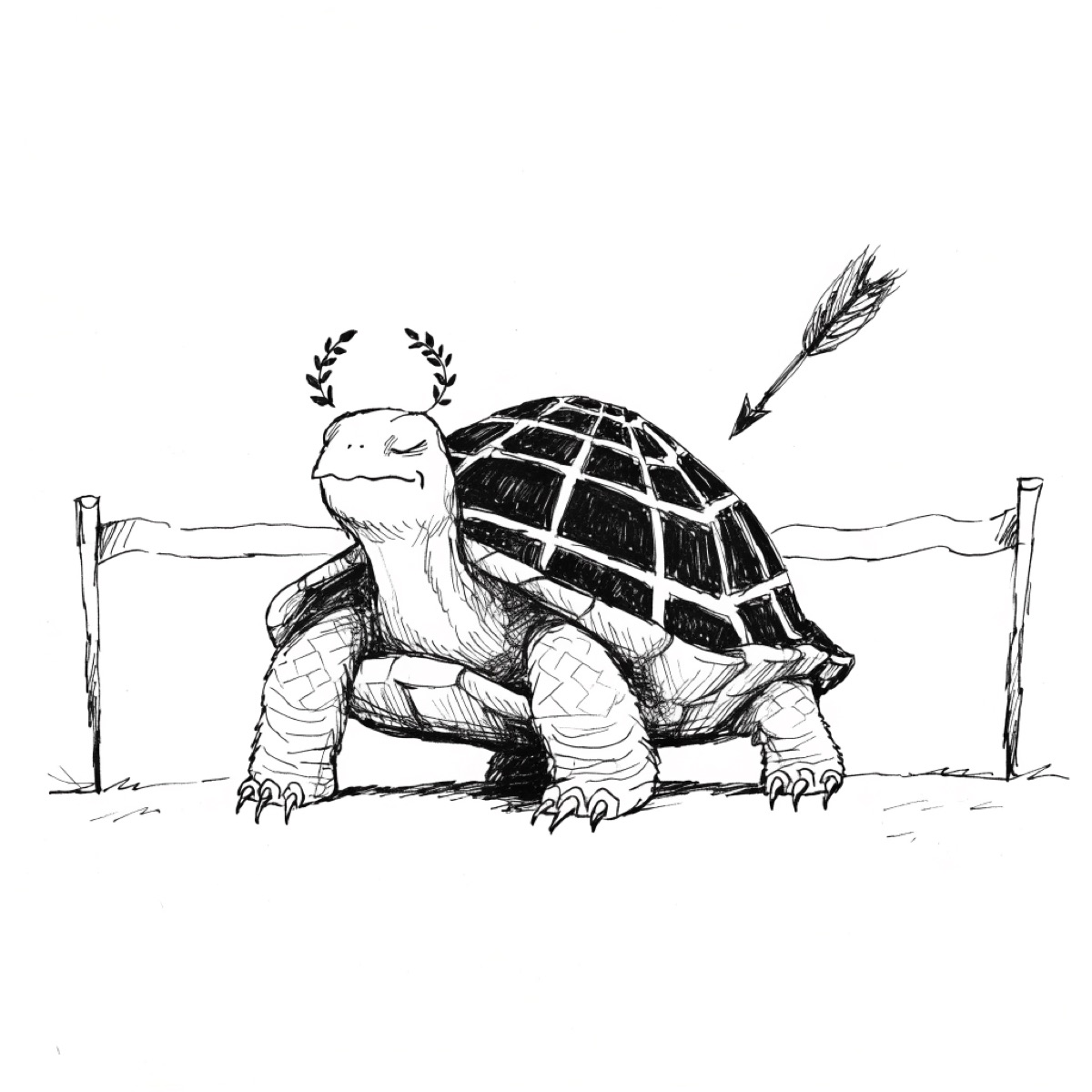
Look at a photograph of an arrow in flight. It hangs in the frame—sharp, motionless, suspended between the bowstring and whatever it was sent to kill. The photograph feels like the truth, a fact extracted from the blur of the world. But ask yourself: is that frozen image the real arrow, or is it a lie the camera tells?
A Greek philosopher named Zeno of Elea asked something very similar around 450 BCE. He looked at the frozen moment and concluded, with a logic as clean and cold as a blade, that motion is impossible. Not difficult. Not illusory in a poetic sense. Literally, logically impossible. And despite twenty-five centuries of effort—including calculus, quantum mechanics, and some of the most sophisticated mathematics humans have ever produced—nobody has given an answer that everyone agrees actually works.
This isn't a dusty classroom puzzle waiting to be swept away. Physicists working on the deepest structure of spacetime are being forced to confront it right now, in laboratories and on chalkboards where the nature of time itself is the subject under investigation.
The Man Who Tried to Stop the World
Zeno was a student of Parmenides, a philosopher who held one of the most radical positions in the history of thought: that reality is singular, eternal, and unchanging. There is no plurality, no movement, no becoming—only Being, static and indivisible. This sounds like mysticism, but Parmenides argued it from pure logic, and Zeno was his attack dog, designing paradoxes as philosophical weapons to defend that view against critics who pointed at the obvious moving world around them.
The Arrow Paradox, his sharpest instrument, goes like this. At any single instant of time, a flying arrow occupies exactly one position in space. At that instant, it is geometrically indistinguishable from an arrow sitting still. If you cannot tell the moving arrow from the stationary one at any given instant, then in what sense is it moving at that instant? And if time is composed of instants—nothing but a long series of frozen nows—then the arrow is always in a stationary state, instant after instant. Motion, Zeno concludes, is nowhere to be found.
This is different from his more famous Achilles paradox, which attacks the divisibility of space: Achilles must first cross half the distance to the tortoise, then half the remaining distance, and so on infinitely, apparently never arriving. The Achilles paradox is about infinite subdivision of a journey. The Arrow Paradox is about time specifically—about what it means for change to exist inside a single moment. That distinction makes it the more modern-feeling, and ultimately the more dangerous, of the two.
How Calculus Claimed to Kill the Paradox
For roughly two millennia, Zeno's arrow flew without being brought down. Then, in the second half of the 17th century, Isaac Newton and Gottfried Wilhelm Leibniz independently invented calculus, and the mathematical world exhaled. Here, finally, was a tool designed precisely for the problem of instantaneous change.
The key invention is the derivative: a way of defining velocity at a single instant by taking the limit of a ratio as the time interval shrinks toward zero. You don't need a finite interval of time to have a well-defined speed; you can describe motion at a frozen moment by examining the mathematical relationship between the moments surrounding it. In the standard textbook treatment, this is where the Arrow Paradox dies. Motion is not a property of a single instant taken in isolation; it is a property of the function—the continuous path traced through time—evaluated at that instant. Problem solved. Next chapter.
But look carefully at what calculus quietly smuggles into the room. The entire machinery of limits and derivatives only works if time is a continuum—infinitely divisible, with no smallest unit, no irreducible quantum of duration. This assumption is enormously powerful mathematically, and it allows us to land spacecraft on asteroids and design semiconductors with nanometer-scale features. But it has never been confirmed empirically. It is a premise, not a finding. And Zeno's paradox, rather than being dissolved by calculus, is arguably just relocated inside it: if there really is a smallest unit of time, the derivative at that scale is undefined, and the arrow is frozen in a way the mathematics cannot rescue.
The Quantum Whisper—Reality Might Actually Be Granular
In 1899, Max Planck was calculating the behavior of electromagnetic radiation and noticed something strange: certain combinations of the fundamental constants of nature—the speed of light, the gravitational constant, Planck's own constant—yielded natural units of length and time. The Planck length is approximately 1.616 × 10⁻³⁵ meters. The Planck time is approximately 5.39 × 10⁻⁴⁴ seconds—the time it takes light to cross a Planck length. These numbers are almost absurdly small. A proton is about 10²⁰ Planck lengths across.
For most of the 20th century, these were treated as curious mathematical artifacts, not physical facts. But two leading approaches to quantum gravity—Loop Quantum Gravity, developed principally by Carlo Rovelli and Lee Smolin in the 1980s and 1990s, and causal set theory, pioneered by Rafael Sorkin—take them seriously as physical limits. In Loop Quantum Gravity, space is not a smooth backdrop but a network of discrete nodes; area and volume come in minimum measurable chunks, much as electric charge comes in discrete multiples of the electron's charge. Spacetime, on this view, is not continuous. It is granular—more like a very fine mesh than a smooth surface.
If that is true, calculus's continuum assumption isn't just a convenient modeling choice. It is a fiction, an approximation that works beautifully at human scales and breaks down completely at Planck scales. Zeno's arrow, frozen at one irreducible quantum of time with no smaller interval available from which to construct a derivative, is frozen in a way that the standard mathematical resolution simply does not address. The paradox resurfaces at the basement of reality, dressed in new mathematics but structurally unchanged.
The Philosophers Push Back—and Forward
Philosophers of physics didn't wait for quantum gravity to weigh in. In the mid-20th century, Adolf Grünbaum offered an influential response grounded in measure theory—the branch of mathematics that deals rigorously with lengths, areas, and the counterintuitive properties of infinite sets. Grünbaum argued that a continuum of durationless instants can perfectly well sum to a finite, non-zero duration. There is no logical contradiction in building a second out of infinitely many zero-length moments, any more than there's a contradiction in the mathematical fact that an infinite series of fractions can sum to a finite number. The paradox, he maintained, is simply confused about how infinities behave.
Critics accepted the mathematical point but pushed back on what it actually explains. Showing that a continuum of instants is logically consistent is not the same as explaining how change occurs within that continuum. The mathematics tells you there's no contradiction; it doesn't tell you what motion is. It's a consistency proof, not a metaphysical account.
The most influential philosophical response is the "at-at" theory of motion, associated with Bertrand Russell and later refined by others. The idea is radical in its simplicity: there is no special ingredient called "motion" that needs to be located inside a single moment. An object moves simply by being at different places at different times. That's all motion is—a pattern across a series of positions. Zeno, on this reading, was demanding an explanation for something that has no further explanation to give, like asking what a wave is between the water molecules that constitute it. The question assumes a ghost that isn't there.
The philosophical countercharge, however, is pointed. The at-at theory works by assuming that the object traces a continuous trajectory—that between any two positions there is a well-defined path. That assumption is exactly what granular spacetime theories call into question. If spacetime has a minimum unit, then "being at different places at different times" only makes sense down to a certain resolution, and below that resolution the concept of a continuous trajectory dissolves. We are, disconcertingly, back at the starting line.
Where Physics and Metaphysics Meet in the Dark
The honest state of play is this: for most practical purposes, the calculus-based resolution works magnificently. Engineers don't need to worry about Planck time when they're designing a bridge or writing the software for a GPS satellite. But "works for practical purposes" and "is true" are not the same claim, and physics at its frontier is not an engineering project.
Experiments testing the granularity of spacetime are among the hardest ever attempted. The Fermi Gamma-ray Space Telescope has probed the fine structure of spacetime by looking for energy-dependent delays in gamma rays traveling from distant gamma-ray bursts—the idea being that if spacetime is a discrete mesh, high-energy photons might travel slightly differently than low-energy ones. So far, no such dispersion has been detected, which places constraints on some granularity models. But the absence of detection is not the same as a confirmed continuum; the Planck scale may simply be too fine for any current instrument to resolve.
Meanwhile, physicists working in the foundations of quantum mechanics are increasingly interested in questions about the reality of time itself. Julian Barbour's work argues that time is not a fundamental feature of reality at all—that what we call "time" is an emergent ordering of configurations, with no deeper substrate. Carlo Rovelli's relational quantum mechanics dissolves the absolute "now" entirely. These are not fringe positions; they appear in peer-reviewed journals and are taken seriously at major research institutions. And every one of them, in some form, circles back to the question Zeno raised: what is happening at an instant, and is an instant even a real thing?
The Arrow Paradox has a way of absorbing every solution that is thrown at it. Calculus defines velocity at an instant by appeal to the surrounding continuum. Quantum gravity suggests the continuum may not be real. The at-at theory eliminates the need for motion within an instant but assumes continuity between instants. Measure theory shows the mathematics is consistent but leaves the metaphysics untouched. Each response is genuine intellectual progress, and none of it is nothing. But the paradox keeps reassembling itself in the new vocabulary of each era, patient as the arrow in the photograph.
Perhaps the most unsettling possibility is not that Zeno was right—that motion is truly impossible—but that our intuitive grasp of motion was always a story we told over the top of something we don't understand. The photograph doesn't lie. The arrow really is frozen in that frame. What we cannot seem to explain, with any tool we currently possess, is exactly where the movement hides when we're not looking.